
City of London – ✍️ EDITORIAL INTRO (SERIES OPENING)
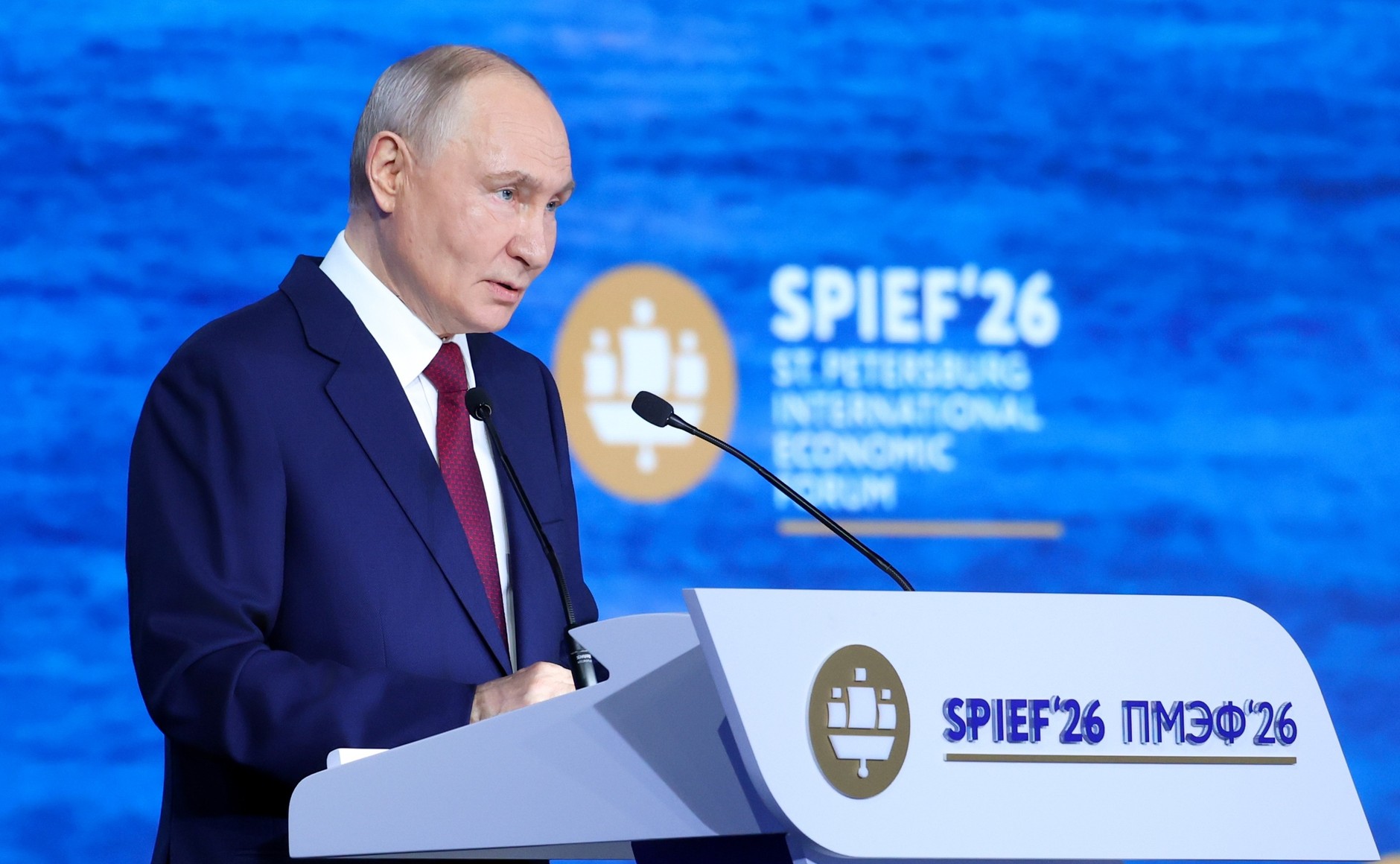
The St. Petersburg International Economic Forum (SPIEF) has progressively evolved beyond its original mandate as an investment platform to become a strategic arena where Russia articulates its vision of global economic and political transformation.
The 2026 edition underscores this shift with particular clarity. Held against the backdrop of prolonged conflict in Ukraine, sustained Western sanctions, and accelerating fragmentation of the global economy, SPIEF now functions less as a conventional economic forum and more as a geopolitical instrument embedded in Russia’s broader foreign policy strategy.
Yet the significance of SPIEF extends beyond symbolic positioning. It reflects deeper structural dynamics shaping the international system: the reconfiguration of trade routes across Eurasia, the consolidation of alternative institutional frameworks such as BRICS+, and the gradual emergence of competing financial and monetary architectures outside Western control.
Taken together, these developments point to a broader transformation of the international order. Economic interdependence is no longer converging toward a unified liberal system, but instead fragmenting into partially overlapping blocs, networks, and regionalized spheres of influence.
This two-part analysis explores SPIEF 2026 through this dual lens.
The first article examines the forum as a geopolitical stage for Russia’s articulation of multipolarity and systemic competition.
The second turns to the deeper geoeconomic dimension, focusing on BRICS+, de-dollarisation, and the construction of emerging financial alternatives that may reshape the architecture of global capitalism.
Introduction
The 2026 edition of the St. Petersburg International Economic Forum (SPIEF), held from 3 to 6 June, reaffirmed its evolution from an investment-oriented platform into a geopolitical instrument of Russian foreign economic policy.
In a context defined by the prolongation of the war in Ukraine, intensified Western sanctions, and accelerating global economic fragmentation, SPIEF has become less a forum for global business integration and more a stage for articulating and legitimising an emerging multipolar order.
Rather than functioning as a Russian equivalent of Davos, SPIEF increasingly reflects a parallel ecosystem of economic diplomacy centred on the Global South, BRICS+ economies, and Eurasian connectivity.
SPIEF as a Geopolitical Device
Historically designed to attract foreign investment into Russia’s modernising
economy, SPIEF has undergone a structural transformation since 2022.
Western corporate participation has significantly declined, while representation from Asia, the Middle East, Africa, and Latin America has expanded. This shift is not merely quantitative but reflects a deeper reorientation of Russia’s external economic relations away from Western institutions and toward alternative centres of gravity.
In this sense, SPIEF operates as a geopolitical signalling mechanism, communicating Russia’s continued integration into global economic networks despite sanctions and political isolation from Western markets.
Multipolarity as Strategic Narrative
A central theme of SPIEF 2026 was the consolidation of multipolarity as both a descriptive and normative framework for global order.
From Moscow’s perspective, the unipolar moment associated with post-Cold War
Western dominance has ended. The emerging system is instead characterised by multiple centres of power, including the United States, China, India, the Gulf states, and an increasingly coordinated Global South.
Within this narrative, multipolarity is not only an analytical claim but a strategic justification for institutional and economic diversification away from Western-led governance structures.
Eurasian Connectivity and the North–South Corridor
A key geoeconomic pillar highlighted during the forum was the expansion of Eurasian infrastructure networks, particularly the International North–South Transport Corridor (INSTC).
This corridor links Russia, the Caucasus, Iran, and India, reducing dependence on traditional maritime routes and Western-controlled logistical chokepoints.
Beyond its logistical function, the INSTC represents a broader attempt to restructure global trade geography, shifting the centre of gravity toward Eurasian inland connectivity and alternative energy and goods routes.
Systemic Competition: The United States, China, and Russia
SPIEF 2026 also reflected the dynamics of an increasingly competitive triangular system involving the United States, China, and Russia.
- The United States continues to defend a rules-based liberal order anchored in financial centrality and institutional governance.
- China expands its industrial and financial influence through infrastructure, trade networks, and currency internationalisation.
- Russia positions itself as a systemic disruptor and geopolitical intermediary, leveraging energy exports and strategic geography.
Rather than competing symmetrically, Russia’s strategy is primarily one of asymmetric balancing, seeking to amplify fragmentation within the existing order while deepening alternative alignments.
Constraints and Structural Asymmetries
Despite the narrative of resilience and reorientation, Russia’s position remains constrained by structural factors.
Key limitations include:
- continued reliance on hydrocarbon exports;
- restricted access to Western capital markets;
- technological dependencies in advanced sectors;
- and growing asymmetry in its economic relationship with China.
These constraints suggest that Russia’s pivot toward the Global South and Eurasia is not a full substitution of Western linkages but a selective reconfiguration of external dependencies.
Conclusion
SPIEF 2026 confirms the forum’s transformation into a platform of geopolitical economy, reflecting Russia’s attempt to embed itself within an evolving multipolar system.
However, a gap remains between strategic narrative and material capacity. While SPIEF successfully projects an image of alternative global integration, its long-term impact will depend on whether political alignments can be translated into sustainable economic structures.
In this regard, SPIEF is less a conventional economic forum than a barometer of systemic transition in the international order—one in which economic networks, geopolitical alignment, and institutional fragmentation are increasingly inseparable.
Riccardo Cacelli
r.cacelli@uam-vertiports.com