London – For years, when the conversation has turned to BRICS and the future of money, attention has often focused on currencies.
A new currency. A common currency. A digital currency.
Perhaps we should look somewhere else.
Because one of the most interesting transformations taking place in global finance today is not about creating new money.
It is about connecting the infrastructure through which existing money moves.
And an apparently technical conversation between Brazil and Europe may help us understand what is beginning to happen.
Brazil meets Europe: Pix and TIPS
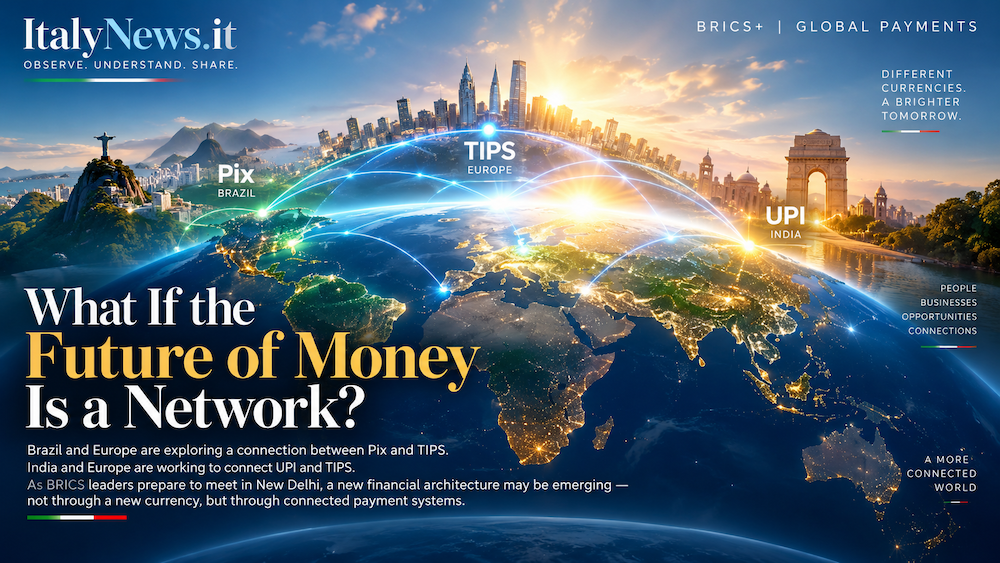
Brazil’s central bank and the European Central Bank are exploring the feasibility of connecting two major instant-payment infrastructures: Pix in Brazil and TIPS in Europe.
The discussions are preliminary. There is no agreement to create such a connection and no Pix–TIPS network exists today.
But the possibility is real enough to be studied.
The ECB had already identified Brazil as one of the potential international connections being explored for TIPS. According to information reported on 3 September, discussions between the two central banks could eventually lead to a pilot project in 2028 if the initiative progresses.
At first sight, this sounds like a story for payment specialists.
It may actually be a story about the future architecture of money.
What is Pix?
The first important distinction is simple: Pix is not a currency.
Created by the Banco Central do Brasil and launched in 2020, Pix is Brazil’s instant-payment system.
It enables people and businesses to send and receive money rapidly, around the clock, through participating financial institutions.
Instead of thinking about Pix as money, it is more useful to think of it as part of the infrastructure on which money travels.
And it has become enormously important in Brazil.
Its success is now raising a new question: what happens when an infrastructure originally built for domestic payments begins looking beyond national borders?
That is precisely what makes the conversation with Europe interesting.
And what is TIPS?
TIPS is not a currency either.
It stands for TARGET Instant Payment Settlement and is an infrastructure operated by the Eurosystem.
It allows payment service providers to settle instant payments in central bank money, continuously and within seconds.
But TIPS is gradually becoming something more interesting than a purely European payment infrastructure.
The Eurosystem is expanding its connections with other instant-payment systems around the world.
Denmark and Sweden are already connected through TIPS. Norway is expected to follow in 2028 and Iceland has expressed interest.
And then the geography becomes much wider.
India is already part of the picture
India operates another extraordinarily important infrastructure: UPI — Unified Payments Interface.
UPI — Unified Payments Interface — is not a currency.
It is India’s instant-payment system, developed by the National Payments Corporation of India (NPCI) and launched in 2016.
UPI allows individuals and businesses to send and receive money between bank accounts in real time, 24 hours a day, using smartphones and participating banks and payment applications.
It has become one of the world’s largest instant-payment ecosystems and a central component of India’s digital financial infrastructure.
Like Pix in Brazil and TIPS in Europe, UPI can be understood as part of the infrastructure on which money travels.
According to the ECB, a bilateral link between TIPS and India’s UPI is expected to go live in 2027.
The ECB is simultaneously exploring similar opportunities with Brazil, Switzerland and Nexus Global Payments, a project connecting fast-payment systems in several Asian economies.
Put these developments next to each other:
Brazil / Pix ↔ Europe / TIPS ↔ India / UPI
We need to be very careful about what this means.
These three systems do not currently constitute a single connected network.
There is no Pix–TIPS–UPI global payment system.
But individual bridges between large payment infrastructures are being explored or built.
And that is the signal worth observing.
From payment systems to payment networks
Pix, UPI and TIPS were developed primarily to make payments faster and more efficient within their respective ecosystems.
Now another stage may be beginning. The challenge is no longer simply:
How can we make domestic payments instantaneous?
It is increasingly: How can different instant-payment systems communicate across borders?
There are around 100 fast-payment systems worldwide, according to the ECB. Connecting even some of them could significantly change how people and businesses make international payments.
Instead of building an entirely new global payment infrastructure from scratch, countries could increasingly connect infrastructures that already exist.
The result would not necessarily be a new currency.It could be something fundamentally different: a network of networks.
The innovation, in other words, may not primarily be monetary.
It may be infrastructural.
And now BRICS enters the picture
This is where the timing becomes particularly interesting.
India will host the BRICS Summit in New Delhi next week, and cross-border payments are already part of the conversation surrounding the meeting.
In August, Reserve Bank of India Governor Sanjay Malhotra confirmed that BRICS countries are discussing potential links between their respective fast-payment systems as well as connections between central bank digital currencies (CBDCs).
He was also careful to say that the options remain at the discussion stage.
That distinction matters.
There is currently no common BRICS payment network resulting from these discussions.
But the direction being explored is significant: instead of focusing exclusively on creating something entirely new, countries are examining whether the financial infrastructures they already possess can begin to communicate with one another.
India is expected to bring cross-border digital payments and CBDCs into the discussions surrounding the New Delhi meeting.
And India itself already provides one of the world’s most important examples of what an advanced national instant-payment infrastructure can become.
Europe is not outside this story
This is perhaps the most interesting aspect of all.
It would be easy to interpret developments in international payment infrastructure through the familiar lens of competing geopolitical blocs.
But the evidence gives us a more complicated — and perhaps more interesting — picture.
Europe is one of the connectors.
The ECB is working with India.
It is exploring possibilities with Brazil.
It is looking at Switzerland.
It is examining Nexus in Asia.
And through Banca d’Italia, the Eurosystem is supporting several Western Balkan central banks in developing a fast-payment system modelled on TIPS which could eventually be technically linked to the European infrastructure.
So perhaps the emerging map is not simply: BRICS | Europe | Asia
Perhaps it increasingly looks like: BRICS ↔ Europe ↔ Asia ↔ national systems ↔ regional systems
Not one network. Not yet.
But potentially many interconnected networks.
Technology alone will not decide which networks connect
There is, however, another side to this transformation.
If two payment infrastructures can technically communicate, it does not necessarily follow that governments will allow them to do so.
India provides a particularly interesting example.
At the same time that India and Europe are progressing towards a UPI–TIPS connection, Indian authorities have stalled a proposed link between UPI and Alipay+, according to Reuters.
The concerns reportedly include national security, data privacy, cyber fraud, money laundering risks and the handling of transaction information.
That contrast tells us something important.
The future global payment architecture will not be shaped by technology alone.
It will also be shaped by: security, data, regulation, sovereignty and trust.
And perhaps trust is the most interesting word of all.
Because connecting two national financial infrastructures ultimately means deciding that they can safely communicate with one another.
A new geography of financial trust?
Imagine, eventually, a map of the world that does not show military alliances or trade agreements.
Instead, it shows which payment systems are connected to which other payment systems.
Which countries allow their financial infrastructure to communicate.
Which technical standards they accept.
Which rules they share.
Where data can travel.
And where the bridges stop.
Such a map could tell us something important about the emerging global economy. Not because every connected country would necessarily be politically aligned.
But because financial interoperability requires a minimum architecture of technical and institutional trust.
This may become one of the less visible dimensions of globalisation over the coming decade.
What should we observe in New Delhi?
This is why the BRICS Summit in New Delhi deserves to be watched from a slightly different perspective.
There will be declarations, bilateral meetings and inevitably considerable geopolitical commentary.
But ItalyNews.it will be watching for some very specific words: payments, interoperability, UPI, Pix, CBDCs, cross-border infrastructure, national currencies.
And, above all: connections.
Because if BRICS members make concrete progress towards connecting existing payment infrastructures, the important story may not be the creation of a new financial object.
It may be the connection of objects that already exist.
Brazil already has Pix.
India already has UPI.
Europe already has TIPS.
And many other countries already possess their own fast-payment infrastructures.
The question is increasingly no longer whether these systems work independently.
It is:
What happens when they start talking to each other?
For much of history, we have understood money by looking at the currency itself.
Perhaps the next chapter will require us to look underneath it.
At the rails.
At the protocols.
At the connections.
At the trust required to build them.
As BRICS leaders prepare to meet in New Delhi, the question may therefore not be whether they can invent a new currency.
Perhaps there is a more interesting question:
Can they connect the payment systems they already have — with each other and with the rest of the world?
Because the next chapter in the history of money may not begin with a new banknote.
It may begin with a new network.
Observe. Understand. Share.
Sources
– The foundations of national sovereignty: the role of central bank money
– Brazil, ECB studying instant payments link in potential first cross-border move for Pix, sources say
– BRICS nations discuss linking payment systems and CBDCs, RBI chief says
– India stalls Alipay+ payments link over security, data concerns, sources say