
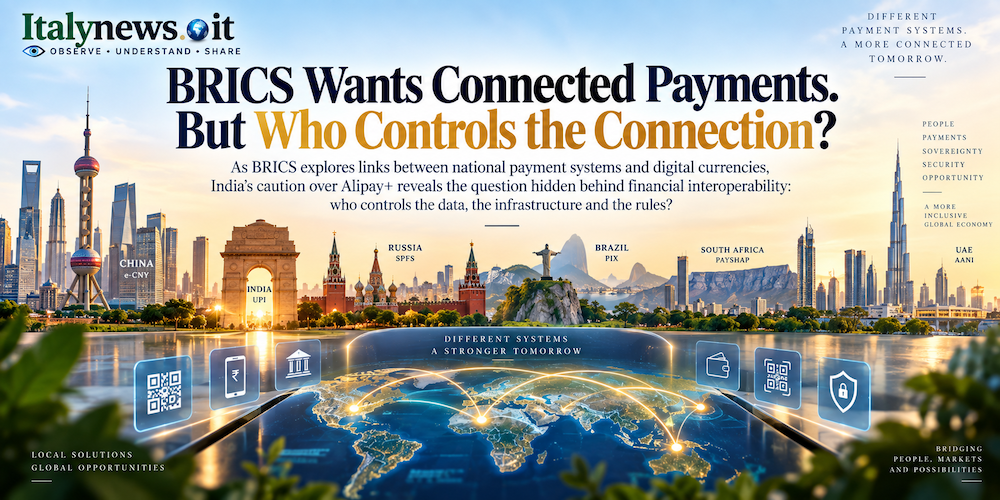
As BRICS explores links between national payment systems and digital currencies, India’s caution over Alipay+ reveals the question hidden behind financial interoperability: who controls the data, the infrastructure and the rules?
London – For years, one question has dominated much of the debate about BRICS and the international financial system: Will BRICS create a new currency to challenge the dollar?
Perhaps we have been looking in the wrong direction.
The transformation now taking shape may be less dramatic, but potentially much more consequential. BRICS does not necessarily need a common currency to change how money moves between its members.
It may simply need its existing systems to learn how to talk to each other.
And that raises a very different question.
Who controls the connection?
From a common currency to connected systems
The Reserve Bank of India has confirmed that BRICS countries are discussing possible links between their fast-payment systems and greater interoperability between central bank digital currencies.
Nothing has yet been decided. RBI Governor Sanjay Malhotra has explicitly said that the proposals remain at the discussion stage.
That distinction matters.
BRICS is not yet constructing a unified payment infrastructure.
But it is exploring something that could ultimately prove more practical than creating a new currency from scratch: connecting national financial infrastructures while allowing countries to retain their own currencies, institutions and technological systems.
Imagine the architecture not as one new railway replacing all the others, but as a network of national railways connected by carefully designed junctions.
India keeps UPI.
Brazil keeps Pix.
Other countries retain their own domestic payment infrastructures.
The innovation lies in the bridges between them.
If those bridges work, businesses and individuals could potentially move money across borders more quickly and cheaply without requiring every transaction to follow the same traditional routes.
But bridges require rules.
And rules require trust.
The Indian paradox
India provides perhaps the best illustration of both the opportunity and the problem.
UPI has become one of the world’s most important digital-payment infrastructures. In August alone, it processed around 24.5 billion transactions, worth approximately $314 billion.
India is simultaneously exploring how that infrastructure can become even more sophisticated. Work is underway on mechanisms that could allow AI agents to initiate small payments autonomously within limits established by users.
India therefore clearly does not fear technological innovation in payments.
Yet another development tells the other half of the story.
A proposed connection between UPI and the China-linked Alipay+ network has stalled amid Indian concerns over national security, data handling, cybersecurity, fraud, money laundering and dispute resolution.
Alipay+ should not be confused with China’s sovereign payment infrastructure. It is operated by Singapore-based Ant International.
Nevertheless, the episode exposes a problem that extends far beyond one company or one bilateral relationship.
A payment connection does not move only money.
It can also involve data, identities, transaction information, technical standards and potentially strategic dependencies.
And suddenly “interoperability” stops being merely a technological problem.
It becomes a question of sovereignty.
Open enough to connect. Sovereign enough to control.
This may ultimately become one of the defining principles of the next generation of global financial infrastructure:
Open enough to interoperate.
Sovereign enough to retain control.
That balance will not be easy.
Every international payment system must answer fundamental questions.
Where is transaction data stored? Who can access it?
Which country’s laws apply? Who verifies identities?
Who resolves disputes? What happens during a cyberattack?
Can one country disconnect another?
Can sanctions interrupt the network?
And who ultimately controls the technological bridge connecting two national systems?
These questions are not secondary details.
They are the architecture.
Russia changes the language
There is another reason to look beyond the familiar narrative of BRICS “de-dollarisation”.
On 8 September, only days before the New Delhi summit, Kremlin spokesman Dmitry Peskov told Indian journalists that Russia was not pursuing a policy aimed at eliminating the dollar.
Instead, he said Moscow was open to any payment mechanism considered acceptable by its partners.
That distinction deserves attention.
The objective may not necessarily be: replace the dollar.
It may increasingly be: make the dollar optional for more transactions.
Those are two very different strategies.
The first requires building a credible alternative reserve currency capable of competing with one of the deepest and most liquid financial ecosystems in the world.
The second requires something potentially easier: more routes.
More currencies. More settlement mechanisms.
More payment systems. More bilateral arrangements.
More interoperability. Not one alternative financial highway.
A network of roads.
The alternative already exists in pieces
Some of this is no longer theoretical.
Russia and India have already developed mechanisms allowing a very large share of their bilateral trade to be settled using their national currencies rather than the dollar.
According to Russian figures reported ahead of the summit, around 96% of Russia-India trade is now settled in rubles and rupees, involving dozens of banks in the two countries.
That does not mean the dollar is disappearing from international finance.
Far from it.
But it demonstrates something important.
Alternative settlement arrangements do not have to wait for the creation of a hypothetical BRICS currency.
They can develop gradually, transaction by transaction and corridor by corridor.
Russia–India today.
Another corridor tomorrow.
Then perhaps connections between the corridors.
The architecture can emerge before anyone formally announces that an architecture exists.
The real BRICS experiment
This may therefore be the more interesting question surrounding the New Delhi summit.
Not: Will BRICS create a currency?
But: Can BRICS create interoperability without requiring financial centralisation?
That would be a very different model from the European monetary project.
Europe built deep economic integration and ultimately created a common currency administered by a supranational central bank.
BRICS may be experimenting with almost the opposite architecture:
national currencies, national central banks, national payment systems — connected where useful, independent where necessary.
If successful, it could become attractive beyond BRICS itself.
Countries would not necessarily have to choose between financial blocs.
They could potentially connect to several networks.
That possibility also fits a wider geopolitical pattern.
India can participate in BRICS and the Shanghai Cooperation Organisation while maintaining an important strategic relationship with the United States.
The UAE can deepen its involvement with BRICS while remaining deeply integrated into Western financial markets.
Countries increasingly appear reluctant to choose a single geopolitical table.
Why should their payment systems behave differently?
But networks need trust
And here we return to Alipay+.
The Indian decision does not prove that BRICS members distrust one another.
Nor does it demonstrate that BRICS financial interoperability will fail.
It does something more useful.
It reveals the conditions that interoperability will have to satisfy.
Technology alone is not enough.
A network connecting sovereign financial infrastructures will require agreements on: data governance, cybersecurity, identity, compliance, settlement, legal jurisdiction and political control.
And those may ultimately prove harder to negotiate than exchange rates.
The future of BRICS finance could therefore be decided not by the design of a banknote bearing the symbols of its member states, but by something far less visible: the protocols governing the bridges between their systems.
New Delhi’s bigger question
When BRICS leaders gather in New Delhi on 12 and 13 September, attention will inevitably turn again to the dollar.
There will be headlines about de-dollarisation.
There will be speculation about a BRICS currency.
There will be arguments about whether BRICS represents a challenge to the Western financial order.
But perhaps another question deserves to be asked.
India already possesses one of the world’s largest instant-payment ecosystems.
Brazil has built Pix.
China has developed enormous digital-payment capabilities and is experimenting extensively with the e-CNY.
Russia has built financial mechanisms designed to remain operational despite Western sanctions.
Other BRICS members are developing their own systems.
The pieces already exist.
The question is whether they can be connected.
And, if they can, under whose rules.
Because the most important financial infrastructure of the next decade may not be a new currency.
It may be the bridge that allows different currencies, different systems and different geopolitical worlds to communicate without becoming one.
And that brings us back to the question hidden behind the technology: BRICS wants connected payments.  But who will control the connection?
Sources
Reserve Bank of India / statements by Governor Sanjay Malhotra on discussions among BRICS members concerning fast-payment systems and CBDC interoperability.
Reuters, 1 September 2026 — reporting on India’s preparation of agentic payments through UPI and August transaction volumes.
Reuters, 3 September 2026 — investigation into the proposed UPI–Alipay+ connection and Indian concerns relating to security, data and financial integrity.
Reuters, 8 September 2026 — statements by Kremlin spokesman Dmitry Peskov concerning the dollar and alternative payment methods.
Reuters, September 2026 — reporting on Russia–India bilateral settlement mechanisms and the reported share of trade settled in national currencies.