
Artificial intelligence is hungry for energy.
That has become one of the defining assumptions of the AI revolution.
Larger data centres, increasingly powerful processors, new power generation, reinforced electricity grids and billions in infrastructure investment are expected to be needed to sustain the rapid expansion of artificial intelligence.
The question normally asked is therefore straightforward:
Where will all this electricity come from?
But a development in Britain suggests that another question may need to come first.
How much of the electricity demand attributed to the AI and data centre boom is actually real?
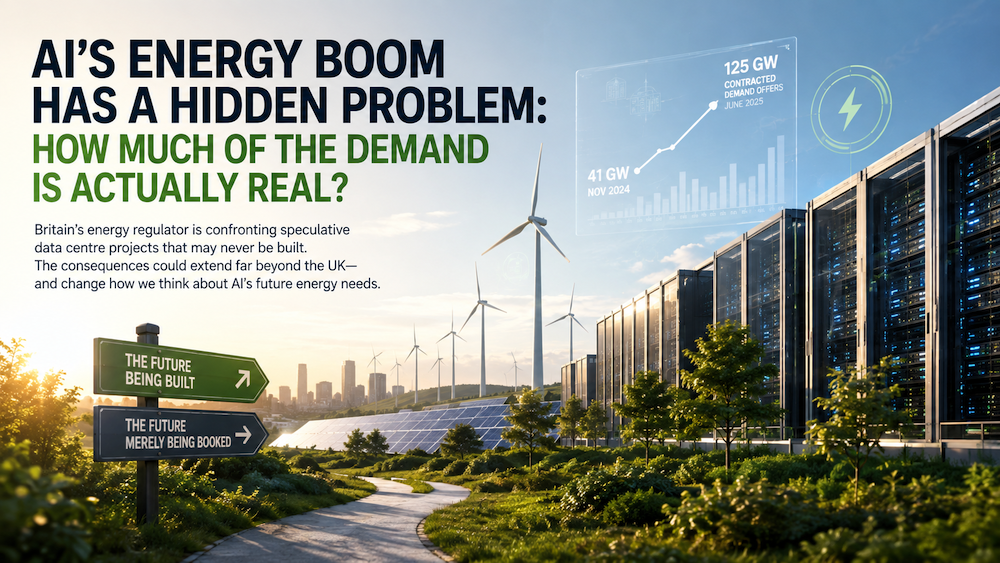
From 41 GW to 125 GW
On 29 July 2026, Britain’s energy regulator Ofgem launched a consultation aimed specifically at tackling what it calls “speculative data centre projects” in the country’s electricity connections queue.
The numbers explain why.
Contracted demand offers increased from 41 GW to 125 GW between November 2024 and June 2025, with data centre projects largely driving the increase.
According to Ofgem, data centres accounted for at least 80 GW.
An additional detail in the regulator’s documentation illustrates the complexity of the picture: around 73 GW of data centre demand is referenced in the consultation itself.
Whatever the precise perimeter of the different figures, the scale is enormous.
But scale is not the most interesting part of the story.
Uncertainty is.
What if some of the data centres are never built?
Ofgem says it is concerned that a significant number of projects in the queue may not ultimately proceed.
That creates an obvious problem.
A speculative project occupying scarce grid capacity can delay another project that is actually ready to invest, build and connect.
But Ofgem identifies another consequence that deserves much greater attention.
A connections queue containing projects that may never materialise can create misleading signals about future network investment needs.
That sentence changes the question.
The issue is no longer simply whether artificial intelligence will consume enormous quantities of electricity.
It becomes:
Are we correctly measuring how much electricity the AI economy will actually need?
A connection request is not a data centre
The distinction matters.
A grid connection request is not a data centre.
An announced investment is not a completed building.
Projected electricity demand is not actual electricity consumption.
Yet all of these expectations can begin influencing infrastructure decisions long before the projects themselves exist.
Electricity networks must be planned years ahead. Generation capacity requires investment. Transmission infrastructure requires land, permits, capital and time.
If part of the demand sitting in connection queues is speculative, governments and network operators face a difficult problem.
They must prepare for a future that may arrive — without knowing exactly how much of that future is real.
Ofgem wants developers to put money behind their plans
Britain’s proposed response is revealing.
Ofgem is considering a new Data Centre Commitment Fee for large developments accepting a grid connection offer.
The proposed fee would range from £237,500 to £712,500 per megawatt, equivalent to approximately 2.5% to 7.5% of average project costs.
The money would be returned when the project reaches energisation.
But if the project leaves the queue early, the fee would be forfeited.
The message is difficult to misunderstand:
If you want to reserve scarce electricity infrastructure, you must demonstrate that you are serious about building.
And money alone would not be enough.
Prove that the project exists
Ofgem is also proposing specific milestones requiring developers to provide evidence that their projects are genuinely progressing.
Among the proposed tests are:
- the existence of a credible end-user for the data centre;
- procurement of electrical equipment with long lead times;
- evidence of the financial and technical capability required to develop the facility.
This is more than an administrative reform.
It represents an attempt to distinguish between expected demand and credible demand.
And that distinction could become increasingly important far beyond Britain.
Is the AI race creating an infrastructure expectations bubble?
The word “bubble” should be used cautiously.
There is no evidence that the extraordinary global expansion of AI infrastructure is imaginary. Data centres are being built, investment is accelerating and electricity demand from computing is undoubtedly increasing.
But Ofgem’s intervention exposes another phenomenon.
Artificial intelligence is creating expectations on such a scale that those expectations themselves are beginning to affect physical infrastructure.
Technology companies, developers, investment funds and governments are competing for land, electricity, grid connections and computing capacity.
Everyone wants to be ready for the future.
The danger is that, when everyone attempts to reserve a piece of that future simultaneously, expectations can begin to look like demand.
The question Europe should also be asking
This is not merely a British issue.
Europe is simultaneously attempting to expand AI computing capacity, electrify transport and industry, integrate renewable energy and reinforce electricity networks.
All of these transformations compete, directly or indirectly, for infrastructure and grid capacity.
Electricity connections are therefore becoming a strategic resource.
And when a resource becomes strategic, knowing who genuinely needs it can become as important as producing more of it.
The lesson emerging from Britain may therefore be relevant across Europe.
The energy challenge of artificial intelligence may not simply be about generating more gigawatts.
It may also be about developing better mechanisms for distinguishing between real demand, potential demand and speculative demand.
The question we are not asking
Much of the global debate about artificial intelligence and energy is built around one question:
How much electricity will AI consume?
It is an essential question.
But Ofgem’s intervention suggests another should now sit beside it:
How much of the energy infrastructure we are preparing for artificial intelligence will actually be needed?
The distinction matters.
Because if governments are preparing electricity grids, generation capacity and billions in infrastructure investment for the AI economy of tomorrow, they need to know whether the signals they are receiving represent real future demand — or simply expectations about that future.
Perhaps the most important challenge is therefore not only predicting how much energy artificial intelligence will consume.
It is learning how to distinguish between the future being built and the future merely being booked.
Observe. Understand. Share.
Source
https://www.ofgem.gov.uk/press-release/ofgem-acts-free-grid-capacity-tackling-speculative-data-centre-projects?utm_source=chatgpt.com
https://www.ofgem.gov.uk/consultation/proposed-data-centre-connection-reforms?utm_source=chatgpt.com