London – Presented by touring opera company Wild Hearts it marked the directorial debut of internationally acclaimed soprano Danielle de Niese—and revealed that her instinct for theatrical storytelling is every bit as assured as her celebrated work on the operatic stage.
De Niese knows The Marriage of Figaro from the inside, having performed Susanna internationally over many years. That familiarity was evident in a production in which every movement, glance and comic interruption appeared carefully considered, while still feeling spontaneous.
A Timeless Comedy of Power and Deception
Mozart’s opera follows Figaro and Susanna as they prepare for their wedding, only to discover that their employer, Count Almaviva, intends to seduce the bride himself. What follows is a breathless succession of disguises, misunderstandings, concealed lovers and elaborate plots, as the servants attempt to outwit their aristocratic master.
Despite being composed in 1786, the opera’s examination of privilege, sexual power and the ability of supposedly ordinary people to challenge those above them remains strikingly relevant. This production, however, never allowed its social commentary to overwhelm its exuberant comedy.
Period Elegance Meets Modern Energy
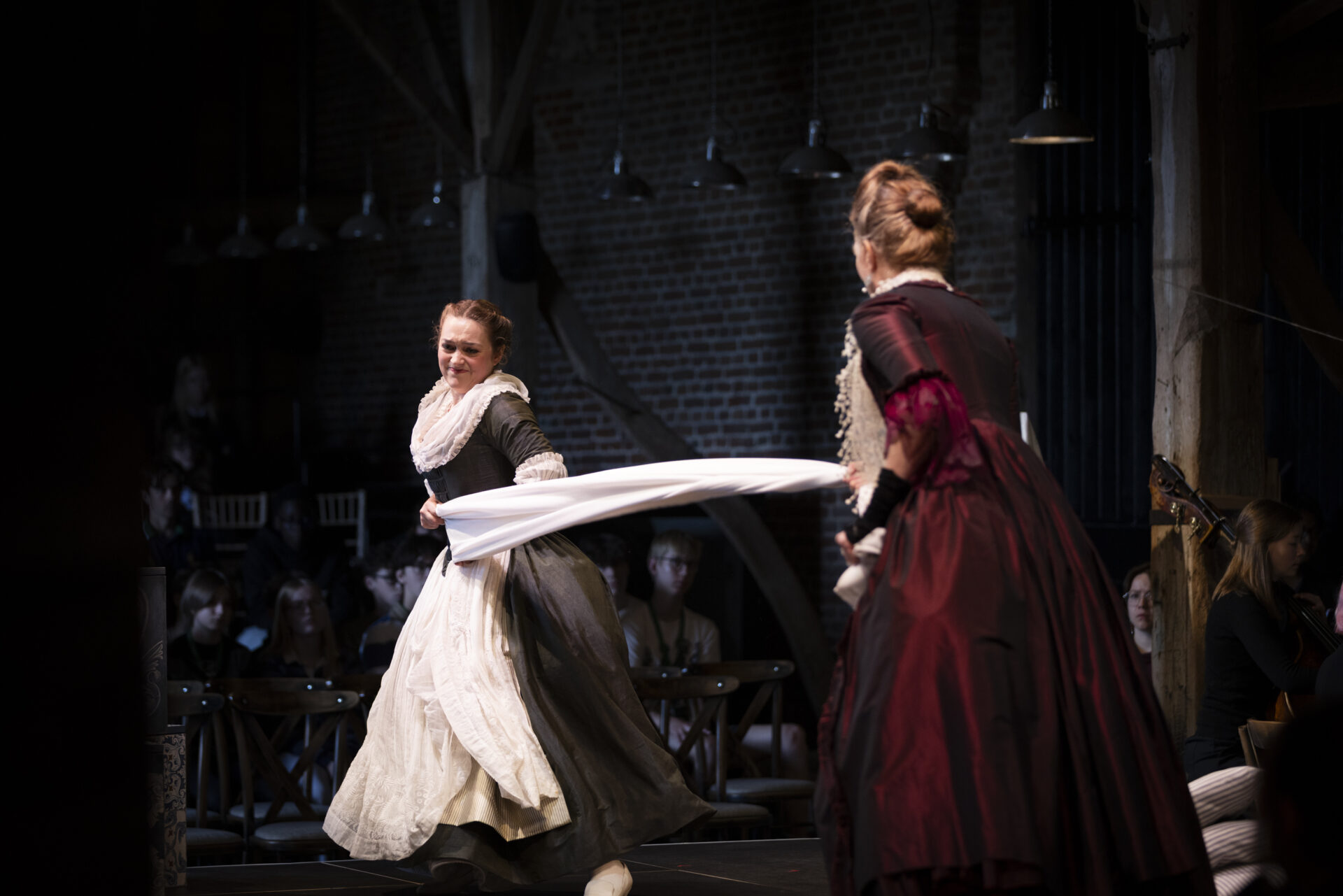
De Niese retained the opera’s 18th-century setting, complete with elegant period costumes, corsets and frock coats, while giving the characters a recognisably modern physical and emotional language. The result was neither a museum piece nor a forced contemporary reinterpretation, but a lively meeting of historical style and modern theatrical energy.
The intentionally economical set, designed by Laura Jane Stanfield, consisted of little more than screens, chairs, boxes, props and a small tree. Yet the apparent simplicity became one of the production’s strengths. Doors, hiding places and grand interiors were suggested through movement and imagination, keeping attention firmly on the performers.
The reduced scenery also suited the frantic mechanics of Mozart’s comedy. Characters concealed themselves in increasingly improbable places, interrupted one another at precisely the wrong moment and exchanged furtive looks as their carefully constructed deceptions threatened to collapse.
Comedy Rooted in Character
There was plenty of broad physical humour, but de Niese generally kept it on the right side of farce. Even the most exaggerated gestures were grounded in the characters’ desires, jealousies and frustrations. Cherubino’s attempts to escape detection provided some particularly memorable comic moments, while the escalating confusion of the ensemble scenes was handled with impressive clarity.
A Charismatic and Accomplished Cast
Jack Sandison brought a warm, confident presence to Figaro, balancing the character’s comic exasperation with genuine anger at the Count’s abuse of power. His Figaro was spirited and intelligent rather than merely mischievous: a man determined to protect both his marriage and his dignity.
Ellie Neate was an engaging Susanna, singing with freshness and assurance while making the character the clear driving force behind many of the evening’s schemes. Her Susanna was perceptive, emotionally alert and frequently several steps ahead of the men around her. Together, Neate and Sandison created a convincing relationship, full of affection but also moments of doubt and irritation.
Timothy Nelson gave Count Almaviva an imposing and sometimes unsettling intensity. His performance captured both the comedy of a powerful man repeatedly outmanoeuvred by his household and the darker implications of his determination to pursue Susanna. He was ridiculous at times, but never entirely harmless.
As the Countess, Elinor Rolfe Johnson provided the production’s emotional centre. Her dignified yet vulnerable portrayal introduced moments of stillness into the surrounding commotion. The Countess’s celebrated aria, “Dove sono”, was delivered with touching restraint and beauty, revealing the loneliness behind her elegant composure.
Abbie Ward’s Cherubino was an irrepressible bundle of adolescent desire and nervous energy. Ward embraced the role’s physical comedy without losing the sincerity of a young character overwhelmed by feelings he barely understands. Olivia Ray brought wit and authority to Marcellina, while Timothy Dawkins, William Searle and Eleanor O’Driscoll completed a tightly coordinated ensemble.
Mozart Made Accessible
Wild Arts’ decision to perform the opera in English made its intricate plot and rapid comic exchanges particularly accessible. The new translation by Danielle de Niese and Artistic Director Orlando Jopling was clear, conversational and immediate, helping the jokes reach the audience without sacrificing the shape of Mozart’s musical lines.
Jopling also conducted his chamber orchestration of the score. Inevitably, the smaller ensemble could not reproduce the sumptuous scale of a full opera orchestra, but what it surrendered in weight it gained in flexibility and transparency. The musicians played with vitality and precision, giving the overture its familiar effervescence and responding sensitively to the singers throughout.
Occasionally, the production’s relentless physical energy threatened to compete with the music. Its strongest passages came when the action was allowed to pause and the emotional complexity beneath the comedy emerged. Nevertheless, the pace rarely faltered, and the performers maintained an impressive sense of ensemble throughout the opera’s complicated finales.
An Intimate and Immediate Operatic Experience
The smaller scale also created an unusually direct relationship between performers and spectators. Rather than watching a distant operatic spectacle, the audience was invited into the characters’ increasingly chaotic world. This sense of immediacy is central to Wild Arts’ approach and helped make a familiar work feel surprisingly fresh.
De Niese’s production demonstrated that stripped-back opera does not have to feel diminished. With a charismatic cast, inventive staging and a clear understanding of Mozart’s balance between comedy and emotional truth, Wild Arts delivered an entertaining and accessible Figaro that retained the work’s humanity.
It was a joyful summer evening of opera—fast, mischievous and full of heart—and an impressive directing debut from an artist who understands exactly how music, character and movement can work together.
Remaining Performances of The Marriage of Figaro
Thursday 3 and Friday 4 September — The Minack Theatre, Cornwall
Sunday 6 September — Titsey Place, Surrey
Tuesday 8 September — Norwich Theatre Royal, Norfolk
Sunday 27 September — The Rep, Birmingham
The Minack Theatre performances are listed as sold out. Further booking information is available from Wild Arts.
Remaining Performances of An Evening of Opera
Saturday 29 August — Alresford Hall, Essex
Saturday 5 September — Titsey Place, Surrey
An Evening of Opera is Wild Arts’ accessible introduction to opera, bringing together popular arias, ensembles and songs from classic musicals. The 2026 production, devised and directed by Guido Martin-Brandis, is performed by four singers accompanied by a string quintet.
To book new performances visit: Holland Park Opera