
H1 2026 AT A GLANCE
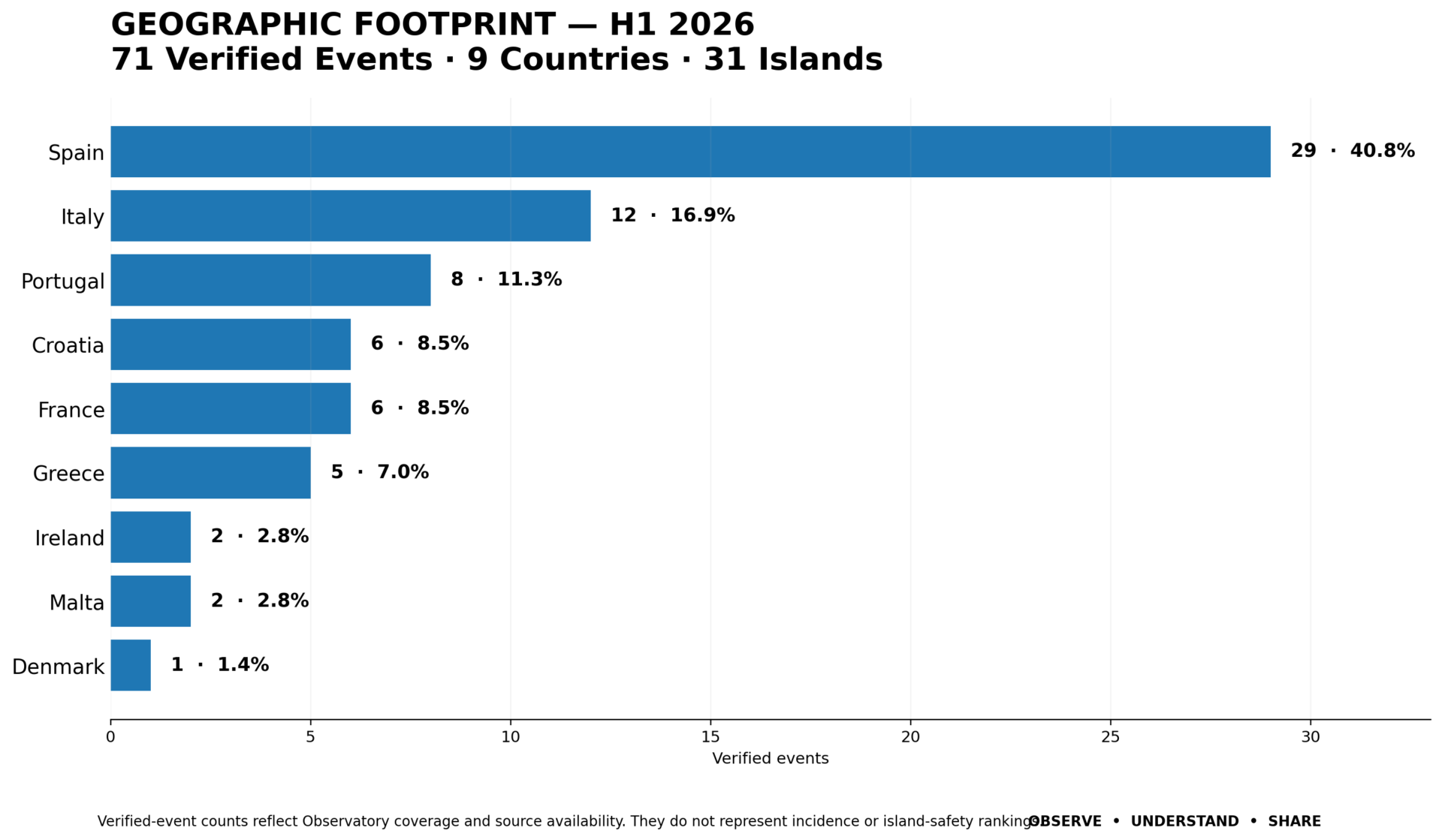
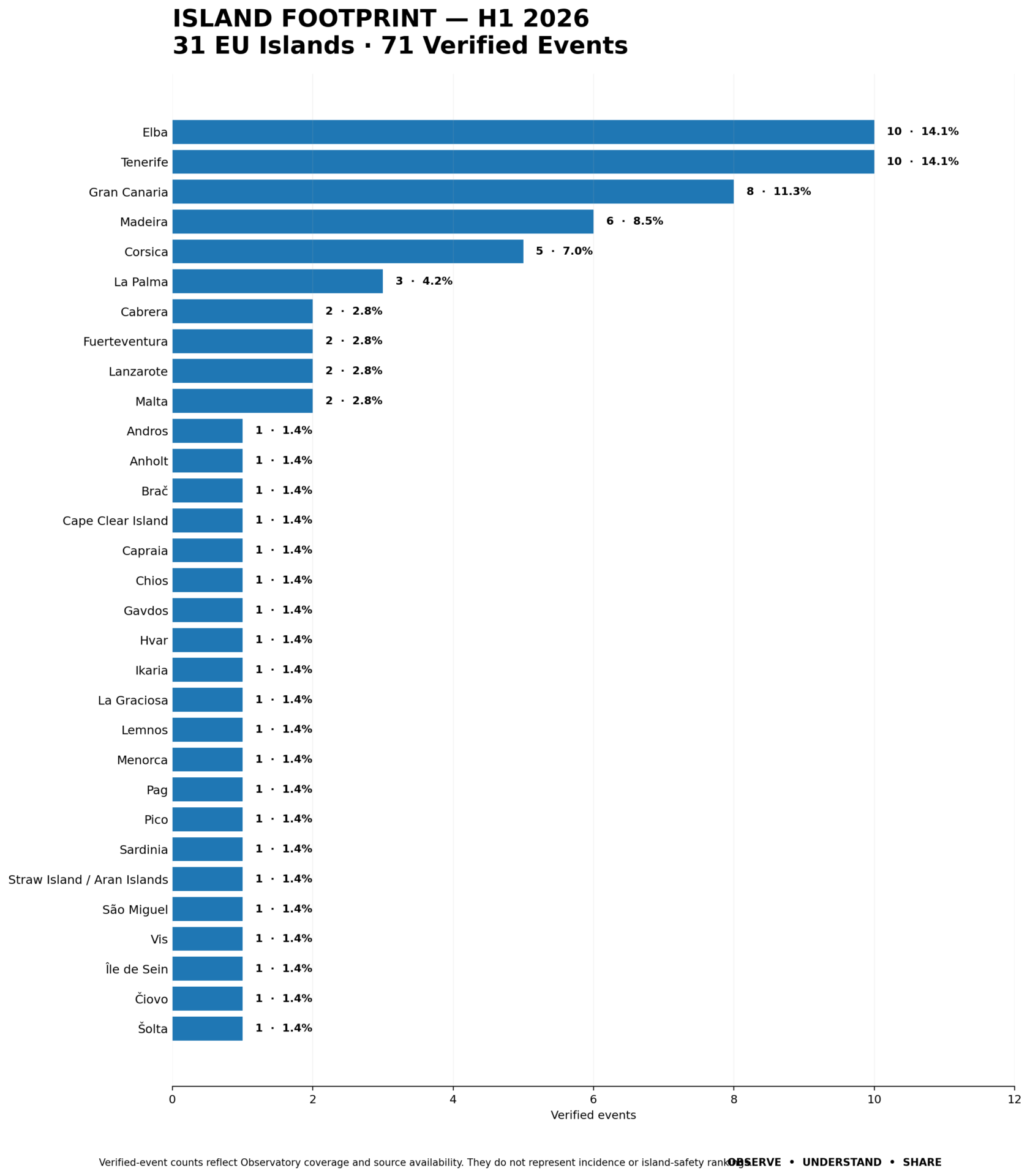
During the first half of 2026, the Observatory identified and verified 71 real-world events across European islands. Their analysis reveals recurring operational patterns related to access, medical response, specialised capabilities and island resilience.
71
VERIFIED EVENTS
9
COUNTRIES
31
ISLANDS / TERRITORIES
WHAT DOES THE EVIDENCE TELL US?
Across the 71 verified events, a clear pattern emerges: island emergencies often require specialised capabilities to overcome constraints related to access, extraction, medical response and localisation.
81.7%
SPECIALISED RESPONSE
58 of 71 verified events
62.0%
ACCESS / EXTRACTION CONSTRAINTS
44 of 71 verified events
52.1%
MEDICAL + ACCESS + SPECIALISED RESPONSE
37 of 71 verified events
Specialised response should not be interpreted as evidence of system failure. In many cases, it represents the capability that enables island emergency systems to overcome geographical, access and operational constraints.
THE DOMINANT PATTERN
The dominant pattern emerging from the H1 2026 evidence is the recurring need to mobilise specialised capabilities to overcome access, extraction, medical and localisation constraints.
WHERE ARE THE OPERATIONAL NEEDS?
The evidence highlights recurring operational needs across different island contexts. These needs do not necessarily indicate capability gaps; they identify the functions that emergency systems repeatedly need to provide or mobilise in order to respond effectively.
73.2%
MEDICAL NEED
52 of 71 verified events
63.4%
ACCESS / EXTRACTION NEED
45 of 71 verified events
22.5%
ENVIRONMENTAL NEED
16 of 71 verified events
FROM NEEDS TO RESILIENCE
Building island resilience means understanding where specialised capabilities are repeatedly required and identifying how prevention, preparedness, monitoring and response can be strengthened.
The evidence suggests that island resilience depends not only on the capabilities available on an island, but also on the ability to rapidly connect local resources with specialised capabilities when and where they are needed.
FROM EVIDENCE TO OPERATIONAL KNOWLEDGE
Individual events provide information. Comparable events provide evidence. When evidence is analysed across different islands, recurring operational patterns begin to emerge — turning observation into knowledge that can support preparedness, prevention and future decision-making.
HOW TO READ THE EVIDENCE
The figures presented by the Observatory describe patterns identified within 71 verified and geolocated events observed during H1 2026. They provide an evidence-based picture of recurring operational needs within the observed dataset, rather than incidence rates for all European island emergencies. Operational needs indicate functions that emergency systems may need to provide or mobilise and do not, by themselves, demonstrate capability gaps.
FROM EVIDENCE TO FINDINGS
Once the verified evidence is examined across emergency types, locations and response patterns, a series of recurring operational conditions begins to emerge.
FINDING 1 — WHEN ACCESS BECOMES PART OF THE EMERGENCY
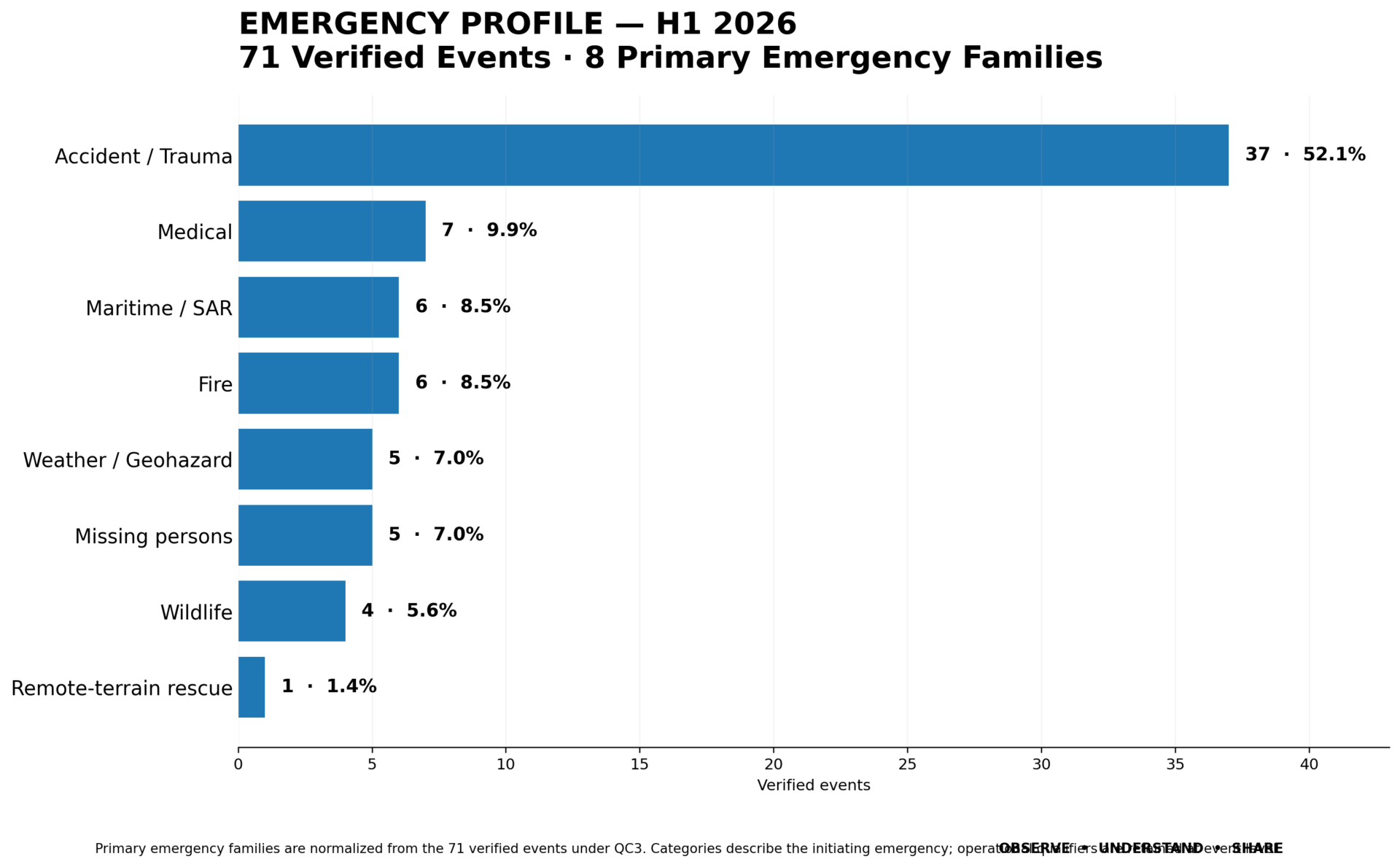
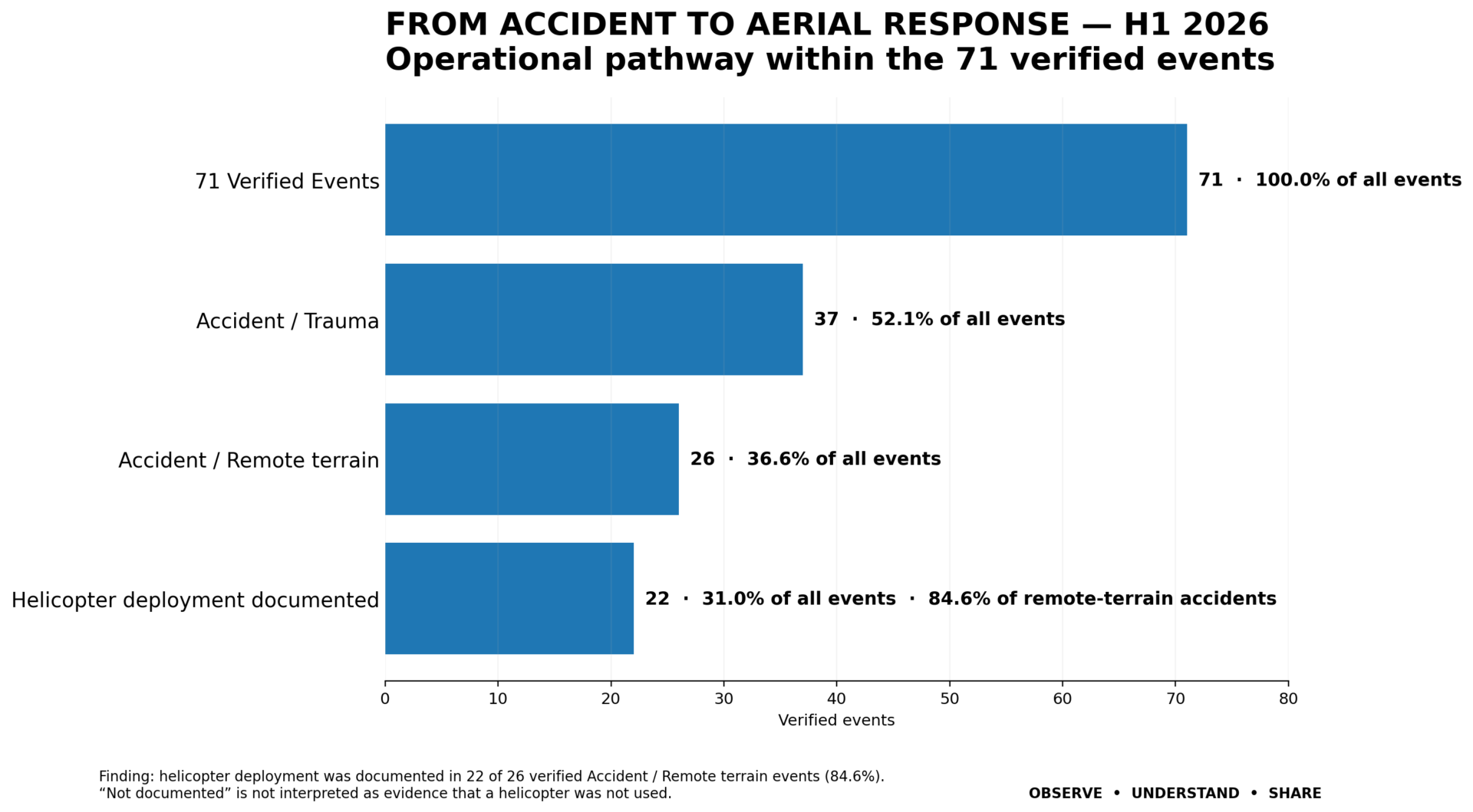
Accident / Trauma was the most frequently observed emergency family in H1 2026, accounting for 37 of 71 verified events (52.1%). Of these, 26 events (70.3%) involved remote terrain. In 22 of those 26 cases (84.6%), helicopter deployment was documented.
On islands, accessibility can turn an ordinary accident into a complex rescue operation.
FINDING 2 — ACCESS AS A SYSTEMIC OPERATIONAL CONDITION
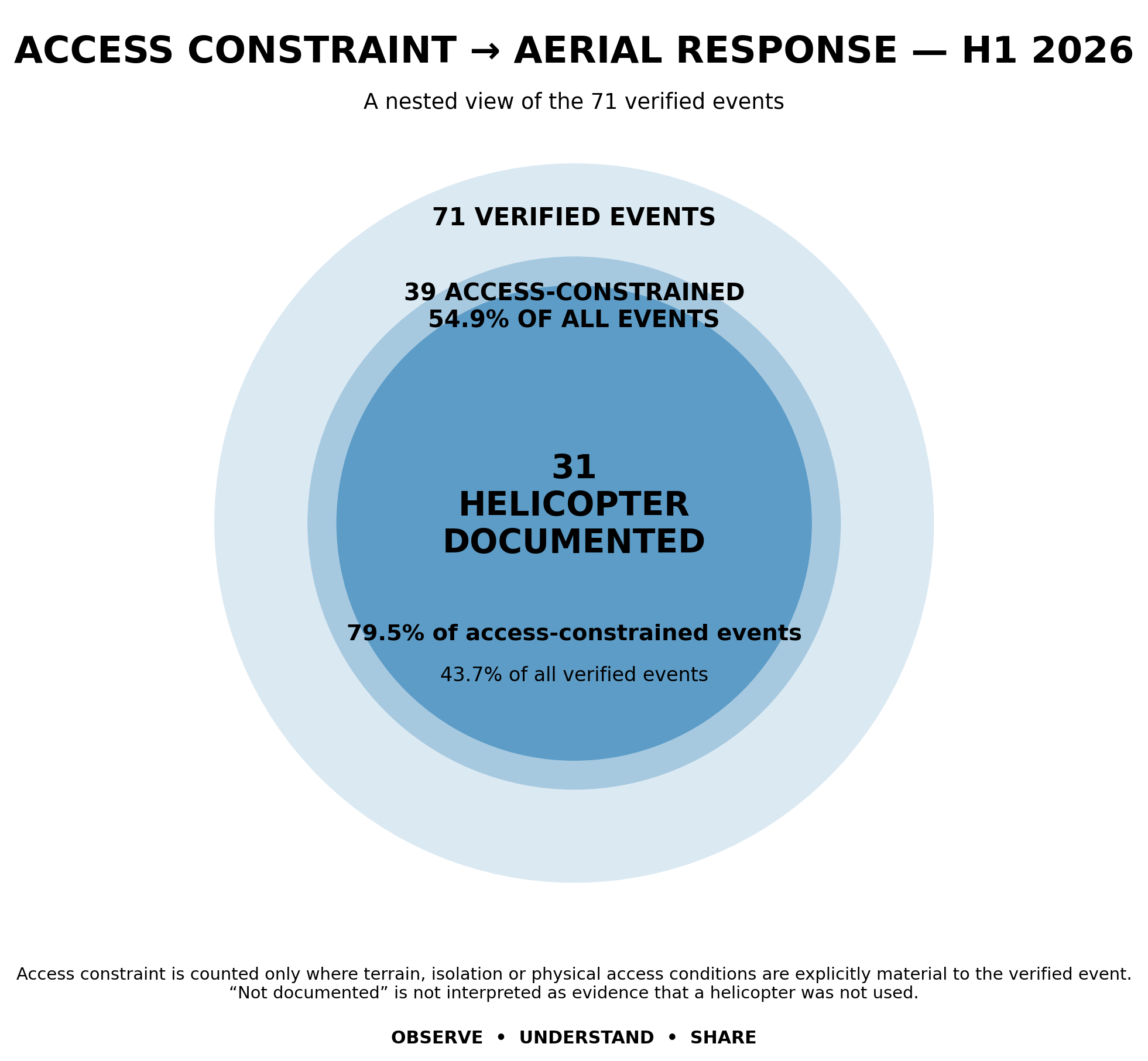
Across the full H1 2026 dataset, 39 of 71 verified events (54.9%) were conservatively classified as access-constrained emergencies. In 31 of these 39 events (79.5%), helicopter deployment was documented. These 31 cases alone represent 43.7% of all verified events.
An event was classified as access-constrained only when the verified information explicitly indicated that terrain, geographic isolation or physical access conditions materially affected access, rescue, extraction or evacuation. Island location alone was not sufficient for classification.
FINDING 3 — THE MISSING TIME
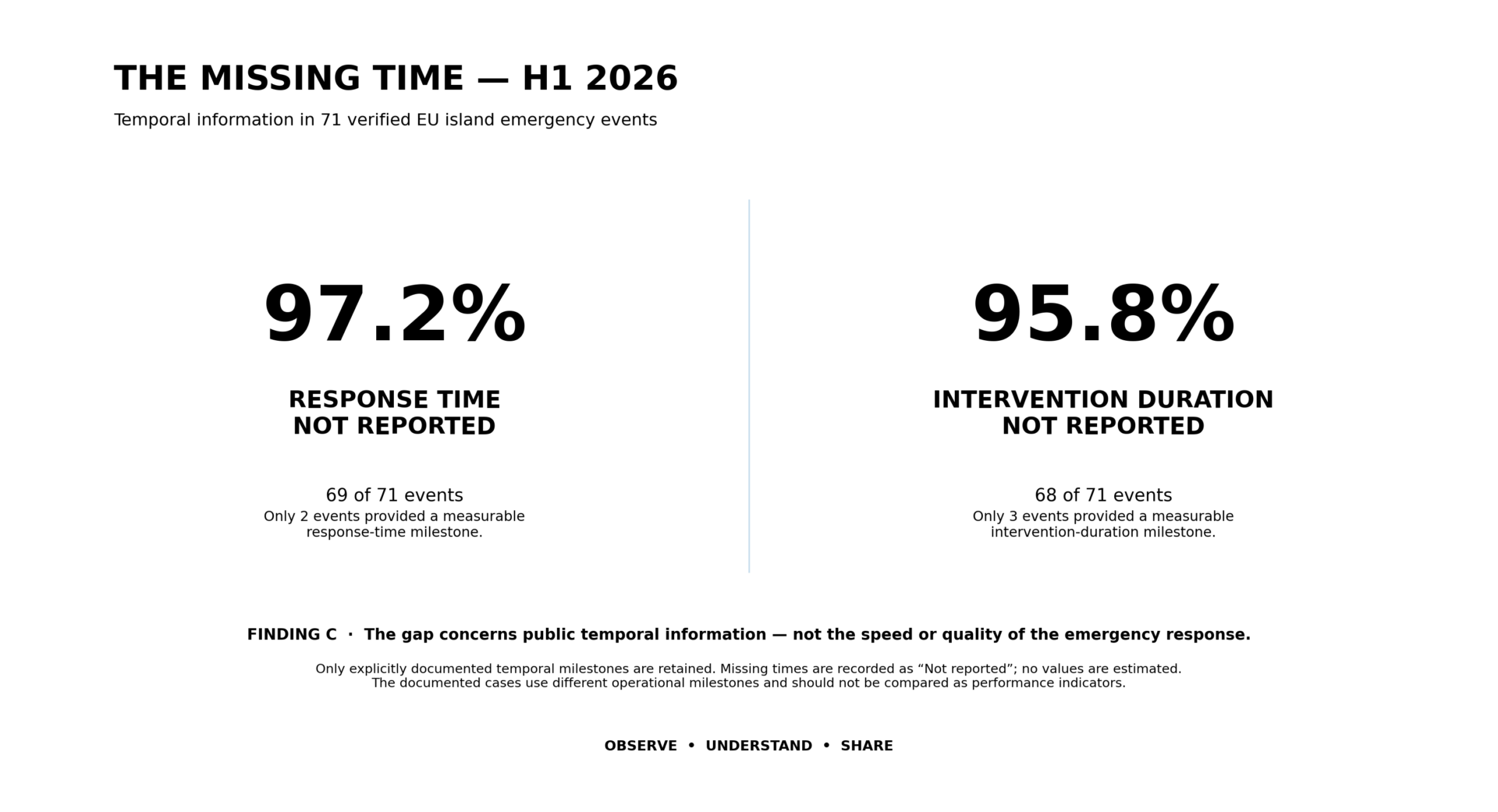
Response Time was measurable from publicly available information in only 2 of 71 verified events (2.8%). In 69 events (97.2%), it was not reported. Intervention Duration was measurable in only 3 of 71 events (4.2%), while in 68 events (95.8%) it was not reported.
This does not indicate that emergency response was slow. It identifies a public temporal information gap: in most verified events, publicly available information did not allow the Observatory to measure how long the response or intervention took.
FINDING 4 — DOCUMENTED OUTCOMES
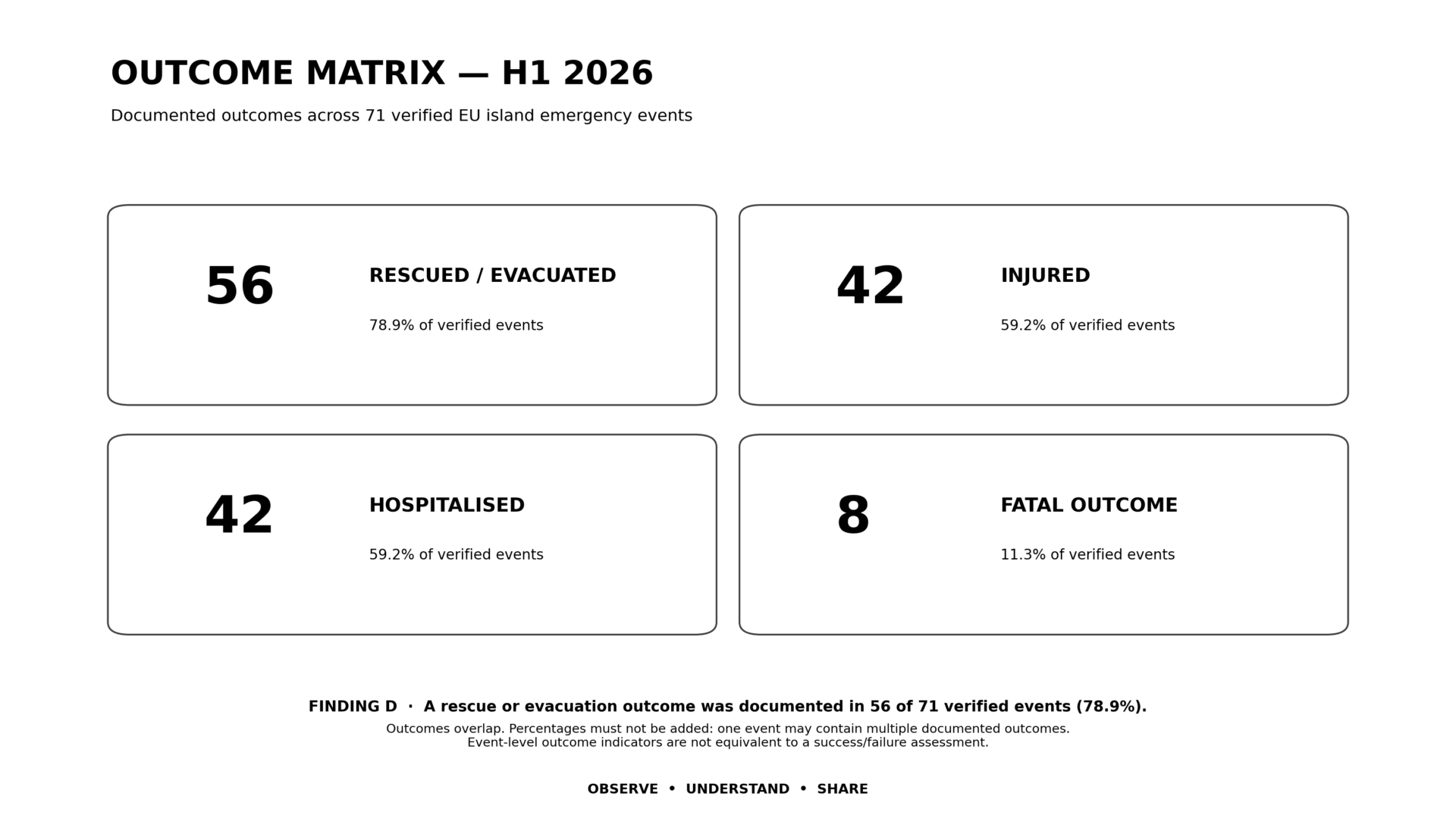
Rescue or evacuation was the most frequently documented outcome in the H1 2026 dataset. In 56 of 71 verified events (78.9%), the documented outcome included at least one rescue or evacuation. Injuries were documented in 42 events (59.2%), hospitalisation in 42 events (59.2%), and fatal outcomes in 8 events (11.3%).
Outcomes overlap. Percentages must not be added: a single event may contain multiple documented outcomes. These event-level indicators describe what was reported and should not be interpreted as measures of rescue success or failure.
WHAT THE EVIDENCE TELLS US
The H1 2026 evidence does not point to a single type of island emergency. It points to a recurring operational condition: access.
It can determine how difficult the emergency is to reach.
FROM EVIDENCE TO THE NEXT QUESTION
What happens before rescue arrives?
The H1 2026 evidence raises a further research question: what capabilities could support people, responders and situational awareness during the critical interval before conventional rescue teams or aerial assets can reach the scene?
EXPLORE THE EVIDENCE
The findings presented in this analysis are based on 71 verified and geolocated emergency events observed across EU islands during H1 2026. Each event is documented through a standardised evidence framework designed to support transparency, traceability and further analysis.
