London – Bishkek is not one of the capitals we usually watch when trying to understand where the world is heading.
Perhaps we should.
The capital of Kyrgyzstan, at the foot of the Tian Shan mountains, belongs to a region that for centuries has been crossed by trade routes, empires, armies, ideas and competing spheres of influence.
It was part of the Russian Empire, later became Frunze under the Soviet Union, and emerged as the capital of an independent Kyrgyzstan after the collapse of the USSR.
Its more recent history is equally revealing.
For more than a decade, the United States operated the Manas air base near Bishkek, a crucial logistical hub for operations in Afghanistan. Russia, meanwhile, maintained its military presence at Kant, also close to the Kyrgyz capital.
The Americans left Manas in 2014.
Russia remained.
Today, however, Bishkek may be telling us a different story.
The first table: Bishkek
On 31 August, Indian Prime Minister Narendra Modi met Russian President Vladimir Putin in Bishkek on the margins of the Shanghai Cooperation Organisation summit.
The official Indian account of the meeting deserves careful reading.
The two leaders discussed political and economic relations, defence, energy, space and mobility. They also exchanged views on India-Russia cooperation in multilateral organisations — specifically BRICS under India’s 2026 chairship.
Modi reiterated that dialogue and diplomacy should remain the way forward in resolving conflicts.
And he told Putin that he looked forward to welcoming him to India for the BRICS Summit in New Delhi on 12–13 September.
At first sight, this was simply another meeting between two longstanding strategic partners.
But look at what happened next.
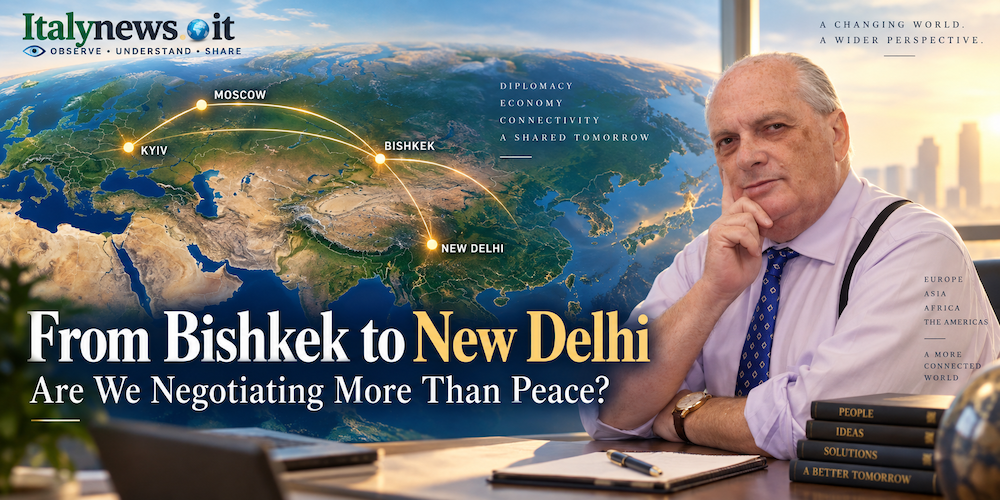
Bishkek → Moscow → Kyiv → New Delhi.
The sequence does not prove that these events are part of a single negotiation.
But it gives us a reason to observe what may be travelling from one table to another.
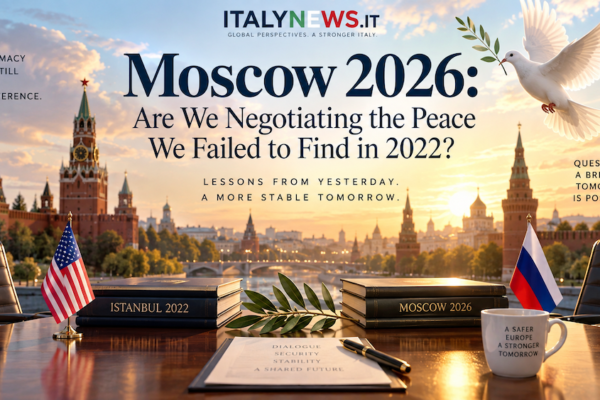
The second table: Moscow
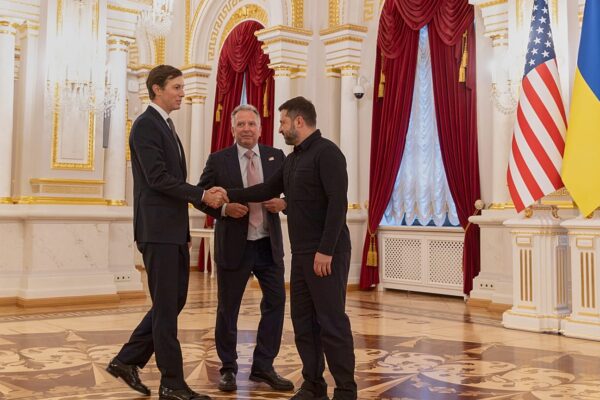
On 5 September, US presidential envoys Steve Witkoff and Jared Kushner met Vladimir Putin at the Kremlin.
The meeting lasted more than three hours.
The obvious subject was Ukraine.
Yet one detail deserves considerably more attention than it has received.
According to the Russian account of the talks, the discussion was not confined to the Ukrainian crisis.
Economic issues were also discussed, including the prospects for major Russia-US projects that could potentially benefit both countries.
Sitting at the Russian table was Kirill Dmitriev, the head of the Russian Direct Investment Fund and Putin’s special representative for investment and international economic cooperation.
None of this proves the existence of a secret geopolitical agreement. Nor does it prove that Washington is preparing a broader rapprochement with Moscow.
But it tells us something important.
Moscow and Washington are discussing not only how a war might end, but also some of what could become possible after an agreement.
And that changes the question.
What if Ukraine is also a door?
For more than four years, the world has understandably watched the war through one overriding question: How will it end?
Territory.
Ceasefire.
Security guarantees.
NATO.
Borders.Sanctions.
But any agreement capable of substantially changing relations between Russia and the West would inevitably bring another set of questions onto the table.
What happens to sanctions?
What happens to energy?
Investment? Trade?
Technology? Frozen Russian assets?
And, ultimately, Russia’s economic relationship with the West?
We do not know what Witkoff and Kushner offered Putin.
We should not pretend that we do.
But we do know that economic cooperation and possible major US-Russia projects entered the conversation.
Perhaps, therefore, Ukraine is not only the negotiation.
Perhaps it is also the door through which a larger negotiation could eventually begin.
The third table: Kyiv
The following day, Witkoff and Kushner travelled from Moscow to Kyiv. There was no announced breakthrough.
But here again, the details matter.
The discussions did not concern only ceasefires, territory and security.
President Volodymyr Zelensky also said that the talks covered economic guarantees, reconstruction and a “prosperity plan” for Ukraine.
That is significant.
Because the conversation in Moscow was already looking beyond the battlefield. And so was the conversation in Kyiv.
Russia was discussing possible future economic projects with the United States.
Ukraine was discussing economic guarantees and the architecture of its post-war recovery with the United States and European partners.
Two capitals on opposite sides of the war.
One emerging question: what does the economy after the war look like?
And then comes the fourth table.
The fourth table: New Delhi
On 12 and 13 September, Putin is expected in New Delhi for the BRICS Summit.
India’s 2026 BRICS presidency has put economic and financial cooperation firmly on the agenda.
Discussions ahead of the summit have included increasing intra-BRICS trade using national currencies, linking fast-payment systems and exploring greater interoperability between central bank digital currencies.
This distinction matters.
For years, much of the public debate about BRICS finance has revolved around a dramatic question: will BRICS create a currency to challenge the dollar?
Perhaps that is the wrong question.
A new common currency may not be necessary.
If national payment systems, local currencies, settlement mechanisms and eventually central bank digital currencies become increasingly interoperable, more trade could take place through infrastructures that do not depend exclusively on the traditional Western financial architecture.
That would not mean the end of the dollar.
It would mean something more subtle.
The growth of alternatives.
And some of those alternatives are already real.
Russia and India have spent years developing mechanisms that allow a growing share of bilateral trade to be settled outside the traditional dollar-based channels. So when Putin arrives in New Delhi, he will not simply be attending another multilateral summit.
He will arrive only days after discussing Ukraine — and potential economic cooperation — directly with representatives of the US president.
Is Washington watching only Ukraine?
There is no evidence that the American mission to Moscow was organised because of the approaching BRICS Summit.
There is no evidence that Washington is attempting to pull Russia away from China.
There is no evidence of a secret US-Russian economic deal.
We should resist the temptation to turn chronology into causality.
But chronology can still tell us where to look.
And it allows us to ask a legitimate question:
Is Washington beginning to look at Russia not only as an adversary to be contained in Ukraine, but also as an economic actor with which some interests might eventually be rebuilt?
If the answer were even partially yes, the implications would extend far beyond Ukraine.
Because BRICS is not a military alliance.
India, Russia, China, Brazil, the UAE and the other members do not have identical strategic interests.
Many of them do not necessarily want to choose between Washington and Beijing.
They want room to deal with both.
And perhaps this is one of the defining characteristics of the international system now emerging.
Not two blocs, but many tables
For much of the past few years, we have tried to understand the changing international order through a familiar map.
West versus BRICS.
Washington versus Beijing.
NATO versus Russia.
Democracies versus autocracies.
Reality may be considerably less tidy.
India can sit with Russia and China in BRICS and the SCO while maintaining an important strategic relationship with the United States.
Countries can participate in institutions promoted by one geopolitical pole while trading, investing and negotiating with another.
And Russia can help build alternative economic mechanisms within BRICS while simultaneously discussing potentially beneficial economic projects with Washington.
Perhaps we are not simply witnessing the construction of another Cold War.
Perhaps something more complicated is emerging:
a world in which countries increasingly try to sit at several tables at the same time.
Back to Bishkek
And that takes us back to the city where our sequence began.
Bishkek.
For centuries, Central Asia was crossed by routes connecting different worlds.
Today’s caravans no longer carry silk.
The new routes carry energy, capital, data, technology, payment systems and political influence.
But geography still matters.
On 31 August, Modi and Putin talked in Bishkek.
On 5 September, American envoys talked with Putin in Moscow.
On 6 September, those same envoys talked with Zelensky in Kyiv.
On 12 September, Putin is expected to arrive in New Delhi and sit down with the leaders of BRICS.
Perhaps these are simply four separate diplomatic events.
That remains entirely possible.
But observing also means being willing to ask whether apparently separate events might be telling us something before the connection becomes obvious.
While much of the world understandably asks whether Moscow and Kyiv can finally find a path towards peace, perhaps we should add another question.
What if we are not negotiating only the end of a war?
What if, behind those doors, the negotiation over the world that comes after it has already begun?
Sources
Prime Minister’s Office, Government of India — Meeting of PM with the President of the Russian Federation, Bishkek, 31 August 2026. Official account of the Modi-Putin meeting, including BRICS, economic, energy, defence and international issues.
Kremlin / Russian Presidential Administration — Moscow talks, 5 September 2026. Official Russian account of Putin’s meeting with Steve Witkoff and Jared Kushner, including the statement that discussions extended beyond Ukraine to economic issues and potential major Russia-US projects.
Reuters — 5 September 2026. Reporting on the more than three-hour Putin-Witkoff-Kushner meeting in Moscow and the subsequent US diplomatic mission to Kyiv.
Office of the President of Ukraine — 6 September 2026. Statements following the Kyiv talks concerning negotiations, security, economic guarantees, reconstruction and Ukraine’s proposed post-war prosperity plan.
Reuters — 6 September 2026. Reporting on the Witkoff-Kushner visit to Kyiv following their talks with Putin and the attempt to revive the negotiating process.
Reserve Bank of India / BRICS 2026 discussions. Statements and reporting concerning possible connections between BRICS fast-payment systems, CBDC interoperability and increased use of national currencies in intra-BRICS trade.
Government of India / BRICS 2026 — New Delhi Summit, 12–13 September 2026. Official material concerning India’s BRICS chairship and the forthcoming summit.