
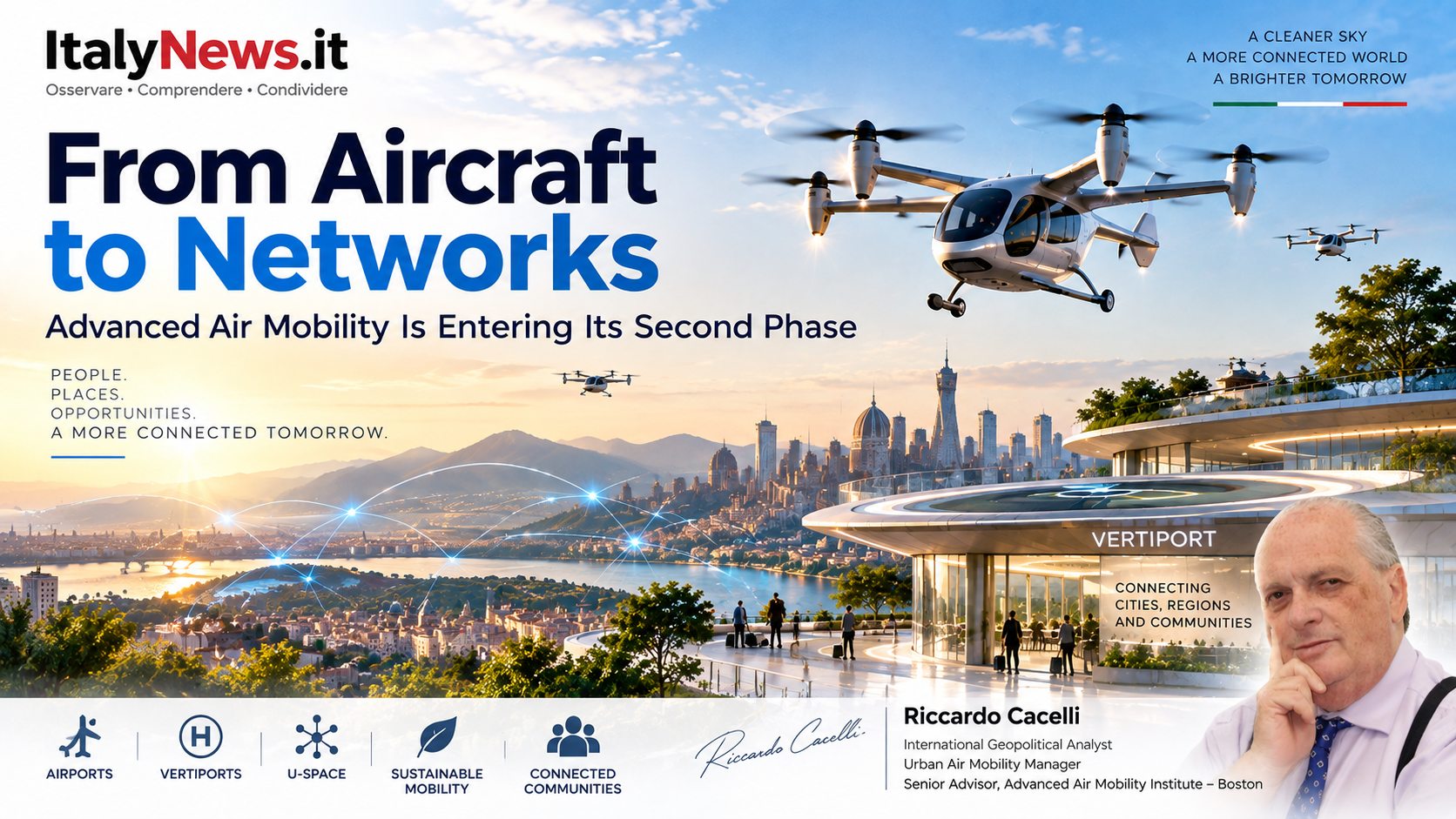
The eVTOL may no longer be the hardest part of Advanced Air Mobility.
The next challenge is building the network around it.
London – For years, Advanced Air Mobility has revolved around the aircraft.
Range, batteries, noise, certification, passenger capacity and the race towards commercial operations have dominated the debate.
Those questions remain fundamental. But recent developments in the United States and Europe suggest that AAM may be entering another phase: from designing aircraft to designing the systems in which those aircraft will operate.
And that raises a different question:
Are we designing vertiports — or are we designing airspace networks?
Dallas: testing integration, not simply an aircraft
On September 10, the US Federal Aviation Administration confirmed the launch in Texas of operations under the eVTOL Integration Pilot Program (eIPP), involving Joby Aviation, BETA Technologies and the Texas Department of Transportation.
The programme is intended to generate operational data that the FAA can use in developing the regulatory framework for Advanced Air Mobility at scale.
One element is particularly significant. Joby scheduled operations connecting Perot Field Fort Worth Alliance Airport with Dallas Fort Worth International Airport, entering DFW controlled airspace and landing at its Corporate Aviation facility.
The importance is not another eVTOL demonstration.
It is the attempt to integrate a new category of aircraft into the complex environment of a major international airport.
Dallas has already been used to explore this question. Joby and NASA previously conducted simulations examining scenarios involving up to 50 electric air-taxi operations per hour in the DFW terminal area.
The problem is therefore moving beyond whether the aircraft can fly towards how many aircraft can safely become part of an existing aviation system.
A methodological note is necessary. FAA material published on September 10 confirmed the programme and described the DFW operation as scheduled for September 12. Until independently confirmed as completed, ItalyNews treats it as a scheduled operational test rather than an accomplished event.
In an emerging industry, distinguishing operational facts from announcements and targets matters.
EASA: “from rules to reality”
Almost simultaneously, Europe produced another signal.
On September 11, EASA published the programme for its 2026 Innovative Air Mobility Implementation Forum, scheduled for October 27–28 in Cologne.
The title itself is revealing:
“From rules to reality: accelerating Innovative Air Mobility in Europe.”
EASA says Europe now has greater experience in implementing its regulatory framework while technologies and services are progressing towards operations.
More important is how EASA frames the discussion.
The Forum brings together U-space, VTOL and UAS, addressing U-space implementation, eVTOL certification and entry into service, BVLOS operations, automation and safety.
This reflects an increasingly obvious reality: an eVTOL cannot be considered independently from the airspace in which it flies, the infrastructure where it lands and the digital services that manage its movements.
The aircraft is becoming one node of a larger system.
Italy: the pieces are beginning to meet
Italy offers another interesting signal.
ENAC recently reiterated its interest in Regional Air Mobility and the development of territorial airport infrastructure, with the objective of creating more capillary air connectivity and strengthening territorial cohesion.
Regional Air Mobility and Urban Air Mobility are different concepts and should not be confused.
But their infrastructures may increasingly form part of the same mobility ecosystem.
On September 11, ENAC also addressed the wider transformation of airspace management. With drones, conventional aircraft and new categories of operations increasingly sharing the sky, the authority highlighted the need for greater digitalisation and interoperability in air traffic management.
Put together, these developments point towards the same problem.
The next bottleneck in AAM may not be the aircraft. It may be the network.
A vertiport without a network is only a landing place
The first AAM narrative often presented the vertiport almost as a small airport: identify demand, find a site, construct a landing area, install charging infrastructure and connect it to the city.
That may no longer be enough.
A successful vertiport depends not only on what happens on its pad but on what happens between pads.
Can several vertiports operate simultaneously? How will routes be managed? How will eVTOL traffic interact with conventional aviation around airports? What happens when passenger flights, emergency services and unmanned aircraft require access to the same airspace?
And at what point does a collection of vertiports become a transportation network?
Dallas is beginning to explore part of that problem operationally.
EASA is approaching it through U-space, certification and implementation.
ENAC is looking at territorial connectivity and increasingly digital airspace.
Individually, these are separate aviation developments.
Together, they may represent a change of phase.
The Italian opportunity
Italy is particularly interesting because its geography naturally lends itself to network-based Advanced Air Mobility.
Large cities coexist with islands, ports, tourist destinations, industrial districts, mountain communities and a widespread network of regional airports.
The most transformative Italian application of AAM may therefore not be replacing a taxi journey across a city.
It may be connecting places that existing transport connects poorly:
airport to territory, port to destination, island to mainland, hospital to remote community, regional airport to regional airport — and eventually vertiport to vertiport.
This is where Regional Air Mobility, Urban Air Mobility, airports and U-space should perhaps stop being considered entirely separate policy domains.
They are different operational concepts, but they may become components of the same transportation architecture.
From aircraft to networks
Certification, range, battery performance, economics and safety remain fundamental.
But the question is no longer simply whether an eVTOL can fly.
Increasingly, the questions are where it will fly, where it will land, who will manage the airspace around it and how hundreds of movements will coexist with conventional aviation.
And perhaps the most important question of all:
Who will design the network before the traffic arrives?
The winners of the first phase of Advanced Air Mobility may be those who build the best aircraft.
The winners of the second may be the cities, regions, regulators and companies that understand something different:
An aircraft creates a flight.
A network creates mobility.
Riccardo Cacelli