
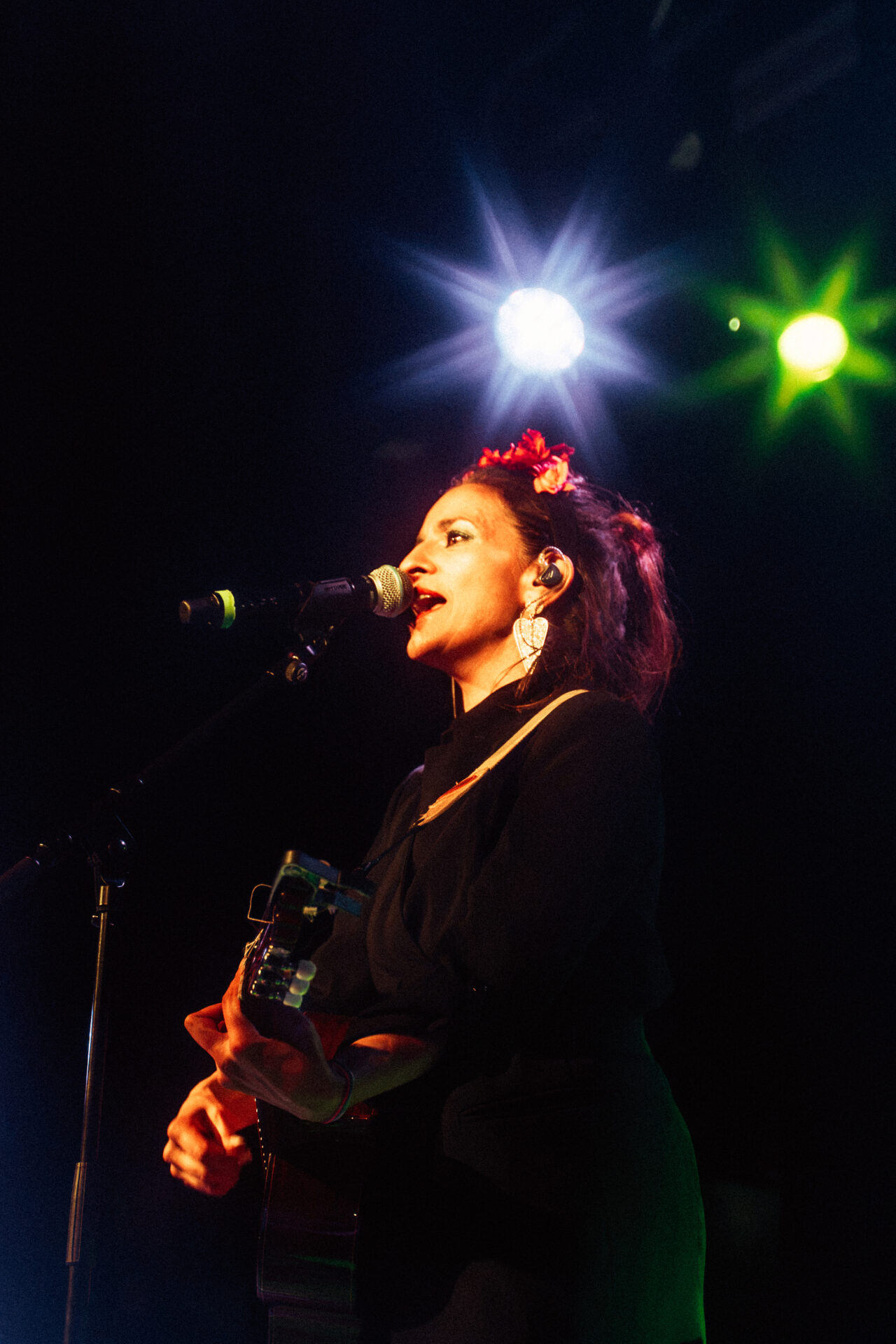
London – The Spanish singer-songwriter returned to London’s Electric Ballroom on 2 November to celebrate the anniversary of her landmark debut album, revisiting the songs that made her one of Spain’s most distinctive musical voices.
More than two decades after she burst onto the Spanish music scene with a rebellious voice and uncompromising lyrics, Bebe returned to London on Monday, 2 November, with a concert celebrating the enduring legacy of her debut album, Pafuera Telarañas.
Taking place at Camden’s Electric Ballroom, the performance formed part of her anniversary tour, revisiting the record that transformed an emerging singer-songwriter into an international sensation. Organised by Gotobeat and 7alent Scout in association with Get In, the evening offered London audiences an opportunity to reconnect with the music that defined a generation.
The album that challenged conventions
Released in 2004, Pafuera Telarañas — loosely translated as “Out with the Cobwebs” — was anything but a conventional pop debut. Combining flamenco-inspired rhythms, rumba, rock, hip-hop influences and acoustic melodies, the album distinguished itself through its emotional honesty and fearless exploration of subjects often overlooked in mainstream music.
At its centre was Malo, the song that propelled Bebe to international fame and became an anthem against domestic violence. Addressing an abusive partner directly, its confrontational lyrics rejected silence and submission, giving musical expression to the anger and determination of women experiencing abuse.
The track resonated far beyond Spain, establishing Bebe as an artist willing to confront uncomfortable social realities through popular music. More than twenty years later, its message remains disturbingly relevant.
Another defining song, Ella, offered a contrasting but equally powerful perspective. Rather than focusing on abuse, it celebrated female independence, self-worth and the courage to rebuild one’s life. Its uplifting message helped establish the track as one of Bebe’s most recognisable compositions.
Then came Siempre me quedará, a deeply emotional ballad exploring loss, vulnerability and the possibility of finding strength after heartbreak. Together, these songs demonstrated the remarkable range of an artist capable of moving between defiance, tenderness and introspection without sacrificing authenticity.
From Madrid’s music scene to international recognition
Behind the stage name Bebe is María Nieves Rebolledo Vila, born in Valencia in 1978 and raised in Extremadura, southwestern Spain. Music was an integral part of her childhood: her parents performed in a folk group, introducing her to traditional sounds and instruments from an early age.
As a young woman, she moved to Madrid to study dramatic arts, gradually immersing herself in the capital’s singer-songwriter circuit. Performing in intimate bars and music venues, she developed the distinctive vocal delivery and candid songwriting style that would later become her trademark.
Her breakthrough arrived when producer Carlos Jean collaborated with her on Pafuera Telarañas. The album’s success culminated in the 2005 Latin Grammy Award for Best New Artist, consolidating her reputation beyond Spain.
A career defined by independence and reinvention
Yet Bebe’s career has never followed a predictable commercial trajectory. Following her extraordinary early success, she stepped away from the spotlight before returning with Y. in 2009, an experimental second album that marked a departure from the accessible sound of her debut.
Subsequent releases, including Un Pokito de Rocanrol in 2012 and Cambio de Piel in 2015, explored new musical directions, from harder-edged rock to more introspective compositions. Alongside music, she pursued acting, appearing in Spanish film productions.
Her artistic evolution has reflected an independent-minded performer more interested in experimentation than reproducing the
The London anniversary concert therefore carried significance beyond nostalgia. Its focus on Pafuera Telarañas, alongside selections from her subsequent career, highlighted the continuing importance of an album whose subjects — violence, identity, freedom and emotional resilience — still speak to contemporary audiences.
The choice of Camden’s Electric Ballroom, a historic venue associated with alternative music and countercultural expression, provided an appropriate setting for an artist whose career has consistently challenged conventional expectations.
For Bebe, revisiting her breakthrough record twenty-two years after its original release was an opportunity to reconnect past and present. For listeners discovering her music today, it offered a reminder that the most enduring songs are not necessarily those that follow trends, but those that dare to say something meaningful.
And few Spanish pop records of the early 2000s did so with quite the same uncompromising spirit as Pafuera Telarañas.
https://gotobeat.com/artist/bebe/