
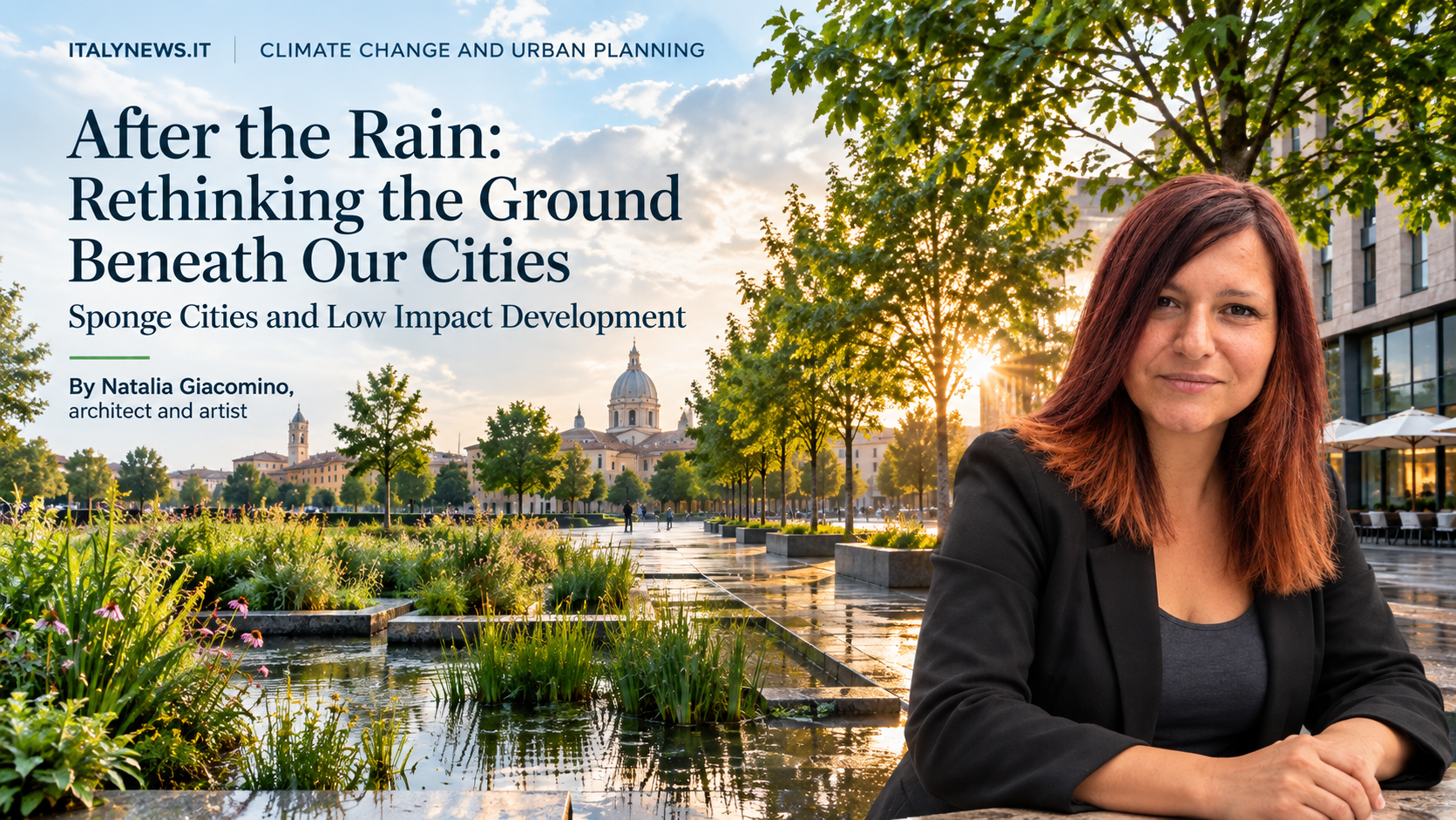
Sponge Cities and Low Impact Development
London – To understand a city, it is worth watching it when it rains.
Water follows slopes, crosses streets and gathers in low places. It shows us how much ground we have left open and how much we have covered. It reveals connections that are easy to overlook on a dry day.
As an architect, I consider that journey part of the design. A change in level, a paved surface or the edge of a planting bed can have consequences beyond a property’s boundary. As an artist, I am also interested in how water changes our perception of a place: the colour of wet materials, reflections, the movement of vegetation. These are two perspectives I want to bring together in my work.
The concept of Sponge Cities responds to the need to rethink the relationship between urban form and water. The approach, brought to wider attention through China’s programme, uses a network of spaces to retain, slow and treat rainwater. Parks, wetlands and permeable surfaces contribute to the city’s water management.
I find this compelling because it takes design beyond the individual building. It asks us to look between buildings, beneath surfaces and along the routes water takes.
The ground deserves attention from the beginning
When urban spaces are transformed, the ground is often considered through immediate practical needs: access, parking, circulation and ease of cleaning. These needs matter. Alongside them, I would like us to ask what role the ground can retain in managing water.
Flood risk has several causes. The IPCC identifies the influence of climate change, urban expansion and increasing impermeable surfaces. A city’s vulnerability therefore also depends on the decisions we make about its ground.
Water management should begin while those spatial decisions are being made. When we decide where to build, how much to pave, which trees to retain and where to leave soil exposed, we are already shaping part of the site’s response to rainfall.
Low Impact Development, or LID, provides an approach to these decisions. It seeks to preserve or restore natural hydrological processes, using soil, vegetation and site grading to reduce runoff and treat rainwater close to where it falls.
Its tools include rain gardens, permeable paving, vegetated channels and green roofs. A rain garden, for example, is a planted depression designed to receive runoff temporarily and filter it through soil and vegetation. A vegetated channel can convey water while slowing its movement.
The appropriate choice depends on the site. Part of LID’s value is that it requires us to understand a place before selecting a solution.
The most important drawing may be a section
A plan can show a planting bed and permeable paving. The section must explain how they work.
Where does the water enter? How much space is available to hold it? What lies beneath the surface? Where does it go when the system is full?
These questions should guide discussions between architects, landscape architects and engineers. England’s standards for Sustainable Drainage Systems, known as SuDS, emphasise the need to assess ground conditions and design for extreme rainfall and potential system failures. Infiltration is appropriate only where site conditions allow it, taking account of groundwater, stability and contamination risks.
For this reason, I would avoid describing a sponge city as floodproof. Every system has a capacity and limits. A sound design makes those limits explicit and considers what happens when they are reached.
A landscape that changes over time
My artistic perspective draws me towards spaces that can change while retaining their quality.
A planted area can be composed through height, colour and texture. It can be engaging when dry and when holding water. Its appearance can shift with the seasons while the underlying design remains legible.
This is how I would like to develop the relationship between art and infrastructure: giving a function a considered form and making it part of everyday experience.
Biophilic design, as I understand it, requires the same attention. I am interested in nature that has room to grow and a role in how a place works. Design must consider soil, water and the care needed over time.
This brings us to a less spectacular but essential question: maintenance. Who will remove sediment? Who will check the water inlets? Who will care for the planting? England’s SuDS standards call for a management and maintenance plan to sustain performance throughout the development’s life.
I believe these responsibilities should be established as the design develops. They influence details, access and the choice of systems.
Starting with the places we already have
Change can begin with a courtyard, a school garden or a street being resurfaced. I see these projects as opportunities to reconsider surfaces and restore a useful role to the ground.
I would begin with two questions: where does water travel today, and where can we safely make room for it?
The answers require technical assessment and decisions about priorities. How much of the budget do we allocate to landscape? How much ground do we leave available? How do we coordinate work across different properties?
Sponge Cities invite us to address these questions together. For me, their value lies in connecting an environmental need with the quality of the places we inhabit.
After a storm, I would like a garden or square to make that care visible: water held where intended, routes that remain usable and vegetation contributing to the design. That would be a technical achievement. It would also be a well designed place.
Scientific and Regulatory References
1. Intergovernmental Panel on Climate Change (IPCC)
Climate Change 2022: Impacts, Adaptation and Vulnerability. Sixth Assessment Report, Working Group II, Chapter 6: Cities, Settlements and Key Infrastructure.
https://www.ipcc.ch/report/ar6/wg2/chapter/chapter-6/
2. UK Department for Environment, Food & Rural Affairs (DEFRA)
National Standards for Sustainable Drainage Systems (SuDS). 2025. Non-statutory technical standards for sustainable drainage design, management and maintenance in England.
https://www.gov.uk/government/publications/national-standards-for-sustainable-drainage-systems
3. United States Environmental Protection Agency (EPA)
Nonpoint Source: Urban Areas. Guidance and resources concerning urban runoff, Low Impact Development and stormwater management.
https://www.epa.gov/nps/nonpoint-source-urban-areas
4. Environmental Science & Policy
China’s Sponge Cities Strategy. 2018. Scientific literature examining the development and implementation of the Sponge Cities approach.
https://doi.org/10.1016/j.envsci.2017.11.016
#ClimateChange #UrbanPlanning #SpongeCities #LowImpactDevelopment #SustainableCities #GreenInfrastructure #SustainableArchitecture #WaterManagement #ClimateResilience #NatureBasedSolutions #BiophilicDesign #RainwaterManagement #NataliaGiacomino #ItalyNews