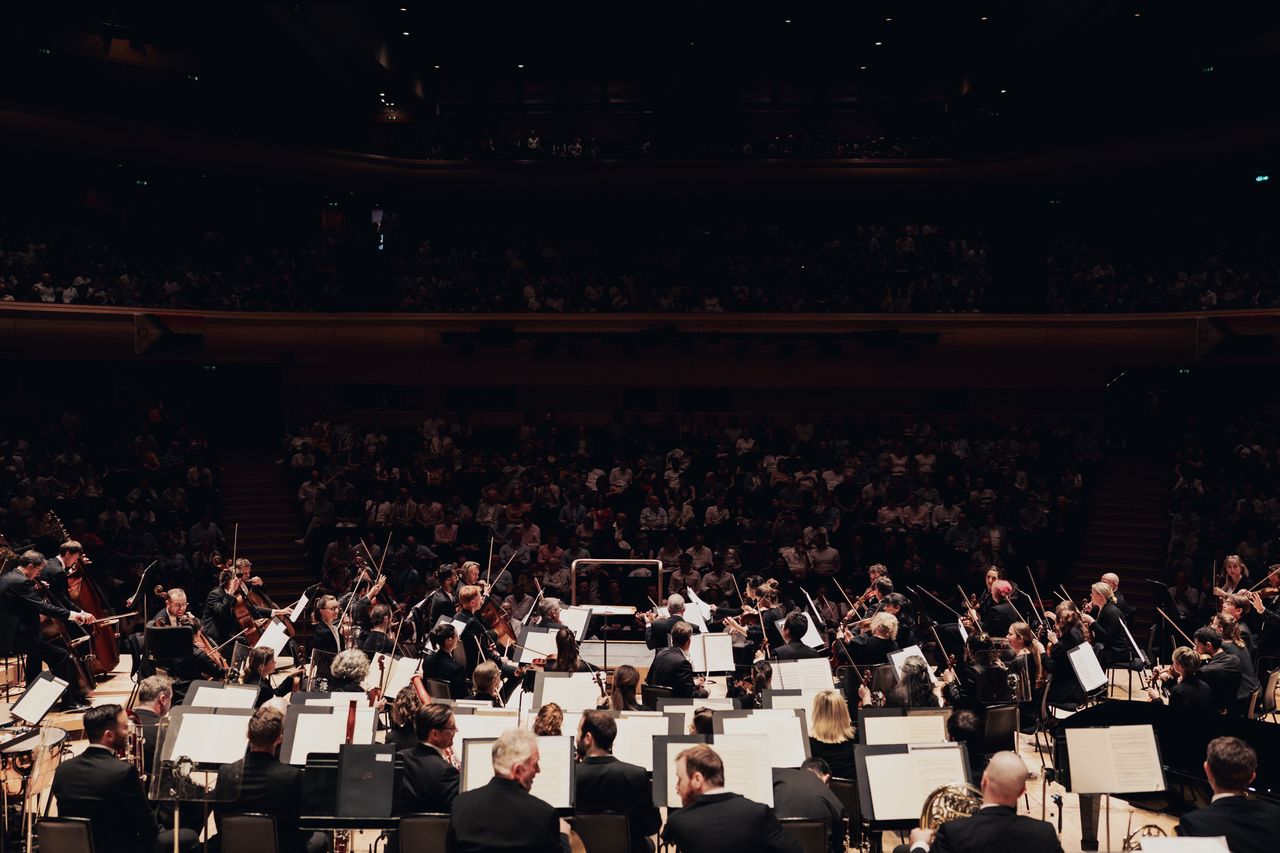
London – On the 14th of June, the Barbican’s concert hall filled for the fourth edition of Classical Pride, the festival founded by conductor Oliver Zeffman to celebrate LGBTQ+ voices in classical music. What began as a single concert in 2023 has rapidly evolved into a multi-venue cultural event spanning orchestral performance, opera, theatre and dance, attracting audiences far beyond the traditional classical music world.
The headline concert, conducted by Zeffman and performed by the London Symphony Orchestra, offered a programme that combined established masterpieces with neglected voices. Michael Tilson Thomas’s jubilant Agnegram opened the evening, followed by the UK premiere of Henriëtte Bosmans’s lyrical and deeply affecting Second Cello Concerto, performed by Laura van der Heijden. After the interval came Samuel Barber’s Adagio for Strings and Knoxville: Summer of 1915, sung by American tenor Freddie Ballentine, before a rousing conclusion with Maurice Ravel’s Boléro.
Yet the significance of the evening extended beyond the programme itself.
At just 33, Zeffman has emerged as one of the most energetic and entrepreneurial figures in British classical music. In an industry often criticised for its conservatism, he has built a reputation not only as a conductor but as a cultural innovator, creating events that challenge assumptions about who classical music is for and how it should be presented.
Classical Pride was born from a simple observation: while Pride celebrations had become established across almost every area of culture, classical music remained largely absent from the conversation. Zeffman’s response was not to create a niche event for a specialist audience, but to place LGBTQ+ artists and composers at the centre of major performances by world-class institutions.
That vision has expanded rapidly. Following its inaugural concert in London, Classical Pride has grown into a festival involving multiple venues and artistic disciplines. Last year it reached an international audience when Zeffman conducted the Los Angeles Philharmonic at the Hollywood Bowl, demonstrating that the concept resonated far beyond the UK.
What distinguishes Zeffman’s approach is his refusal to treat representation as separate from artistic excellence. The inclusion of Bosmans’s concerto in this year’s programme exemplified that philosophy. The Dutch composer’s work was not presented as a historical curiosity but as a compelling piece of music that deserved to stand alongside Barber and Ravel on one of London’s most prestigious stages.
The audience response suggested that the approach is working. The atmosphere at the Barbican felt celebratory without becoming self-congratulatory, welcoming newcomers while retaining the seriousness expected of a London Symphony Orchestra performance. Rather than asking audiences to choose between accessibility and artistic quality, Classical Pride demonstrated that the two can reinforce one another.
At a time when many arts organisations are struggling to attract younger and more diverse audiences, Zeffman’s success offers a glimpse of what the future might look like. His achievement has not been to reinvent classical music but to reveal dimensions of its history and culture that have often been overlooked.
The result is a festival that feels both historically informed and unmistakably contemporary. As Classical Pride continues to expand, it is becoming clear that its significance lies not only in celebrating LGBTQ+ musicians and composers, but in reshaping the wider conversation about what classical music can be.
For one evening at the Barbican, that future felt not only possible but already underway.