
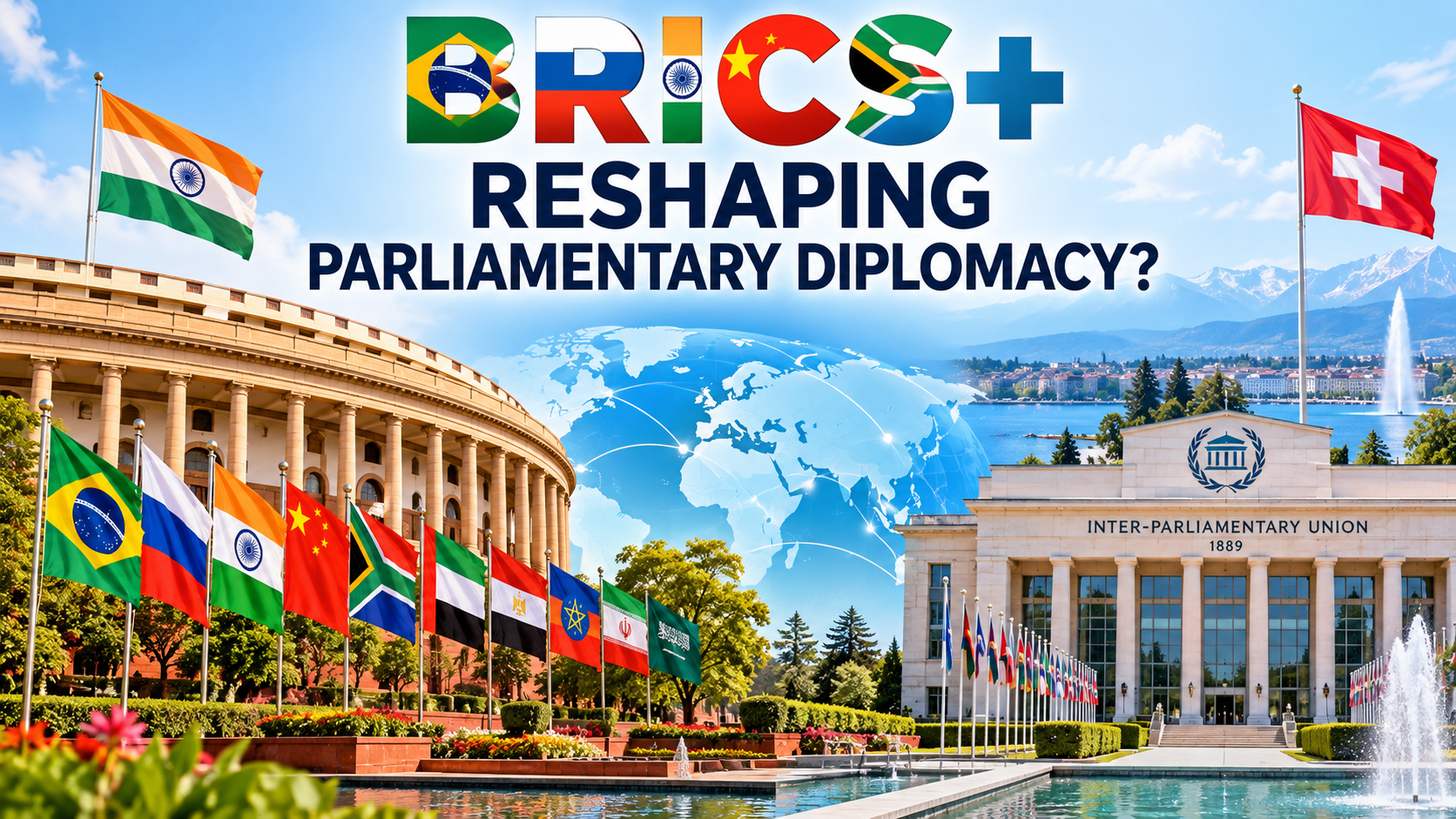
Documents from South Africa and the 2026 BRICS Parliamentary Forum reveal a little-noticed initiative to establish a BRICS+ geopolitical group within the Inter-Parliamentary Union. Could the BRICS countries be seeking greater influence within existing international institutions?
City of London – When the international community discusses BRICS, attention usually turns to trade, currencies, economic influence, and the changing balance of power between emerging economies and Western nations.
Yet another development deserves attention.
On 27 October 2026, the 12th BRICS Parliamentary Forum concluded in New Delhi with a joint declaration addressing international cooperation, global governance, and the role of national parliaments.
Among its provisions, paragraph 9 contains a potentially significant initiative: a Russian proposal to consider establishing a BRICS+ geopolitical group within the Inter-Parliamentary Union (IPU).
The proposal has received relatively little attention compared with the Forum’s broader statements on international security and United Nations reform.
But its implications deserve closer examination.
What if BRICS countries are exploring ways to strengthen their influence not only by developing new institutions, but also by organising themselves within those that already exist?
The overlooked connection: October 2024
The New Delhi declaration might suggest that the Russian initiative is a recent development.
However, an official South African parliamentary document reveals an earlier chapter.
On 14 October 2024, representatives of BRICS parliaments met at the invitation of the Deputy Speaker of Russia’s Federation Council.
According to a report subsequently published by the Parliament of South Africa on 24 June 2025, the meeting addressed the proposed establishment of a BRICS+ geopolitical group within the IPU, together with its rules of procedure.
The stated objective was to coordinate parliamentary actions and positions on IPU matters, including vacancies in the organisation’s bodies and emergency agenda items.
This detail changes the significance of the October 2026 declaration.
The proposal did not suddenly emerge in New Delhi.
It had already been discussed two years earlier, with attention extending beyond general political cooperation to the practical mechanisms of parliamentary coordination.
The documentary sequence is therefore revealing:
October 2024: BRICS parliamentary representatives discuss the Russian initiative.
June 2025: The South African Parliament publishes a report documenting that discussion.
October 2026: The BRICS Parliamentary Forum formally acknowledges the initiative in its New Delhi declaration.
These developments do not demonstrate that the proposed group has been established.
They do show that the idea has remained on the parliamentary agenda.
Why the Inter-Parliamentary Union matters
Founded in 1889, the Inter-Parliamentary Union is one of the world’s oldest international political organisations.
It brings national parliaments together to promote dialogue, cooperation, peace, democratic institutions, and parliamentary engagement with global challenges.
The IPU is not a world parliament. Its resolutions do not automatically become binding national legislation.
Nevertheless, it provides an established framework for parliamentary diplomacy.
Within the organisation, six recognised geopolitical groups help coordinate positions, prepare discussions, review vacancies, and nominate candidates for institutional positions.
These groups represent Africa, the Arab world, Asia-Pacific, Eurasia, Latin America and the Caribbean, and the predominantly European and Western Twelve Plus group.
Their role is more significant than their names might suggest.
They participate in the internal processes through which parliamentary representatives seek influence, negotiate priorities, and contribute to the organisation’s decisions.
According to the IPU, member parliaments may belong to more than one geopolitical group, although they must identify which group they represent when submitting candidatures.
This institutional detail is important.
A BRICS+ group, if established under the applicable rules, could potentially allow participating parliaments to coordinate their activities without necessarily abandoning existing regional affiliations.
Its actual influence would depend on membership, internal cohesion, procedures, and the positions adopted by participating parliaments.
A different dimension of global influence
Much of the debate surrounding BRICS focuses on whether the grouping can develop alternatives to Western-dominated economic and financial arrangements.
The parliamentary initiative suggests another possibility.
Rather than relying exclusively on the creation of new structures, BRICS countries might seek a more coordinated presence within established multilateral organisations.
Such an approach would not necessarily involve replacing existing institutions.
It could instead involve participating in their procedures, seeking representation, and coordinating positions on selected issues.
The distinction matters.
International influence is not exercised solely through financial resources, military capabilities, or trade agreements.
It also develops through institutional rules, nominations, working groups, resolutions, and sustained diplomatic relationships.
These mechanisms rarely attract the same attention as international summits.
Yet they can shape how institutions operate.
The Russian proposal therefore raises a question that extends beyond BRICS itself:
Could parliamentary coordination become another instrument through which emerging powers seek greater representation in international governance?
Does Russia speak for all BRICS countries?
There is an important qualification.
The initiative originated from Russia.
The New Delhi declaration records that the participating parliamentary representatives took note of the proposal to consider establishing the group.
It does not announce that all BRICS members have agreed to create it.
Nor does it establish a common institutional strategy.
BRICS countries have different political systems, regional interests, diplomatic relationships, and international priorities.
India, Brazil, China, South Africa, Russia, and the grouping’s newer members do not necessarily approach every international issue from the same perspective.
Consequently, greater parliamentary coordination cannot be assumed simply because the proposal appears in a joint declaration.
The decisive questions concern whether participating parliaments will pursue the initiative, how they would organise it, and whether they could maintain common positions.
Until those questions are answered, the proposal remains an initiative under consideration rather than an established institutional development.
What could this mean for Europe?
European parliamentary delegations already participate in the IPU, including through the Twelve Plus geopolitical group.
The creation of a BRICS+ group could introduce an additional framework for coordinating parliamentary positions across several existing regional groupings.
That possibility would raise practical questions.
Would the new group concentrate primarily on nominations and institutional representation?
Could it coordinate positions on international security, development, or global governance?
How would it interact with existing geopolitical groups?
And would its members act collectively on politically sensitive issues, or continue to prioritise national positions?
There is no evidence that the proposal would automatically create a unified parliamentary bloc opposed to Europe or the West.
Indeed, the capacity of BRICS members to coordinate effectively remains an open question.
Nevertheless, European parliamentary institutions have reason to follow developments involving the structures through which international parliamentary cooperation is organised.
The significance of what has not yet happened
The available documents establish the existence and continuity of the Russian initiative.
They do not establish that the IPU has recognised a new BRICS+ geopolitical group.
Nor do they demonstrate that the participating parliaments have reached a final agreement on its creation.
Those distinctions are essential.
But the absence of a final decision does not make the initiative irrelevant.
International institutional changes often develop through preliminary meetings, procedural discussions, and proposals that receive little public attention.
The October 2024 meeting and the October 2026 declaration illustrate why examining institutional documents can reveal developments that conventional summit coverage overlooks.
For ItalyNews.it, the central issue is not whether the BRICS countries have already transformed international parliamentary diplomacy.
They have not been shown to have done so through this proposal.
The question is whether they are beginning to develop an additional means of participating in, and potentially influencing, the institutions that help shape international dialogue.
Perhaps the next stage of international competition will not be defined only by the institutions countries create, but also by how they organise themselves within the institutions the world already has.
And that leads to a question worth asking:
Are the BRICS+ seeking to reshape international institutions from within?
Riccardo Cacelli
Primary Sources
1. Government of India — Lok Sabha Secretariat
Joint Declaration of the 12th BRICS Parliamentary Forum, New Delhi, 26–27 October 2026.
Paragraph 9 records the Russian initiative concerning a possible BRICS+ geopolitical group within the IPU.
https://www.pib.gov.in/PressReleseDetailm.aspx?PRID=2329065&lang=1®=3
2. Parliament of South Africa
Announcements, Tablings and Committee Reports, 24 June 2025.
The parliamentary documentation records the meeting of 14 October 2024 and describes the proposed BRICS+ IPU geopolitical group’s objectives and rules of procedure.
https://www.parliament.gov.za/storage/app/media/Docs/atc/01ls62wgaecydm6t52tfhkqlj3m2eetw4h.pdf
3. Inter-Parliamentary Union
Geopolitical Groups — Official institutional information.
Explains the composition, responsibilities, and procedures of the IPU’s six existing geopolitical groups.
https://www.ipu.org/about-ipu/members/geopolitical-groups
#BRICS #BRICSPlus #ParliamentaryDiplomacy #Russia #India #GlobalSouth #InterParliamentaryUnion #Geopolitics #GlobalGovernance #InternationalRelations #ItalyNews