More than 2,400 years after the Peloponnesian War, can diplomacy prevent strategic rivalry from turning into global conflict? Perhaps it is time to study not only the wars humanity has fought, but also those it has managed to avoid.
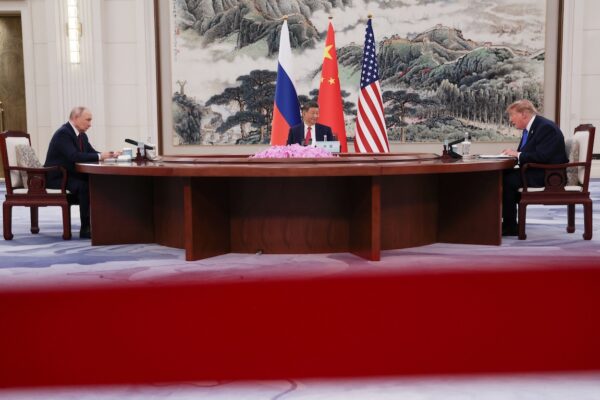
City of London – On 19 November 2026, three of the world’s most influential political leaders met in Shenzhen, China: Chinese President Xi Jinping, US President Donald Trump and Russian President Vladimir Putin.
During their trilateral summit, President Xi referred to a concept that has become increasingly prominent in international relations and strategic studies: the Thucydides Trap.
“The Thucydides Trap is by no means a destiny. How major countries choose to act makes a big difference.”
These words, published by the Chinese Ministry of Foreign Affairs, raise a fundamental question.
Why, in the twenty-first century, does the leader of one of the world’s major powers find it necessary to recall a war fought in ancient Greece more than 2,400 years ago?
And what can that war teach us about the future of international relations?
An ancient war, a contemporary warning
In 431 BC, Athens and Sparta entered a conflict that would last, with interruptions, for twenty-seven years.
Athens was an expanding economic, naval and political power. Sparta was an established military power concerned about the changing balance of influence in the Greek world.
The Athenian historian Thucydides identified a fundamental cause of the conflict: the growth of Athenian power and the fear it generated in Sparta.
The Peloponnesian War ended in 404 BC with the defeat of Athens, leaving much of the Greek world weakened.
More than two millennia later, the relationship between power, fear, perception and political decision-making remains central to international affairs.
Technology has changed. The geographical scale of competition has changed. The consequences of war have changed dramatically.
But have human beings changed sufficiently in the way they manage rivalry and fear?
From ancient Greece to Harvard
The expression “Thucydides Trap” is modern.
It was popularised by Graham Allison, a political scientist at Harvard University, whose 2017 book, Destined for War: Can America and China Escape Thucydides’s Trap?, examined the risks associated with competition between emerging and established powers.
Allison’s research identified sixteen historical confrontations over approximately five centuries. Twelve resulted in war, while four did not.
Much of the international debate has understandably focused on the twelve cases that ended in armed conflict.
I would suggest directing greater attention towards the other four.
What prevented war?
What political decisions, diplomatic initiatives, strategic compromises or particular historical circumstances made a different outcome possible?
These sixteen cases do not constitute a mathematical model capable of predicting the probability of a future war. Nor does the theory establish a universal law of history.
It offers a framework for examining the dangers created by changes in the distribution of power.
The exceptions are therefore as valuable as the recurring pattern.
Four wars that did not happen
Among the cases examined by Allison and his research team, four stand out:
- Portugal and Spain in the late fifteenth century.
- The United Kingdom and the United States in the late nineteenth and early twentieth centuries.
- The United States and the Soviet Union during the Cold War.
- The United Kingdom and France in relation to the rise of reunified Germany in modern Europe.
These cases are profoundly different.
The Iberian rivalry was partly managed through diplomatic negotiations, including the Treaty of Tordesillas in 1494, although its arrangements disregarded the rights of Indigenous populations.
The gradual accommodation between Britain and the United States involved changing strategic priorities and a growing convergence of interests.
During the Cold War, nuclear deterrence, diplomatic communication and arms-control agreements contributed to preventing direct war between the two superpowers, despite devastating proxy conflicts elsewhere.
In Europe, economic interdependence, political integration and shared institutions helped manage profound changes in the continental balance of power.
None of these examples provides a universal formula for peace.
Nevertheless, they demonstrate that structural rivalry does not necessarily determine the final outcome.
A more complex world
The international system of 2026 cannot simply be reduced to a modern version of Athens and Sparta.
Competition between the United States and China extends far beyond conventional military capabilities.
Artificial intelligence, semiconductor manufacturing, critical minerals, energy security, space technology, financial infrastructure and global supply chains have become essential components of national power.
At the same time, Russia, India, the European Union, the expanding BRICS framework and other regional powers contribute to an increasingly complex international landscape.
Countries are economically interconnected while remaining strategically competitive.
They cooperate in some areas and confront one another in others.
This complexity makes historical analogies useful, but potentially misleading when applied without sufficient consideration of contemporary realities.
Perhaps the greatest difference between the ancient Greek world and our own is that a direct confrontation between nuclear powers could threaten far more than the countries immediately involved.
The consequences could extend across continents and generations.
Shenzhen: beyond diplomatic declarations
The significance of the Shenzhen meeting lies not only in the presence of three major powers, but also in the explicit recognition of the dangers associated with confrontation.
According to the official Chinese account, President Xi emphasised mutual respect, peaceful coexistence, cooperation and dialogue.
Yet diplomatic declarations must ultimately be assessed against subsequent actions.
Independent reporting on the summit indicated that the discussions did not produce major immediate breakthroughs.
Several questions therefore remain.
Will new mechanisms for preventing international crises be established?
Will structured negotiations on nuclear arms control resume?
Can military and diplomatic communication channels reduce the risk of miscalculation?
Can economic and technological competition be managed without progressively transforming it into military confrontation?
And what role will Europe and the wider international community play?
Strategic stability cannot be understood exclusively through the interests of three major powers.
The sovereignty, security and aspirations of other nations must also be considered.
The real significance of Shenzhen will become clearer through what follows the meeting, rather than through the meeting itself.
Why do we study wars more than peace?
Throughout our education, we learn about wars.
We study battles, invasions, military alliances, territorial conquests and peace treaties.
We remember the names of generals, the dates of major conflicts and the countries that emerged victorious or defeated.
But how much do we know about the wars humanity has managed to avoid?
How often do we study the diplomatic negotiations that prevented military escalation?
How familiar are we with the individuals who worked behind the scenes to stop an international crisis from becoming a war?
In October 1962, during the Cuban Missile Crisis, the United States and the Soviet Union faced the prospect of nuclear confrontation.
Military deterrence was a central element of that crisis. But communication, confidential negotiations, compromise and political restraint were also instrumental in its resolution.
The absence of war was not the absence of history. It was history shaped by human decisions.
Perhaps our schools, universities and research institutions should devote greater attention to these experiences.
Not simply to understand why wars begin, but to understand how they can be prevented.
Diplomacy as a strategic capability
Governments invest considerable resources in military technologies, intelligence, cybersecurity and the development of advanced defence systems.
These capabilities are regarded as essential components of national security.
Should we not also examine how much attention and resources are devoted to strengthening diplomacy, crisis prevention and international conflict resolution?
Diplomacy should not be regarded merely as an activity conducted after a crisis has emerged.
It is also a strategic capability that can operate before a crisis becomes irreversible.
Understanding the interests, fears and perceptions of other nations does not necessarily mean accepting their political choices.
It means acquiring the knowledge required to manage differences without automatically escalating them.
Diplomacy is not a substitute for security. It is one of its essential components.
History is not destiny
I firmly believe in the importance of diplomacy.
Analysing geopolitical tensions, military developments and possible conflicts does not mean wishing for those scenarios to materialise.
It means attempting to understand the decisions being made today and their potential consequences for future generations.
On 19 November 2026, in Shenzhen, the Chinese president reminded his American and Russian counterparts of a lesson drawn from ancient Greece.
Whether that lesson will influence future political decisions remains to be seen.
More than 2,400 years after Thucydides, humanity possesses technologies that the ancient world could never have imagined.
We are developing artificial intelligence, exploring space and creating increasingly sophisticated instruments of communication.
But have we developed an equally advanced capacity for diplomacy?
And what if the real Thucydides Trap were our belief that history must inevitably repeat itself?
SOURCE
- Chinese Ministry of Foreign Affairs — President Xi Jinping Chairs China-Russia-U.S. Summit, 19 November 2026. fmprc.gov.cn
- Chinese Ministry of Foreign Affairs — President Xi Jinping Meets with U.S. President Donald J. Trump.
fmprc.gov.cn
- Harvard University — The Thucydides’s Trap Case File.
belfercenter.org - Harvard Gazette — Graham Allison’s new book evaluates the U.S.-China face-off.
Harvard Gazette
- Associated Press — Trump, Xi and Putin hold rare 3-way talks on nuclear risks but deliver no breakthroughs.
AP News
Hashtag: #ThucydidesTrap #Geopolitics #Diplomacy #StrategicStudies #InternationalRelations #China #USA #Russia #Peace #ConflictPrevention #ItalyNews