
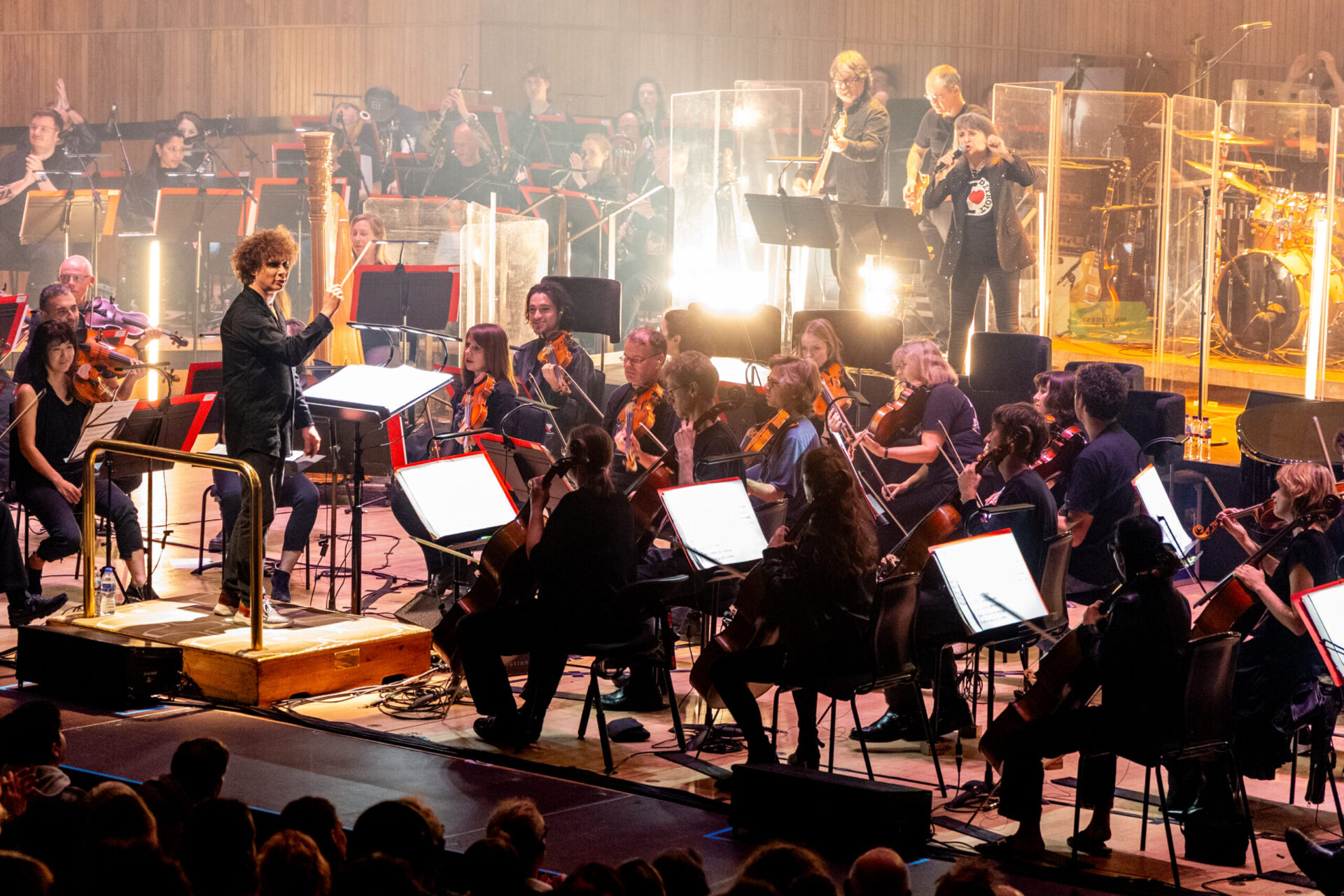
London – On 22 April 2026, Forged in Sound: Heavy Metal Orchestrated took over the Southbank Centre as part of its Multitudes festival, bringing together two musical traditions rarely placed side by side: classical orchestral music and the intensity of rock and heavy metal.
Performed by the Philharmonia Orchestra, a 100-strong ensemble under the direction of Santtu-Matias Rouvali, the concert unfolded as an exploration of scale, sound and physical impact.
The programme moved across a wide repertoire, from Wagner’s Ride of the Valkyries to Mahler’s Adagietto from Symphony No.5, alongside works by Vivaldi, Sibelius and Mosolov. These pieces, already charged with dramatic force, were placed in dialogue with orchestral interpretations of rock and heavy metal, creating a continuous tension between tradition and reinvention.
What emerged most clearly was the shared language between genres. The density of sound, the drive of rhythm and the emotional intensity often associated with heavy metal found clear echoes in the orchestral canon. Rather than feeling like a contrast, the pairing revealed underlying affinities—suggesting that the divide between these musical worlds may be narrower than expected.
Part of the wider Multitudes programme, the performance reflects the Southbank Centre’s broader aim to rethink the orchestral experience through interdisciplinary approaches. The festival positions classical music not as a fixed tradition, but as a form capable of absorbing and responding to contemporary influences.
There is also a notable sense of physical immersion in a concert of this scale. The impact of a large orchestra performing at full intensity creates an experience that extends beyond listening, emphasising sound as something felt as much as heard.
Forged in Sound ultimately resists categorisation. It does not attempt to reconcile classical music and heavy metal into a single form, but instead allows their energies to coexist—highlighting the power, scale and expressive potential that both traditions share.
Within the context of Multitudes, it stands as a clear example of how orchestral music continues to evolve, expanding its boundaries while remaining rooted in its own dramatic force.
To view the programme and book visit: Multitude.