
London – Italy does not end at its borders.
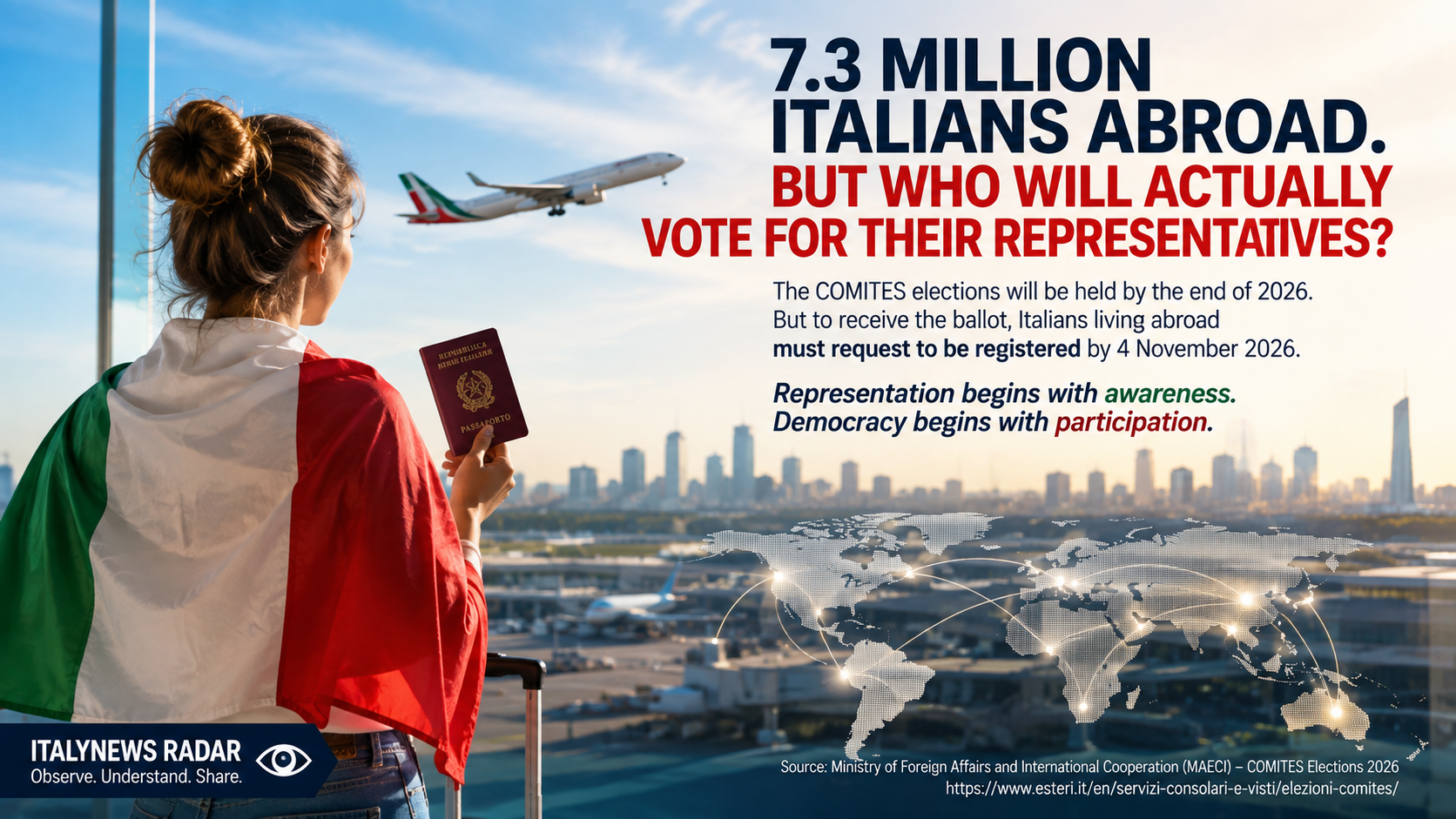
More than 7.3 million Italian citizens now live abroad, according to figures released by Italy’s Ministry of Foreign Affairs and International Cooperation in June 2026.
They are spread across every continent, supported by a network of 176 career consulates and 330 honorary consulates. Argentina, Brazil and Germany host some of the largest Italian communities, while one in six Italians living abroad resides in Latin America.
It is a vast Italy beyond Italy.
An Italy that works, studies, builds businesses, raises families and creates relationships in other countries while maintaining a legal, cultural and often emotional connection with its country of citizenship.
But representation requires something more than numbers.
It requires participation.
And the forthcoming 2026 elections for the COMITES — Committees of Italians Abroad — reveal a rule that deserves much greater public attention.
You do not automatically receive the ballot
The COMITES elections will take place by the end of 2026.
These committees are elected bodies representing Italian communities in their relationship with Italy’s diplomatic and consular authorities and contribute to the integration and needs of Italian communities in the countries where they live.
Voting takes place by post.
But there is an important difference between COMITES elections and Italian parliamentary elections or referendums.
For COMITES, the electoral package is not automatically sent to every eligible voter.
Citizens who meet the legal requirements must first expressly request to be included in the electoral list.
For the 2026 elections, that request must be submitted to the relevant Italian consulate no later than 4 November 2026.
No request, no ballot.
The rule is clearly stated in the official information currently being published by Italian consulates around the world.
It is perfectly legal.
But legality does not make the democratic question disappear.
How many Italians abroad know this?
This is perhaps the question that matters most.
Millions of Italians living abroad may be familiar with AIRE, passports, consular services and elections for the Italian Parliament.
But how many know what a COMITES is?
And among those who do, how many know that receiving the ballot requires an active request?
The distinction is crucial.
In a parliamentary election, an eligible Italian voter abroad normally expects the electoral package to arrive.
In a COMITES election, the citizen must first decide to enter the electoral process.
Participation therefore begins before voting itself.
It begins with information.
The 4% warning
The previous COMITES elections offer a striking example.
In the Oslo consular district in 2021, there were 5,778 eligible voters.
Only 233 requested to participate.
That was approximately 4% of those entitled to vote.
Ultimately, 191 voters participated in the election.
Oslo is only one constituency and should not be treated as representative of every Italian community worldwide.
But precisely because it is a documented case, it raises a legitimate question.
If only a small proportion of eligible citizens enter the electoral process, what exactly are we measuring when we speak about representation?
The legitimacy of the elected representatives is not in question.
The system follows the law.
The question concerns something different:
the breadth of participation on which that representation rests.
A democratic paradox
There is an interesting paradox at the heart of the system.
COMITES exist precisely because Italians abroad need representation.
Distance from Italy creates specific problems: consular services, integration, language and culture, new migration, social needs, education, professional networks and relationships with local institutions.
The committees are intended to help bring those communities closer to the Italian State.
Yet before citizens can choose their representatives, they must already be sufficiently connected to the system to know that an election is happening — and that they must register to participate.
The citizens most distant from Italian institutions may therefore also be those least likely to enter the process designed to represent them.
That is the contradiction worth observing.
From an administrative rule to a democratic question
It would be easy to treat the 4 November deadline as a service announcement:
Remember to register if you want to vote.
It is important information, and Italian diplomatic and consular offices are rightly publishing it.
But the issue deserves another level of analysis.
Why does this opt-in mechanism exist?
How many eligible citizens requested ballots in previous COMITES elections worldwide?
How large are the differences between countries and consular districts?
Does participation change where consulates and COMITES communicate more actively?
Could digital tools reduce the distance between potential voters and their representatives?
And, ultimately:
should representation of Italians abroad depend upon citizens first requesting access to the ballot?
These are not questions against COMITES.
Quite the opposite.
They are questions about how to make representative institutions stronger.
An Italy that has changed
There is another reason this discussion matters.
Italian emigration has changed.
The traditional image of the Italian emigrant no longer captures the complexity of the population living outside the country.
Today’s Italy abroad includes historic communities and new generations, researchers and entrepreneurs, students and pensioners, professionals, families, young graduates and people who may move repeatedly between countries.
At the same time, the scale of Italy beyond its borders has become impossible to regard as marginal.
More than 7.3 million citizens represent a population larger than that of many European countries.
The institutional relationship between Italy and this population therefore cannot be regarded merely as a matter of consular administration.
It is increasingly a question of citizenship, participation and representation.
Representation begins with awareness
Perhaps the first challenge of the 2026 COMITES elections is therefore not convincing Italians abroad whom to vote for.
It is making sure they know that they can vote — and what they must do in order to receive the ballot.
The deadline is 4 November 2026.
There is still time.
But the deeper question will remain even after the votes have been counted.
If millions of citizens live outside Italy, how do we ensure that the institutions created to represent them are connected not merely to those who already participate, but also to those whose voices are rarely heard?
Because democracy does not begin when a ballot is counted.
It begins when a citizen knows that their participation matters.
And representation begins with awareness.
Observe. Understand. Share.