
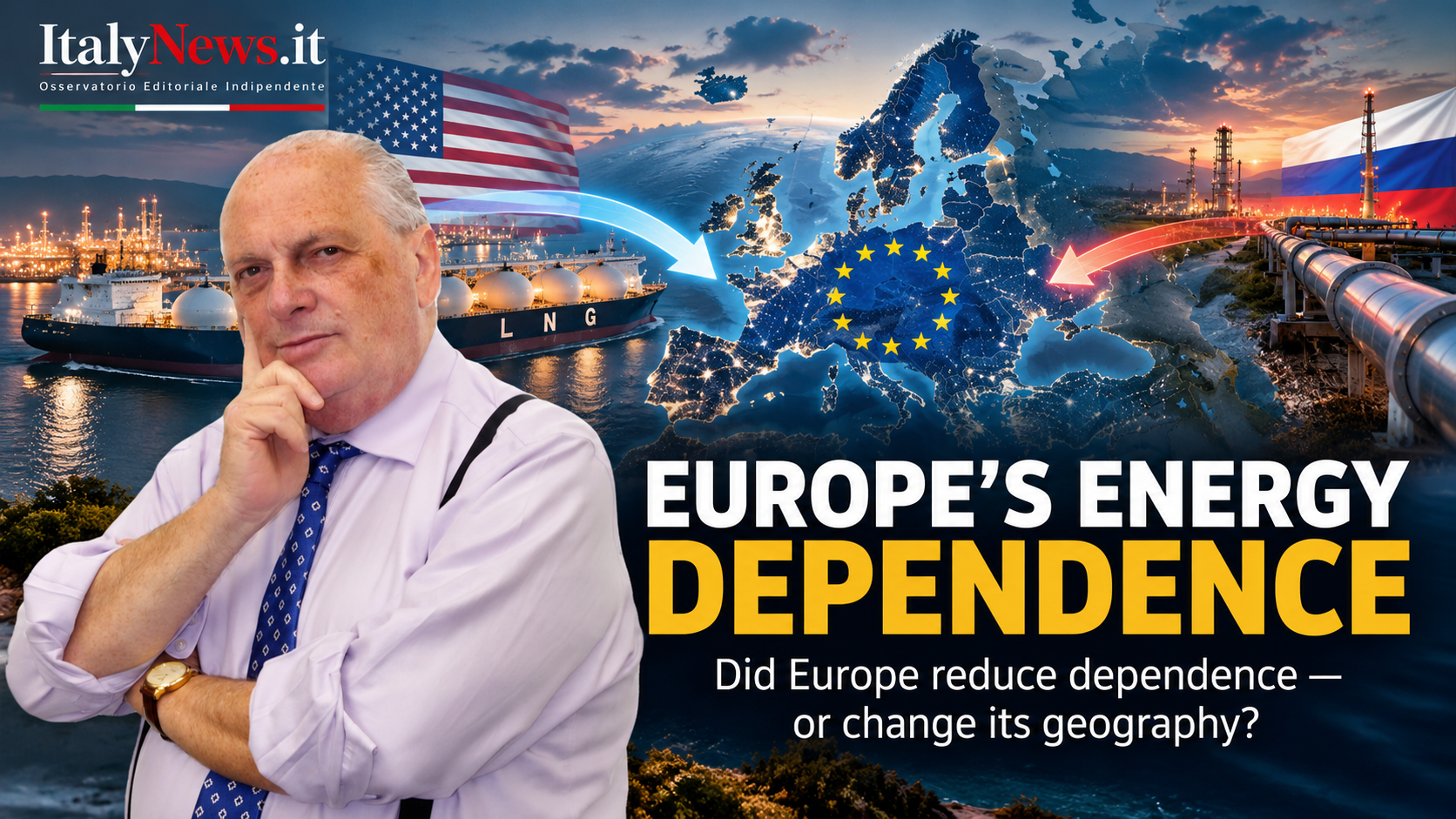
After turning away from Moscow, Europe increasingly relies on the United States for LNG and diesel. Washington’s debate over diesel exports exposes a larger question: diversification is not the same as strategic autonomy.
City of London – Europe learned a painful lesson in 2022: allowing one external energy supplier to become indispensable creates strategic vulnerability.
Four years later, Russian energy dependence has been substantially reduced. But the latest data raise a different question:
Has Europe reduced dependency itself — or mainly changed its geography?
From Moscow to Washington
The transformation has been remarkable. In Q2 2026, the United States supplied 63.2% of EU LNG imports and was also the EU’s largest petroleum-oil supplier, with 18.8%. Russia still accounted for 17.3% of LNG and 10.2% of gaseous natural-gas imports.
| EU energy import indicator | Share | Period |
|---|---|---|
| US share of EU LNG imports | 63.2% | Q2 2026 |
| US share of EU petroleum-oil imports | 18.8% | Q2 2026 |
| US share of EU diesel imports | ~50% | Aug. 2026 |
| Russian share of EU LNG imports | 17.3% | Q2 2026 |
| Russian share of EU gaseous natural-gas imports | 10.2% | Q2 2026 |
The numbers do not imply that the United States has replaced Russia in the same political or strategic sense. It has not. The United States is an ally and a major contributor to Europe’s post-2022 diversification.
But they reveal something else: changing supplier and reducing dependency are not necessarily the same thing.
When American domestic politics reaches Europe
The Trump administration is considering measures to lower high US diesel prices ahead of the November midterm elections. Options under discussion include encouraging foreign stock releases, increasing domestic supplies and potentially restricting US diesel exports. No final decision on export restrictions has been taken.
The EU has expressed concern about possible US export restrictions. At the same time, Washington has urged European countries to draw down emergency diesel inventories to help reduce global prices.
This creates an unusual situation: Europe imports around half its diesel from the United States. Washington is considering ways of limiting exports while simultaneously asking Europe to release some of its own emergency stocks.
What happens when Europe’s energy security becomes exposed to another country’s domestic priorities?
Europe’s three vulnerabilities
| Supply area | Current vulnerability | European exposure |
|---|---|---|
| Russia | War, sanctions and disruption | Traditional supply substantially reduced |
| Middle East | Conflict and maritime chokepoints | Refined products exposed to regional disruption |
| United States | Domestic supply and price decisions | ~50% of EU diesel imports in Aug. 2026 |
| Europe | Limited short-term flexibility | Refineries already running near maximum capacity |
The European Commission said on 29 September that EU oil-product supply remains stable for the time being, but diesel and jet-fuel prices remain high. Commercial stocks at the Amsterdam-Rotterdam-Antwerp hub are below their five-year average, while European refineries are operating near maximum capacity. Emergency stocks remain available.
That is not an immediate supply crisis. It is a warning about resilience.
Dependency does not require hostility
Europe was right to reduce its exposure to Russian energy. But perhaps the deeper lesson of 2022 was not simply do not depend on Russia. It was:
Do not allow any external supplier, route or infrastructure to become indispensable.
| Strategy | What it achieves | What it does not guarantee |
|---|---|---|
| Supplier replacement | Changes where energy comes from | Independence |
| Supplier diversification | Reduces concentration risk | Route security |
| Route diversification | Reduces chokepoint exposure | Domestic capacity |
| Strategic stocks | Buys time during disruption | Long-term supply |
| Domestic capacity, renewables & storage | Reduces external exposure | Complete self-sufficiency |
| System resilience | Allows disruption without crisis | — |
This suggests a different way of measuring European energy diversification.
Not simply:
How many suppliers does Europe have?
But:
What happens if its largest supplier disappears tomorrow?
That question applies whether the supplier is an adversary, a neutral country or an ally. Because dependency does not require hostility. It requires indispensability.
My Observation
Diversification is not the act of replacing one supplier with another. It is the ability to lose one supplier without creating a crisis.
Europe has substantially reduced its Russian energy dependence.
Its next challenge is more difficult: building an energy system resilient enough that no external supplier becomes indispensable.
by Riccardo Cacelli
Observe · Connect · Enable
#EnergySecurity #EuropeanUnion #LNG #EnergyGeopolitics #StrategicAutonomy #EnergyResilience #Geopolitics.
