
Between 13 and 16 May 2026, the inaugural edition of Global Design Forum İstanbul transformed the city into a platform for dialogue between architecture, fashion, technology and urban culture. Organised through Global Design Forum — London Design Festival’s flagship platform for global design discourse — the event was presented in collaboration with People Places Ideas (PPI), with artistic direction by Melek Zeynep Bulut (@peopleplacesideas).
Through talks, discussions and public installations unfolding across some of İstanbul’s most historic locations, the Forum brought together leading voices in contemporary architecture, design and cultural theory.
Developed around the curatorial theme Worlds in Contact, curated by Beatrice Galilee, the Forum explored what happens when different worlds — materially, politically and bodily — collide, and how architecture, fashion, technology and design can respond to movement, impermanence and human experience in an increasingly unstable and interconnected world.
Over two days, architects, designers, artists and cultural thinkers reflected on the future of design beyond objects and aesthetics, expanding the conversation toward ecology, migration, sustainability, memory, AI and public space. Speakers included Tom Dixon, Lina Ghotmeh, Lesley Lokko, Liam Young, Marina Tabassum and Hussein Chalayan.
The programme itself unfolded as an extension of the city. Visitors encountered installations across the Topkapı Palace complex, the Bosphorus-facing grounds of Kabataş High School and the Museum of Turkish and Islamic Arts, transforming İstanbul into a living laboratory for reflection on architecture, temporality and collective experience.
Among the most talked-about installations was Pavilion of the Moment by Waugh Thistleton Architects, created in collaboration with the National Wood Association and TORID. Constructed from slender timber boards of Turkish Pinus Nigra, the pavilion drew inspiration from the geometry of the nearby Hagia Irene, proposing a more sustainable and regenerative vision of architecture grounded in lightness, reflection and impermanence rather than monumentality.
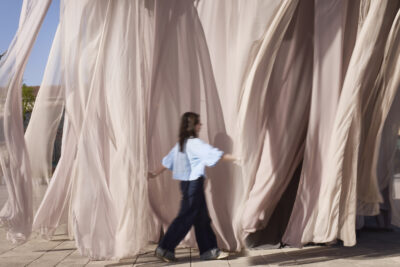
At the Topkapı Palace complex, Yakîn explored architecture through the lens of Islamic mysticism. Designed by YAKIN Kolektif together with Dr. Nil Aynalı, Furkan Türkyılmaz and Muhammed Arif Aksu, the installation used flowing silk curtains to create an immersive inward journey where space became emotional and sensory rather than purely physical.
Meanwhile, Oblique Land by Salon Architects and Alper Derinboğaz transformed the Bosphorus waterfront into an active architectural surface, altering visitors’ perspectives and movement through sharply angled planes inspired by the city’s topography.
Yet among the Forum’s most intellectually resonant moments was the closing keynote by Hussein Chalayan, whose work has consistently occupied the intersection of fashion, technology, art and design with a rigour that few in any discipline can match.
Long regarded as one of the most conceptual voices in contemporary fashion, Chalayan approached clothing not as decoration or commerce, but as a cultural language capable of reflecting displacement, migration, memory, transformation and the emotional architecture of the body itself.
His intervention echoed many of the Forum’s central themes: impermanence, movement, identity and the increasingly fluid boundaries between fashion, architecture and design. Throughout the conversation, Chalayan reflected on the role of fashion as both an aesthetic and political medium, capable of responding to technological acceleration and geopolitical instability while remaining deeply connected to human vulnerability.
What emerged was not simply a discussion about garments or trends, but a wider reflection on how creative disciplines are being reshaped by global movement, AI, cultural hybridity and shifting ideas of belonging.
The significance of Chalayan’s presence felt particularly powerful in İstanbul, a city suspended between continents, histories and identities. His work has long explored transitions between East and West, private memory and public space, technology and emotion. Within the context of Global Design Forum İstanbul, those concerns became part of a broader dialogue about how contemporary design can respond not only to innovation, but also to the psychological and political realities of the present.
Forum Highlights & Speakers
The Forum programme brought together some of the most influential voices in contemporary architecture, design, fashion and cultural theory.
Highlights from Day One included Worlds in Contact with Fernando Laposse, Mireia Luzárraga, James Bridle, Boonserm Premthada and Defne Koz, moderated by Beatrice Galilee; Design of Our Time – Material Worlds featuring Tom Dixon and Lina Ghotmeh; Liam Young’s speculative project Planet City with live soundscapes by Forest Swords; and Designing Design Worlds with Dominique Petit-Frère, Beatrice Leanza, Justine Simons OBE and Sheikha Reem Al-Thani.
The day concluded with the highly anticipated keynote by Hussein Chalayan, moderated by journalist Caroline Roux.
Day Two shifted toward questions surrounding AI, ecology, materiality and identity through conversations including Worlds in Code with Melike Altınışık, Roland Lamb, Ahmad Angawi and Suhair Khan; Nothing New Under the Sun with Olaf Grawert, Ma Yansong and Andrew Waugh; and Identity & Design featuring Professor Lesley Lokko in conversation with Beatrice Galilee.
Other sessions explored craft traditions, ecological systems and food politics through speakers including Samer Yamani, Serap Ekizler Sönmez, Selva Gürdoğan, Jan Boelen and Cooking Sections, before concluding with a closing keynote by architect Marina Tabassum.
Across four days, Global Design Forum İstanbul positioned design not simply as an aesthetic discipline, but as a tool for rethinking how cities, bodies and identities are inhabited and experienced. Through installations, discussions and public encounters, the Forum transformed İstanbul itself into a site of reflection on sustainability, memory, migration and the future of contemporary culture.
The result was less a traditional conference than a citywide conversation about what design can become when it moves beyond permanence, authorship and form — and begins instead to engage with uncertainty, movement and lived human experience.
Follow the editor on instagram @francescalombardo_auhour
Get in touch for reviews or coverage.