London – In April 1991, the UN Security Council adopted Resolution 688, paving the way for a safe haven in Iraqi Kurdistan. It enabled more than 1.5 million displaced Kurds to return from the mountains along Iraq’s borders with Iran and Turkey, where they had fled following Saddam Hussein’s brutal suppression. Establishing the safe haven required a mix of formal and informal diplomacy – formal diplomacy provided legitimacy and an official framework for action, while informal diplomacy helped negotiate practical arrangements and put pressure on governments to act.
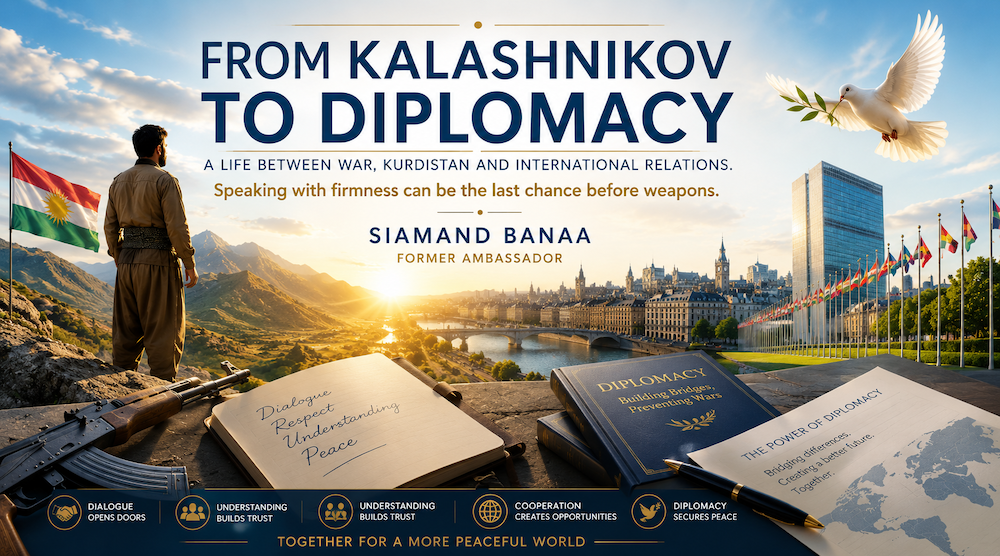
That same year, I was appointed as the Kurdish representative in Turkey. Having spent almost four years as a Peshmerga, a Kurdish soldier, I discarded my AK-47 and Kalashnikov and donned an oversized suit – the only one I could find in the market in the little town of Zakho, close to the Turkish border – and went to Ankara to assume my new role.
So began my journey to becoming a professional diplomat representing the interests of my oppressed people, the Kurds.
It was a precarious task to balance the interests of the Kurds in a country that had denied the very existence of my people, but with the goodwill of some outstanding Turkish diplomats in the foreign ministry and the help of some Western diplomats, I managed to steer through a complicated environment and have productive discussions behind closed doors.
Five years later, I became the High Representative for the Kurdish Regional Government in London, navigating as the unofficial ambassador of an unrecognised and unaccredited region in the Middle East.
Representatives of several Global South states were particularly cautious about engaging with me, reflecting, I suspect, their governments’ reluctance to have official contact with an unrecognised entity that might jeopardise their relations or trade with Arab/Muslim states not well disposed to the Kurdish question.
During my career, I observed that many diplomats from the Global South were appointed on the basis of ideological loyalty to their regimes or through nepotism rather than on professional merit. This made them less inclined to depart from the official line, operating in a more rigid and restrained manner.
Most Western diplomats, by contrast, were generally more willing to meet me informally and entertain conversations outside the confines of formal policy.
Luigi Amaduzzi, Italy’s ambassador to the UK at the time, was instrumental in arranging the return of the remains of five Kurdish refugees who suffocated in an enclosed truck while attempting to cross from Greece. As the KRG did not have any representatives in Italy then, the matter had to be coordinated from London. Ambassador Amaduzzi demonstrated the value of flexibility in diplomacy when official channels were limited.
Many of the conflicts since the Second World War might have been avoided had diplomacy been given more room to work before political leaders settled on a course of action.
Now more than ever, diplomacy requires flexibility: the freedom to engage beyond formal positions, to be creative and to leave room for dialogue where rigid adherence to policy might otherwise close the door.
But flexibility in diplomacy should not be confused with a lack of firmness. A clear position and sustained engagement are not contradictory; they are often most effective when pursued together.
The present US-Iran conflict is, in large part, a consequence of the West’s failure – particularly that of the Europeans – to send Iran’s rulers a clear, unified message about their nuclear programme. For a quarter of a century, intermittent diplomacy and ambiguous statements achieved little and, if anything, encouraged Tehran to capitalise on Western indecision, pursuing its nuclear ambitions and expanding its influence across the Middle East through its proxies.
After decades as a clandestine diplomat, I was appointed as the Ambassador of Iraq to the Netherlands in 2004. Presenting my credentials to Her Majesty Queen Beatrix and discussing archaeology, in which she was exceptionally knowledgeable, was a memorable beginning to my role as an official, accredited diplomat.
Another memorable moment came two years later, when the diplomatic corps in the Netherlands gathered at the Clingendael Institute, a leading centre for diplomacy, to hear Iran’s then Foreign Minister, Manouchehr Mottaki, speak about his country’s nuclear programme.
Departing from the main topic, he then spoke at length about Iraq, undiplomatically blaming the country’s problems on the US. This afforded me the opportunity to respond to him.
I asked Mottaki very directly about Iran’s interference in Iraq and the wisdom of pursuing a nuclear weapons programme despite widespread international opposition. He appeared flustered and struggled to give a coherent response.
A few minutes later, the Iranian ambassador, seated beside him, apologised to the assembly and brought the discussion to an abrupt end.
I was struck by how little the American, British and other European ambassadors pressed him on his claims. Their questions were, at best, lukewarm.
That evening, the international press reported the exchange. A few days later, my minister informed me that Iran had lodged a formal complaint.
Some of my fellow ambassadors told me that I had been too outspoken. I remember defending my position by recalling Clausewitz’s observation that war is merely the continuation of policy by other means.
That was precisely the point: diplomacy is most valuable when diplomats and political leaders have the space to speak frankly, test differences and find a way forward before those differences harden into conflict.
It is better to be clear and firm at the negotiating table than to allow ambiguity and hesitation to do the talking.
The same lesson applies to the war in Ukraine. After Russia’s annexation of Crimea in 2014, European diplomacy made efforts to engage Moscow and Kyiv, notably through the Normandy Format and the Minsk agreements, but these efforts were insufficient to the scale of the danger that was emerging.
Europe had the greatest immediate stake in preventing a wider war on its own doorstep and should have invested far greater diplomatic resources and political attention in that effort. Engagement with Putin needed to remain sustained, direct and ambitious, keeping open every possible avenue through which diplomacy might still have averted a wider conflict.
The principles of modern diplomatic practice, whose development can be traced through the Congress of Vienna and which were subsequently codified in the Vienna Conventions, remain indispensable.
But the practice of diplomacy must evolve with the world it serves. Today’s conflicts require both the authority of formal diplomacy and the flexibility of informal engagement.
Third-party actors are a valuable addition in today’s world to help test ideas, build trust and explore possibilities that may be difficult to pursue through official channels. These are not competing forms of diplomacy, but complementary ones.
If diplomacy is to remain effective in an era of faster-moving crises, hardened positions and increasingly complex alliances, its foundations must be preserved while allowing for greater scope to engage creatively and flexibly.