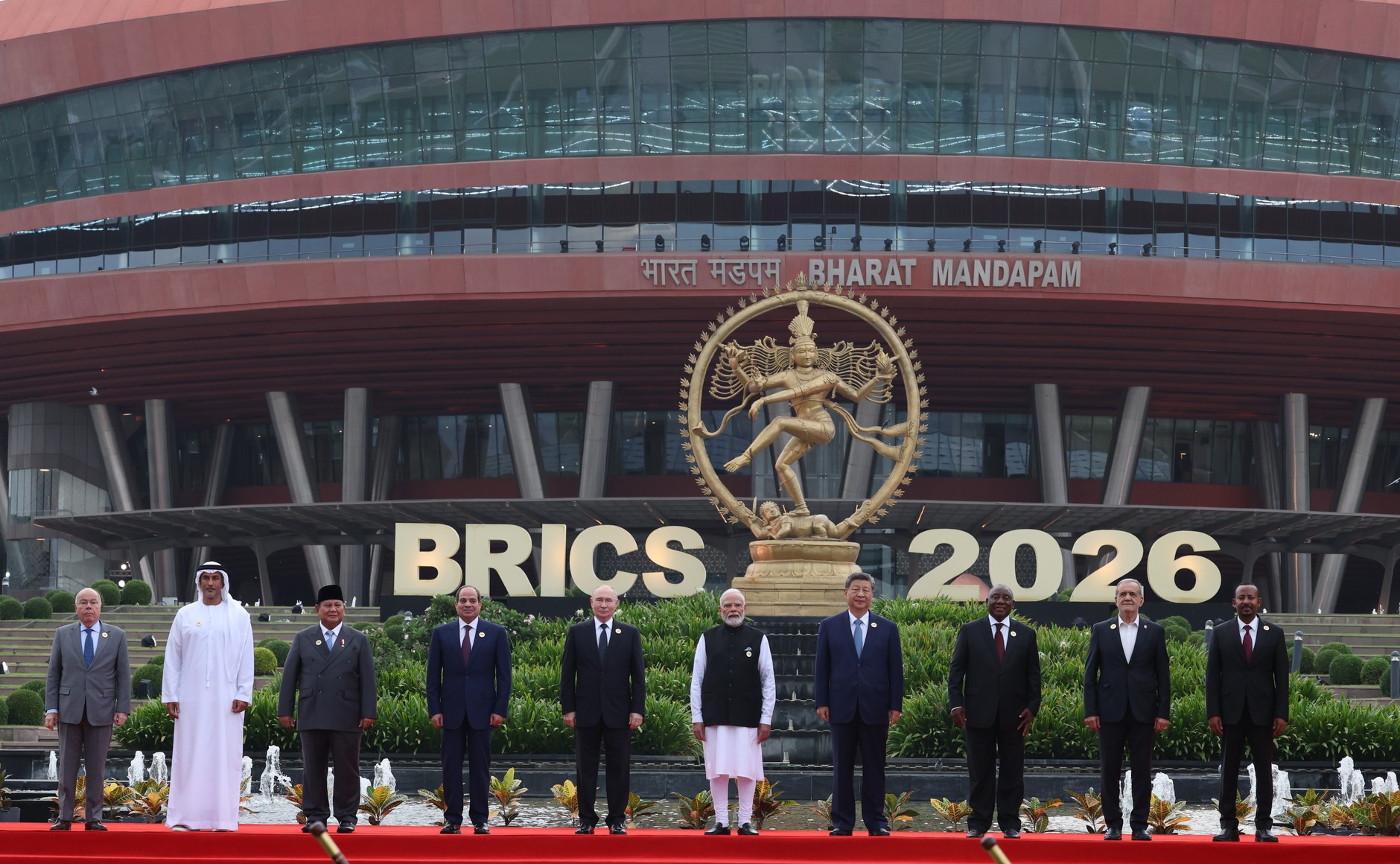
Four billion people, around 31% of the world’s land area, and a grouping that continues to attract new countries. Numbers, data, bilateral meetings, BRICS Pay and the words of its leaders: an evidence-based look at what actually happened in New Delhi.
London – Before listening to the leaders’ declarations, before interpreting the geopolitical implications, and before returning to the familiar narratives about BRICS and the West, there is something simpler we can do.
Look at the numbers.
BRICS today comprises 11 countries according to India’s 2026 Presidency: Brazil, China, Egypt, Ethiopia, India, Indonesia, Iran, Russia, Saudi Arabia, South Africa and the United Arab Emirates.
Using a consistent statistical basis, they account for approximately 4 billion people — close to half of humanity — spread across roughly 46 million square kilometres, or around 31% of the world’s land area.
How much of the world is already inside BRICS?
| Indicator | BRICS | United States | European Union |
|---|---|---|---|
| Countries | 11 | 1 | 27 |
| Population | ≈4.0 bn | ≈342 m | ≈452 m |
| Share of world population | ≈48% | ≈4.1% | ≈5.4% |
| Land area | ≈46 m km² | ≈9.1 m km² | ≈4 m km² |
| Approx. share of world land area | ≈31% | ≈6% | ≈3% |
This table does not tell us who is more powerful.
It does not measure wealth, military capabilities, technological leadership or the quality of institutions. It simply tells us how much of the world we are observing.
That is the first piece of evidence we need before deciding how much weight to give to the words spoken in New Delhi.
1. Representation: the table could become much larger
The 11 current members do not tell the whole story.
BRICS already has 10 Partner Countries: Belarus, Bolivia, Cuba, Kazakhstan, Malaysia, Nigeria, Thailand, Uganda, Uzbekistan and Vietnam. Official BRICS documentation also records a much broader group of countries that have expressed an interest in participating as members or partners.
Precision matters here.
This does not mean that more than 30 countries have submitted formal applications for full membership.
The wider pool has included Algeria, Azerbaijan, Bahrain, Bangladesh, Chad, the Republic of the Congo, Equatorial Guinea, Eritrea, Honduras, Kuwait, Laos, Myanmar, Morocco, Nicaragua, Pakistan, Senegal, South Sudan, Sri Lanka, Palestine, Syria, Türkiye, Venezuela and Zimbabwe, in addition to countries that subsequently became partners or members.
Admission is not automatic. It is a political process requiring agreement among BRICS members.
But we can perform a purely quantitative exercise.
How large could the table become?
| Indicator | BRICS today | BRICS + Partners | Expanded scenario* |
|---|---|---|---|
| Countries | 11 | 21 | 44 |
| Population | ≈4.0 bn | ≈4.6 bn | ≈5.47 bn |
| Share of humanity | ≈48% | ≈55% | ≈66% |
| Land area | ≈46 m km² | ≈52.8 m km² | ≈62.5 m km² |
| Approx. share of world land area | ≈31% | ≈35% | ≈42% |
*The expanded scenario is a purely quantitative exercise based on the documented pool of countries that have expressed interest in the BRICS process. It does not imply that all have formally applied for full membership, nor that they will be admitted.
The number 44 is therefore not a forecast.
But the progression from 11 → 21 → 44 tells us something that is already real: BRICS has developed a capacity to attract other countries.
This is the context in which one of the central ideas heard in New Delhi — representation — should be considered.
Narendra Modi argues that the Global South should move from simply receiving rules to having a greater role in shaping them. The New Delhi Declaration similarly calls for a more representative and equitable international order and a reformed multilateral system.
The question is therefore not whether we agree with that position.
The question is this:
When almost half of humanity is already sitting around the table, can the demand for greater representation simply be ignored?
2. Multipolarity and dialogue: what actually happened in New Delhi?
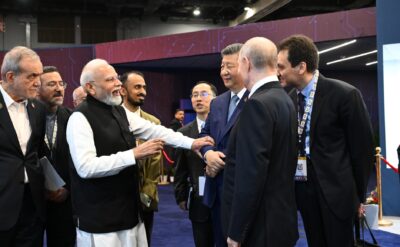
Xi Jinping used another important concept: multipolarity.
Vladimir Putin, meanwhile, also sees BRICS as a mechanism through which participating countries can reduce their dependence on economic and financial structures dominated by the West.
Modi emphasises representation for the Global South.
These are not identical positions.
And that may be precisely the point.
BRICS does not bring together countries with the same political systems, military alliances, strategic interests or views of international conflicts.
New Delhi offered two particularly significant examples.
India and China.
Xi returned to India after seven years. The two countries have a disputed border, experienced deadly military clashes in 2020 and continue to have major strategic differences.
Yet Modi and Xi talked.
Iran and the United Arab Emirates.
Amid the current tensions in the Middle East, Iranian President Masoud Pezeshkian and Abu Dhabi Crown Prince Sheikh Khaled bin Mohamed bin Zayed met on the sidelines of the summit.
Iran and the UAE also subscribed to the same New Delhi Declaration calling for restraint, dialogue, consultation and diplomacy.
This does not mean BRICS has resolved their differences.
It demonstrates something more limited — but verifiable: their differences did not prevent dialogue.
Perhaps this is where we risk using the wrong categories.
We are accustomed to understanding international affairs through blocs, alliances, friends and adversaries. We therefore tend to ask whether BRICS is becoming another bloc opposed to the West.
But what if its defining characteristic is different?
What if the strength of BRICS lies not in bringing together countries that think alike, but in keeping countries that do not think alike around the same table?
3. BRICS Pay: when multipolarity attempts to become infrastructure
This is where BRICS Pay becomes relevant.
The term has attracted very different narratives — from claims about an imminent common BRICS currency to predictions of a payment system that will replace the dollar.
The New Delhi Declaration says something more precise and therefore, perhaps, more interesting.
The leaders instructed finance ministers and central bank governors to continue discussions on the BRICS Cross-Border Payments Initiative, while acknowledging the work of the BRICS Payment Task Force in identifying possible paths towards greater interoperability between BRICS payment systems.
They also welcomed technical work aimed at making cross-border payments faster, less expensive, more accessible, efficient, transparent and secure.
That is what we can verify.
New Delhi did not create a single BRICS currency.
Nor did it announce a unified financial system ready to replace the existing international payment architecture.
What does exist is a concrete process through which countries representing close to half of humanity are exploring ways to make their payment systems more interoperable and facilitate cross-border transactions, including through mechanisms involving local currencies.
That distinction matters.
Saying that “BRICS Pay will replace the dollar” would be a prediction.
Saying that “BRICS Pay is irrelevant” would also be a premature judgement.
Observing the development of alternative infrastructure is analysis.
The real test will come from measurable results: adoption, transaction volumes, participating countries, interoperability, costs and the ability to operate beyond pilot projects.
Multipolarity can remain a political concept.
When it becomes infrastructure, it starts becoming measurable.
4. Was New Delhi a bridge to 2027?
That may be the most important question left by the summit.
We do not know how many new countries will join BRICS.
We do not know whether any will join in the immediate future.
We do not know how quickly alternative payment arrangements will develop.
And we do not know whether the dialogue witnessed in New Delhi will produce concrete diplomatic results.
What we do know is that BRICS today brings together 11 countries, approximately 4 billion people and around 31% of the world’s land area.
We know that another 10 countries already have Partner Country status.
We know that a considerably larger group has expressed interest in moving closer to the organisation.
We know that India and China talked.
We know that Iran and the United Arab Emirates talked.
We know that the members succeeded in adopting a common New Delhi Declaration despite significant geopolitical differences.
And we know that they are attempting to translate at least part of the idea of multipolarity into practical mechanisms, including cross-border payment infrastructure.
None of these facts proves that BRICS will define the future international order.
Nor do they prove the opposite.
But they allow us to ask a question without resorting to propaganda:
Was New Delhi 2026 simply another summit, or was it a bridge towards a new phase of BRICS?
In 2027, we may begin to have an answer.
For now, we have something perhaps more useful:
numbers, facts and a question worth continuing to observe.
Methodological note: India’s 2026 BRICS Presidency and South African government documentation describe BRICS as having 11 full members, including Saudi Arabia. Some international reporting continues to describe Riyadh’s formal membership status differently. For the quantitative analysis above, ItalyNews.it follows the membership perimeter adopted by the 2026 host Presidency while explicitly acknowledging that discrepancy.