
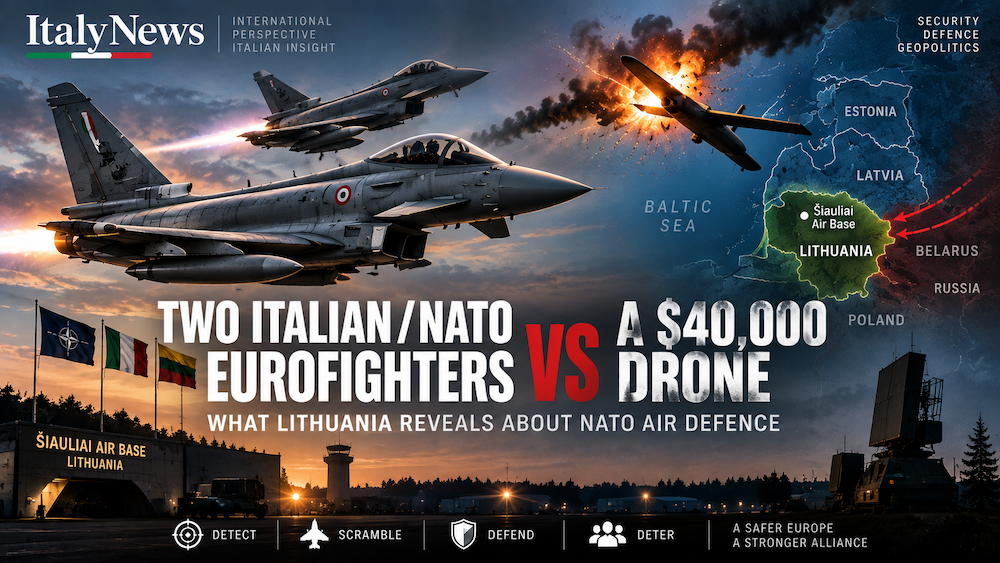
A relatively inexpensive unmanned aircraft triggered two Italian fighters on NATO alert. The incident raises a question that goes well beyond Lithuania: can Europe make the economics of air defence sustainable?
London – Shortly after midnight on 15 September, a drone entered Lithuanian airspace from the direction of Belarus.
Two Italian Air Force Eurofighter F-2000s stationed at Šiauliai Air Base were scrambled under NATO command. They intercepted and neutralised the unmanned aircraft. Italy currently leads the NATO air-defence deployment there with four Eurofighters.
Nobody was reported injured.
But after the military response came the more difficult questions.
Whose drone was it? What did it cost? And how much did it cost to stop it?
What we know — and what we do not
Italian Defence Minister Guido Crosetto said the threat had “most probably” come from Russia. Lithuanian authorities, however, have not yet formally established the drone’s origin.
A Ukrainian military source who examined images of the wreckage told Reuters that it appeared to be a Geran-2, the Russian-produced development of the Iranian Shahed family.
Lithuanian Defence Minister Robertas Kaunas said the drone carried an explosive. The investigation into its origin continues.
That distinction matters.
Until forensic examination establishes the aircraft’s identity and origin, it would be premature to describe it simply as a “Russian drone”.
THE LITHUANIA INCIDENT — WHAT IS VERIFIED
| Question | What we know |
|---|---|
| Where? | Lithuanian airspace, drone entering from the direction of Belarus |
| NATO response | Two Italian Eurofighter F-2000s scrambled |
| Italian deployment | Four Eurofighters at Šiauliai |
| Outcome | Drone intercepted and neutralised |
| Explosive | Confirmed by Lithuanian Defence Minister |
| Drone type | Geran-2 considered likely by a Ukrainian military source examining wreckage images |
| Origin/operator | Not yet officially established by Lithuania |
| Weapon used by Eurofighters | Not publicly disclosed |
Sources: Italian Ministry of Defence, Lithuanian Ministry of National Defence and Reuters.
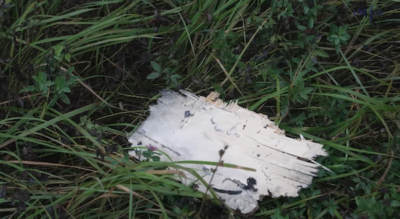
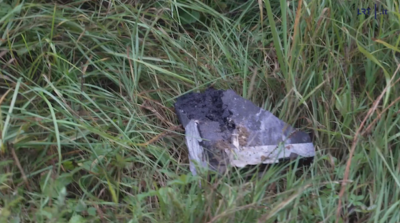
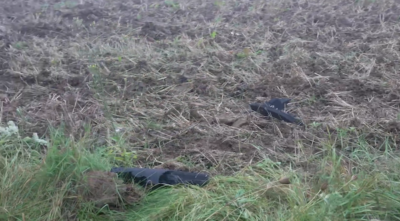
Debris of the drone shot down over Lithuania on 15 September 2026. Lithuanian authorities are examining the wreckage to determine the aircraft’s origin and operator. Source: Lithuanian Armed Forces.
The $40,000 question
If forensic analysis confirms that the aircraft was a Geran-2 or comparable Russian-produced Shahed derivative, another aspect of the incident becomes important: economics.
There is no publicly established production price for the individual drone destroyed over Lithuania.
The Center for Strategic and International Studies estimated the production cost of Russian Shahed models at approximately $35,000 each, according to Reuters. Other configurations and estimates can vary substantially.
So the $40,000 in our headline is an indicative order of magnitude, not the known purchase price of the aircraft destroyed over Lithuania.
And that leads to the other side of the equation.
We know that two Eurofighters were scrambled.
We do not yet know what weapon was used to destroy the drone.
Without that information, any attempt to calculate the exact cost of the interception would be misleading.
A cannon engagement, a short-range missile and a beyond-visual-range missile produce radically different cost equations.
But the weapon is only part of the bill.
The cost starts before the missile
Air defence does not begin when a pilot presses a button.
It begins with aircraft stationed hundreds or thousands of kilometres from their home bases; pilots and ground crews on continuous readiness; maintenance, fuel, logistics, radar coverage, command-and-control systems and NATO infrastructure capable of identifying a threat and ordering an interception within minutes.
Italy’s 2026 parliamentary authorisation for the national air component supporting NATO Air Policing, Air Shielding and allied airspace surveillance provides some sense of that scale.
ITALY’S NATO AIR-DEFENCE DEVICE — 2026
| Authorised resource | 2026 |
|---|---|
| Aircraft | 19 |
| Ground vehicles | 2 |
| Maximum personnel | 387 |
| Financial requirement | €89.06 million |
These figures cover the broader Italian NATO air device for 2026. They are not the cost of the Lithuanian interception and should not be interpreted as such.
That €89 million is nevertheless important.
It tells us that the real economic comparison is not simply:
one drone versus one missile.
It is: a low-cost airborne threat versus an entire high-readiness air-defence architecture.
From Estonia to Romania to Lithuania
The Lithuanian deployment is not an isolated Italian operation.
During 2026 the Italian Air Force has progressively maintained operational fighter deployments along NATO’s eastern flank.
In Romania, for example, approximately 150 Italian Air Force personnel and four Eurofighters operated from Mihail Kogălniceanu Air Base for two months, maintaining Quick Reaction Alert duties. The deployment ended on 31 July; from 1 August, Italy’s eastern-flank commitment continued in Lithuania.
ITALIAN AIR FORCE — SELECTED OPERATIONAL DEPLOYMENTS IN 2026
| Country | Base | Italian Air Force deployment | Aircraft / capability | Status |
|---|---|---|---|---|
| Estonia | Ämari | Baltic Eagle III | Eurofighter / NATO air defence | Completed |
| Romania | Mihail Kogălniceanu | Black Storm III | 4 Eurofighters; ~150 AM personnel | Completed 31 July |
| Lithuania | Šiauliai | Baltic Thunder III | 4 Eurofighters | Active |
| Kuwait | Ali Al Salem / Al Mubarak | TFA Kuwait / Prima Parthica | Eurofighter, KC-767A, Predator | Operational |
| Saudi Arabia / Gulf | King Fahd and regional deployment | Task Force Air Arabia | 4 Eurofighters, E-550A CAEW, C-130J/KC-130J, radar and C-UAS | Active |
The Gulf deployment alone currently comprises approximately 400 Italian Air Force personnel distributed between Saudi Arabia, Kuwait and Bahrain.
This table is deliberately limited to identifiable Italian Air Force operational deployments. It does not include Army, Navy or Carabinieri contingents, nor temporary exercises.
The new economics of air defence
The problem Lithuania has exposed is not uniquely Italian.
Ukraine has already been forced to confront it on an industrial scale.
Instead of routinely matching relatively inexpensive drones with sophisticated surface-to-air missiles, Ukraine has increasingly developed cheaper interceptor drones. Reuters reported this year that some Ukrainian interceptors cost only a few thousand dollars, with the cheapest below $1,500.
The logic is obvious.
If an attacker can repeatedly generate threats costing tens of thousands of dollars while forcing the defender to respond with systems costing orders of magnitude more, the economic asymmetry itself becomes part of the weapon.
That does not mean Lithuania should have allowed the drone to continue flying.
Quite the opposite.
When an unidentified aircraft carrying an explosive enters NATO airspace, the cost of not intercepting it could be incomparably higher than the cost of destroying it.
The question is therefore not whether NATO should defend its airspace.
It is how.
From fighter aircraft to counter-drone architecture
Europe’s next air-defence challenge may consequently be less about acquiring another generation of extraordinarily capable fighter aircraft than about building several layers of defence beneath them.
Detection. Electronic warfare. Counter-UAS systems. Low-cost interceptors. Ground-based air defence.
And finally, when necessary, combat aircraft.
Eurofighters remain essential for threats that require their speed, sensors, weapons and ability to make complex decisions in the air.
But using the most sophisticated layer of the system against every inexpensive unmanned threat would create an economic model that becomes increasingly difficult to sustain if incursions multiply.
Lithuania therefore offers Europe something more important than another airspace incident.
It offers a glimpse of the equation that may define air defence for the next decade:
not simply whether a threat can be destroyed, but whether it can be destroyed at a sustainable cost.
And somewhere between a drone costing perhaps tens of thousands of dollars and two Italian Eurofighters taking off from Šiauliai lies a question Europe can no longer afford to ignore.
Who can sustain the economics of the sky?