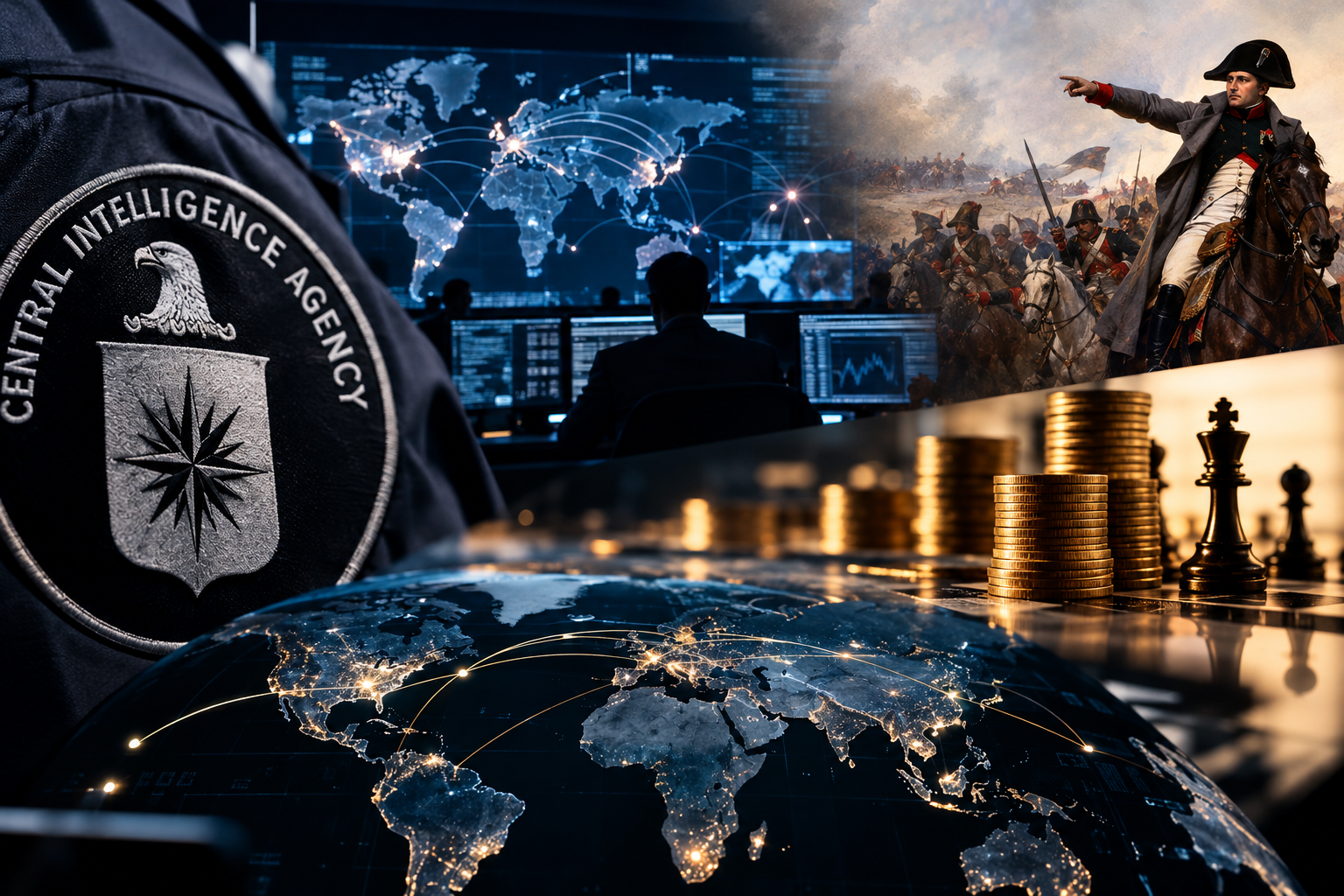
From London’s Royal Exchange to a proposal by former CIA Deputy Director David S. Cohen: two centuries of history reveal how access to timely information can influence economic decisions.
As Washington considers the role of intelligence in commercial competition, Europe faces a fundamental question: are we prepared to understand the changes reshaping the global economy?
A Morning Coffee at the Royal Exchange
Every morning in London, I walk into the Royal Exchange for a coffee.
Today, this historic building in the heart of the City houses luxury shops, restaurants and cafés. Yet its name tells a much older story: one of international trade, merchants, financial transactions and information travelling across continents.
Outside, directly in front of the building and opposite the Bank of England, stands the equestrian statue of the Duke of Wellington.
The statue was unveiled on 18 June 1844, exactly 29 years after the Battle of Waterloo, fought in 1815 and ending in Napoleon Bonaparte’s final defeat.
Within a remarkably small area, three elements that have shaped the history of great powers come together: war, international trade and finance.
Connecting them, both then and now, is the strategic value of information.
Whenever I pass Wellington’s statue, I find myself in a place where British military history meets the history of international markets.
And Waterloo leads us to a particularly revealing story.
Waterloo: The Value of Knowing Before Others
One of the most enduring stories in European financial history emerged from the Battle of Waterloo.
Its central figure was not Wellington but Nathan Mayer Rothschild, a London-based banker whose family had established an extensive international network of financial relationships and communications.
The Rothschild family maintained couriers and trusted associates capable of transmitting information across European borders.
In an era without telephones, radio, the internet or satellite communications, receiving news of a political or military event before others could offer a considerable advantage.
According to a famous account, Rothschild learned of Napoleon’s defeat before other London investors.
The story claims that he then deliberately created the impression that Napoleon had won, prompting investors to sell their securities, before purchasing them at dramatically reduced prices.
However, historical evidence requires us to distinguish documented events from legend.
Research has not substantiated the alleged stock market manipulation. The story gained prominence years later, including through publications hostile to the Rothschild family.
The family’s international communications network, by contrast, was real.
And that is the aspect most relevant to our discussion.
Two centuries ago, timely access to reliable information could already provide a strategic advantage in economic decision-making.
Waterloo also teaches another lesson: information must be verified.
A compelling narrative is not necessarily an accurate account of what happened.
Two hundred years later, communication technologies have changed beyond recognition.
The strategic importance of knowledge has not.
A Proposal from the Former Leadership of American Intelligence
On 14 October 2026, former Central Intelligence Agency Deputy Director David S. Cohen discussed a proposal in an interview with National Public Radio that deserves attention far beyond the United States.
His argument is that American intelligence agencies should be permitted to collect confidential commercial information about foreign companies and, under a regulated framework, share selected intelligence with US businesses to strengthen their international competitiveness.
Cohen had outlined the proposal several days earlier in Foreign Affairs, in an article titled The Case for Economic Espionage.
This was not the announcement of a new official CIA policy or a decision by the US government.
Cohen was expressing his own position, informed by his experience at the highest levels of American intelligence.
Nevertheless, the implications are significant.
For decades, the United States has maintained an important distinction between collecting economic intelligence for national security purposes and using intelligence agencies to provide direct commercial advantages to individual private companies.
Cohen believes that this distinction should now be reconsidered.
When National Security Depends on Private Industry
Cohen’s argument reflects three major transformations.
The first concerns the increasingly close relationship between private industry and national security.
Companies developing artificial intelligence, semiconductors, quantum technologies and advanced computing systems are no longer producing technologies with purely commercial applications.
Their innovations can directly influence military capabilities, critical infrastructure security and a country’s technological position.
The second transformation concerns China.
Competition between Washington and Beijing now extends across scientific research, universities, industrial laboratories, supply chains, critical minerals and international markets.
Cohen argues that China’s technological and industrial advances make it increasingly difficult for the United States to maintain a policy that excludes the use of intelligence to support American commercial competitiveness.
The third transformation concerns the changing role of government in the economy.
The United States has expanded its industrial policy instruments in sectors considered strategically important.
Subsidies, technology restrictions, export controls and interventions in critical supply chains demonstrate that the relationship between markets and national security has already changed.
Cohen proposes extending that transformation to intelligence activities.
Economic Intelligence Is Not Necessarily Industrial Espionage
An important distinction must be made.
Intelligence does not necessarily mean espionage.
Research and analysis can rely on publicly available documents, corporate registers, financial information, institutional sources, knowledgeable individuals and direct observation.
These methods can help governments, companies and investors understand markets, territories, organisations and international developments through lawful and verifiable activities.
That is fundamentally different from a government intelligence service obtaining protected commercial information and transferring it to a domestic company to provide a competitive advantage.
This is the policy change Cohen is inviting Washington to consider.
The distinction concerns the legality of intelligence activities, the intended recipients of information, the interests being protected and the accountability of the institutions involved.
Who Decides Which Companies Receive Intelligence?
Cohen acknowledges that his proposal raises significant risks.
If American intelligence agencies were authorised to collect confidential information for the benefit of private businesses, who would select the beneficiaries?
Major multinational technology companies?
Businesses already involved in defence programmes?
Emerging companies developing strategically important technologies?
And what criteria would prevent political favouritism, conflicts of interest or corruption?
To address such concerns, Cohen proposes a framework involving the President and Congress, with rules governing the circumstances in which commercial intelligence could be shared.
Yet a fundamental question remains.
When a government selects private companies that may benefit from information collected by its intelligence agencies, where does the protection of national interests end and preferential commercial treatment begin?
This is not merely an intelligence question.
It concerns the relationship between public authority, competition and democratic accountability.
What About Europe?
Cohen’s proposal emerges primarily from the technological competition between the United States and China.
However, it would be a mistake to regard the issue as exclusively bilateral.
European companies compete with American businesses across numerous strategic industries, including aerospace, defence, pharmaceuticals, energy, digital technologies, industrial automation and semiconductors.
A European company may simultaneously be a strategic partner of the United States, a supplier to American infrastructure projects and a commercial competitor of a US corporation.
NATO membership does not eliminate economic competition.
Nor does cooperation on national security necessarily mean that industrial and commercial interests are identical.
It is therefore reasonable to ask what the adoption of Cohen’s proposal might mean for European businesses.
Would companies based in allied countries be excluded from commercial intelligence collection?
Would specific safeguards apply?
What protections could the European Union establish?
There is no basis for claiming that the CIA has already been authorised to transfer European industrial secrets to American companies under the policy Cohen proposes.
But there is now a public proposal that makes these questions worth examining.
The European Union has already begun developing its approach to economic security, identifying risks involving supply chains, critical technologies, infrastructure and the potential weaponisation of economic dependencies.
The European Economic Security Strategy, presented by the European Commission and the High Representative in June 2023, provides an important institutional reference.
Yet the central question remains:
Does Europe possess the analytical capacity, strategic awareness and institutional responsiveness needed to anticipate changes in the international economic environment?
The World Factbook Paradox: When the CIA Shared Knowledge with Everyone
For decades, the CIA made The World Factbook freely available to the public.
It became one of the best-known international reference sources for geographical, demographic, economic, energy-related and institutional information.
I personally used this resource in my professional activities, appreciating its organisation, the breadth of its information and the opportunity to examine and compare data concerning countries and territories around the world.
It was a valuable source of knowledge accessible to researchers, journalists, professionals, entrepreneurs and ordinary citizens.
In February 2026, the CIA announced the closure of The World Factbook.
The decision deserves reflection.
At a time when the United States is debating whether intelligence agencies should be allowed to provide confidential economic information to selected private companies, a longstanding public resource that helped people understand international economic conditions has been discontinued.
There is no evidence of a direct connection between these two developments.
Nevertheless, the contrast raises an important question.
In a world where economic and geopolitical knowledge is becoming increasingly strategic, should access to reliable, publicly available information be expanding rather than contracting?
Information should not be regarded exclusively as a competitive advantage reserved for a privileged few.
It is also an essential resource enabling societies, businesses and individuals to understand developments and make informed decisions.
The Strategic Risks of an Inward-Looking Information Culture
This debate leads to a broader consideration.
Too often, national and European public discussions focus on the immediate consequences of events without paying sufficient attention to the international processes that produced them.
A decision taken in Washington can affect an Italian company.
An industrial strategy developed in Beijing can reshape the prospects of an entire European manufacturing sector.
An agreement concerning critical minerals in Africa, an economic transformation in the Gulf or a technological breakthrough in Asia can influence investment, employment and competitiveness long before its implications become widely understood.
Europe must overcome an inward-looking approach to international information.
We need to look beyond the Mediterranean, beyond the Atlantic and beyond the Pacific.
This does not mean abandoning national identities or interests.
It means recognising that those interests are increasingly influenced by decisions and developments taking place far beyond our borders.
Geographical distance does not necessarily mean economic distance.
And timely access to information can become an essential component of strategic decision-making.
Knowing that something has happened is not enough.
We must understand where the information originated, assess its reliability, identify the interests involved and evaluate its potential consequences.
Being informed in time does not simply mean knowing what happened before everyone else. It means understanding what is changing before those changes begin to shape our decisions.
When Information Arrives Too Late
Economic and political history contains countless examples of decisions made on the basis of incomplete information, mistaken interpretations or assessments that were already outdated.
Today, the speed of technological and economic change makes this challenge even more significant.
A company may lose competitiveness not because of a manufacturing failure but because it failed to recognise a transformation in its supply chain.
An investor may underestimate a risk by focusing exclusively on financial indicators while overlooking the political and territorial environment.
A government may intervene only after an industrial transformation is already well advanced, leaving fewer options available.
The volume of information available does not automatically guarantee better understanding.
Indeed, the multiplication of information sources can make it increasingly difficult to distinguish what is genuinely relevant from what is merely attracting attention.
That is why the quality of analysis matters just as much as the speed at which information is collected.
A Transformation That Concerns Everyone
David S. Cohen’s proposal is not currently an official American policy.
It may be adopted, modified or rejected.
Nevertheless, the debate it has opened deserves attention because it reflects an increasingly close relationship between national security, technology, industry and international competition.
For governments, understanding the economic and technological capabilities of other countries is becoming strategically important.
For businesses, recognising international changes in time can make the difference between a sustainable investment and a decision with damaging consequences.
For citizens, access to reliable information is essential to understanding the political and economic choices that affect their lives.
And for Europe, perhaps the most important question is not simply what the United States will decide.
It is whether we will be capable of understanding those decisions, evaluating their consequences and developing our own responses before it is too late.
Tomorrow morning, when I return to the Royal Exchange for my coffee, I will once again walk past Wellington’s statue.
More than two centuries have passed since Waterloo.
Horseback couriers have given way to satellite communications, artificial intelligence and global digital networks.
Yet one question continues to connect those two centuries.
Who knows the facts? Who knows them first? And who has the tools to understand them before making a decision?
The world does not begin at our borders.
And the decisions shaping our future are not made only close to home.
Sources and References
- David S. Cohen, The Case for Economic Espionage, Foreign Affairs, 8 October 2026.
https://www.foreignaffairs.com/united-states/case-economic-espionage-david-cohen - National Public Radio, interview with David S. Cohen, 14 October 2026.
https://www.npr.org/2026/10/14/nx-s1-5996830/why-should-the-cia-should-spy-on-companies-abroad - Brian Cathcart, Nathan Rothschild and the Battle of Waterloo, Rothschild Archive.
https://www.rothschildarchive.org/materials/nathan_and_waterloo.pdf - Fondation Napoléon, historical examination of the Rothschild Waterloo stock market legend.
- Central Intelligence Agency, announcement concerning the closure of The World Factbook, February 2026.
- European Commission and High Representative of the Union for Foreign Affairs and Security Policy, European Economic Security Strategy, 20 June 2023.
https://eur-lex.europa.eu/legal-content/EN/TXT/?uri=CELEX:52023JC0020 - Central Intelligence Agency, remarks by Director Mike Pompeo at the University of Texas at Austin National Security Forum, 12 October 2017.
Coming Next on ItalyNews.it
Strategic Intelligence: The Value of Information in Economic and Industrial Decision-Making
From Open Source Intelligence (OSINT) to Human Intelligence (HUMINT) and Field Intelligence: how timely, reliable information can support better-informed decisions by businesses, professionals and investors.
ItalyNews.it — Observe • Understand • Share
#ItalyNews #CIA #EconomicIntelligence #StrategicIntelligence #EconomicEspionage #Geopolitics #DavidSCohen #Waterloo #Wellington #RoyalExchange #BankOfEngland #NathanRothschild #EconomicSecurity #BusinessIntelligence #OSINT #GlobalEconomy #USChinaRelations #EuropeanUnion #InformationMatters #DecisionMaking