London – A person can cross Europe in a few hours.
A passport travels with them.
A smartphone travels with them.
Their bank cards work in another country.
Their identity can increasingly be verified digitally.
But if that person suddenly needs medical treatment, something surprisingly important may not have made the journey with them: their trusted health information.
Vaccination records, essential medical information, prescriptions and other health credentials remain fragmented between institutions, systems and countries.
The World Health Organization describes the problem very simply: when people move between clinics, districts or countries, their health information rarely moves with them.
That may be beginning to change.
Quietly, an infrastructure is being built that could eventually make verified health information more portable across borders.
Its name is the Global Digital Health Certification Network — GDHCN.
And it deserves much more attention.
From the Covid certificate to global digital infrastructure
The origins of the network lie partly in one of the most controversial and extraordinary periods in recent history.
During the Covid-19 pandemic, countries needed a way to verify vaccination and testing certificates across borders.
Europe developed the EU Digital Covid Certificate infrastructure, eventually extending its reach beyond the European Union.
When the emergency faded, the infrastructure did not simply disappear.
WHO took lessons and technical experience from that system and used them as the foundation for something broader.
The GDHCN was launched as an open and interoperable digital public infrastructure capable of allowing participating countries and organisations to verify digital health credentials issued elsewhere.
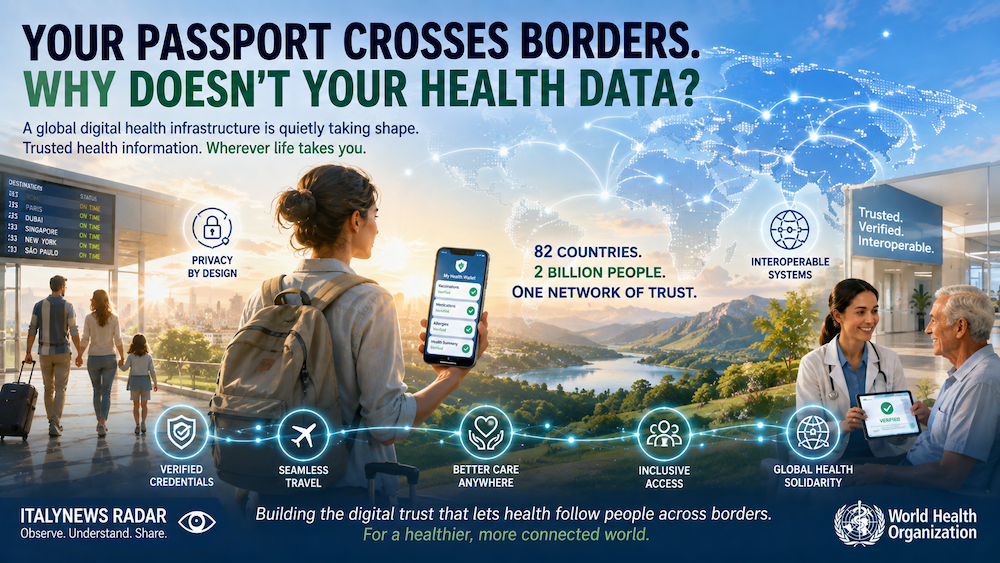
By May 2026, WHO said the network had expanded to 82 countries and around 2 billion people.
That number alone should make us stop and look more closely.
Because this is no longer merely a pandemic technology.
It is becoming infrastructure.
What exactly is being built?
The distinction is essential.
WHO is not building a giant global database containing everyone’s medical records.
According to WHO, it does not hold or have access to the underlying personal health data exchanged through the system.
Instead, the architecture is based on trust.
Participating authorities provide cryptographic public keys that allow other participants to verify whether a digitally signed health credential was genuinely issued by a recognised authority.
WHO acts as what it calls a “trust anchor.”
Think of the difference this way.
The system does not necessarily need to know what your health record says.
It needs to make it possible for an authorised party to establish that the credential you present is authentic.
That is a very different architecture.
And it is precisely why the word trust may ultimately be more important than the word data.
The health wallet
The next step is already being discussed.
At the Global Digital Collaboration Conference taking place on 1–2 September 2026, WHO and its partners are examining the development of secure, portable and trusted digital health wallets.
The ambition is straightforward but profound:
allow individuals to securely hold and share verified health information when moving between healthcare facilities — and potentially between countries.
WHO says its existing GDHCN already connects more than 80 countries and nearly 2 billion people.
The challenge now is moving from certificates toward practical, interoperable health wallets.
That could eventually transform something we currently take for granted:
the fact that our medical information often stops at the border even when we do not.
Imagine the traveller
Consider a simple situation.
An Italian citizen travels to another country and suffers a medical emergency.
The physician treating that patient may know almost nothing about them.
What medications are they taking?
What vaccinations have they received?
Is a particular medical document genuine?
Is a prescription authentic?
What relevant information has another healthcare provider already recorded?
Today, answering such questions across different healthcare systems can be slow, fragmented or impossible.
A trusted digital health infrastructure could change that.
Not by creating one enormous global medical record, but by allowing health systems to recognise and verify information issued by other trusted health systems.
The difference could become particularly important for travellers, migrants, people with chronic conditions, displaced populations and those requiring continuity of care across borders.
Migration makes the question even bigger
In March 2026, the International Organization for Migration became the first international organisation to join the GDHCN.
That development deserves attention.
Migrants and displaced people are precisely among those most likely to move between jurisdictions while experiencing fragmented access to healthcare.
Portable and verifiable health information could therefore become more than a convenience.
It could become part of humanitarian infrastructure.
WHO and IOM explicitly describe the objective in terms of continuity of care, privacy, dignity and access to reliable health information across borders.
Once again, the technology is only part of the story.
The deeper issue is mobility.
People move. Health systems remain territorial.
Digital infrastructure may begin to bridge that gap.
From vaccination to prescriptions — and beyond
The potential uses are already expanding.
WHO identifies possible applications including digital vaccination certificates, cross-border prescription verification, International Patient Summaries and certification of health professionals.
A separate three-year initiative launched in Southeast Asia in March is testing digital health wallets beginning with digital vaccination certificates before potentially expanding into routine immunisation records, maternal and child health information and broader personal health summaries.
This is where the story becomes much larger than Covid.
The infrastructure created to solve an emergency verification problem may be evolving into a foundation for cross-border continuity of healthcare.
That is a significant transformation.
But infrastructure creates governance
Every infrastructure that creates convenience also creates questions.
Who determines which credentials are recognised?
Who decides which institutions are trusted issuers?
Who establishes interoperability standards?
What happens when national privacy laws differ?
Who can revoke a credential?
What happens if a digital identity is compromised?
How much information should a health wallet contain?
Who controls access?
And perhaps most importantly:
how do we make health information portable without making individuals transparent?
WHO’s architecture already provides one important answer: the organisation says it does not hold the underlying patient data.
But decentralisation does not eliminate the need for governance.
It changes the governance problem.
Instead of asking who owns one global database, we must ask:
Who governs the trust between many different databases, authorities and countries?
The lesson of the passport
There is an interesting historical parallel.
A passport works internationally not because every country uses the same database.
It works because governments recognise documents issued by other trusted authorities according to shared standards.
The document travels with the person.
The trust travels with the document.
Digital health may be moving toward a similar principle.
Different countries can retain their healthcare systems.
Different institutions can retain their records.
Patients can retain greater control over their information.
But a common trust infrastructure can potentially allow one system to recognise what another system has issued.
If that works at scale, the consequences could be substantial.
The question we should be asking
The debate around digital health often concentrates on apps, electronic medical records and artificial intelligence.
All are important.
But beneath them something less visible may be taking shape:
the infrastructure that allows health information to become trustworthy beyond the institution — or country — where it was created.
That is why perhaps we should stop asking only:
“When will all our medical records become digital?”
And start asking:
“When our health information crosses a border, who will guarantee that it can be trusted?”
The answer will require technology.
But it will also require standards, governance, privacy protections, political cooperation and public confidence.
The Global Digital Health Certification Network may therefore be important not because it creates a global health database.
It does not.
Its importance may lie in something more subtle:
it is beginning to create a global language of digital health trust.
Our passports learned to cross borders a long time ago.
Perhaps our health information is finally beginning to learn how to follow us.
Observe. Understand. Share.
SOURCE:
– Global Digital Health Certification Network
– WHO Director-General’s address to Member States at the 79th World Health Assembly – 19 May 2026
– WHO Director-General’s address to Member States at the 79th World Health Assembly – 19 May 2026