
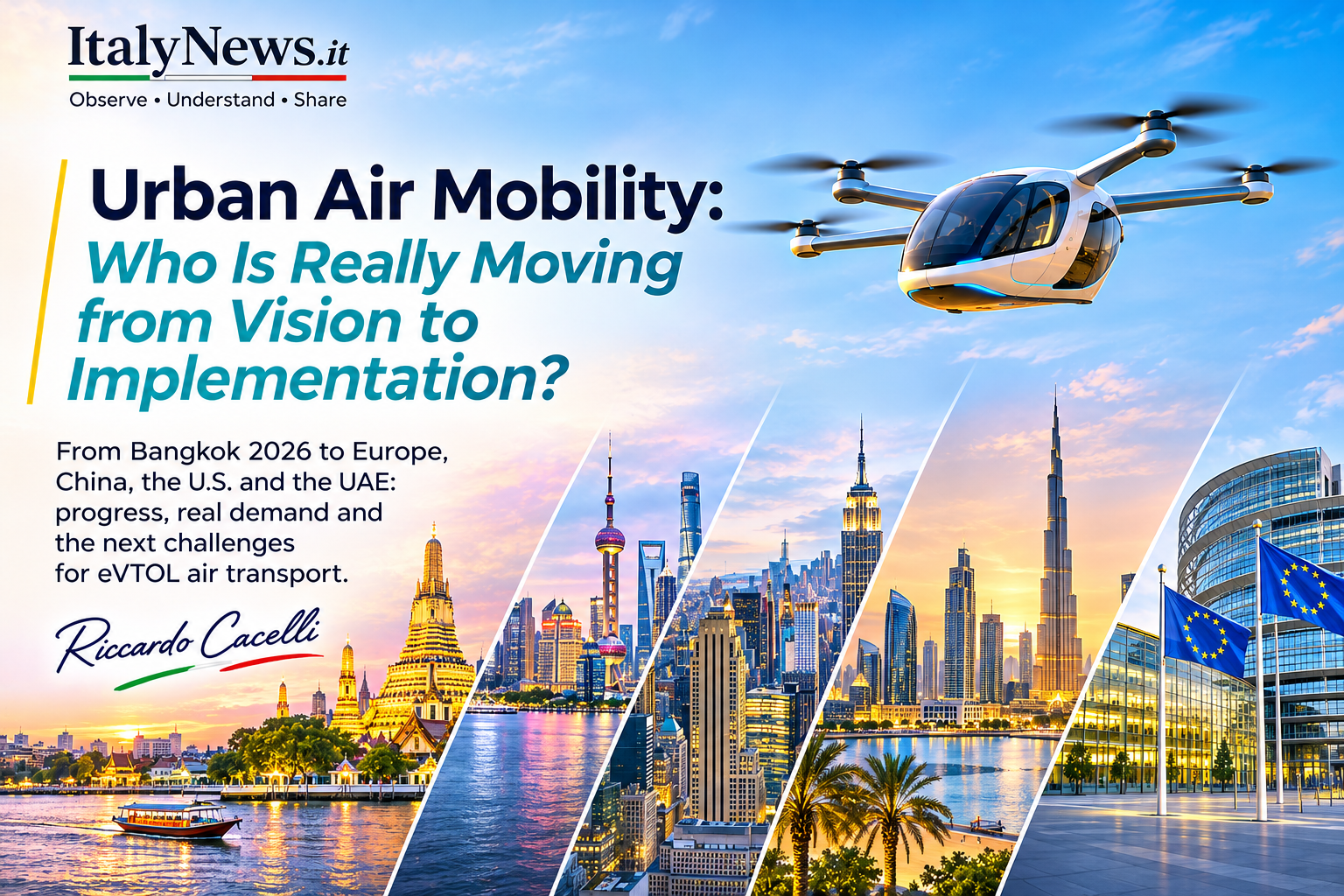
Ahead of ICAO’s 2026 Global Symposium in Bangkok, an international perspective on technological progress, urban planning, investment risks and the challenge of turning eVTOL aircraft into viable local transport services.
City of London – The world of Advanced Air Mobility is preparing for another important international gathering.
From December 1 to 3, 2026, Bangkok will host the second Global Advanced Air Mobility Symposium organised by the International Civil Aviation Organization (ICAO), under the theme From Vision to Implementation: Enabling the AAM Ecosystem.
Two years after the first symposium in Montréal, the choice of theme raises an unavoidable question: how much has actually changed?
Over the past few years, the industry has witnessed a succession of technological announcements, investment commitments, demonstration flights, certification programmes and ambitious infrastructure projects.
But how many of these developments have become services that people can actually use?
For Urban Air Mobility (UAM), this distinction is particularly important.
We are not discussing long-distance aviation or simply the introduction of electric vertical take-off and landing aircraft.
We are considering whether a new form of air transport can become a meaningful component of local mobility systems, complementing existing rail, road, maritime and public transport networks.
Connections between urban centres and railway stations, ports, strategically located road transport hubs or territories with limited accessibility may offer interesting opportunities.
But none of these connections should be considered necessary before their demand, costs and benefits have been examined.
The fundamental question is not where an eVTOL aircraft could land.
It is where, why and for whom such a service would make sense.
China: From Certification to Commercial Operations
China has achieved some of the most significant regulatory and operational milestones in the development of electric vertical take-off and landing aircraft.
In October 2023, the Civil Aviation Administration of China (CAAC) granted type certification to EHang’s EH216-S autonomous passenger aircraft.
Production certification followed in 2024.
In March 2025, two operators received authorisations enabling commercial passenger-carrying operations with this aircraft type.
These are tangible achievements, not merely industrial announcements.
However, the initial commercial activities have largely focused on aerial sightseeing and tourism.
Their evolution into regular urban transport networks represents a different challenge.
A sightseeing flight demonstrates that an aircraft can carry paying passengers under an authorised operational framework.
An urban mobility network must demonstrate something more: the ability to connect different locations with sufficient frequency, reliability, capacity and pricing to serve sustained transport demand.
China has made substantial progress in aircraft certification and operational authorisation. The next challenge is demonstrating how those achievements can support viable local transport networks.
For international investors, the distinction matters.
Technological and regulatory leadership does not automatically translate into commercial sustainability.
Asia: Different Strategies, Similar Questions
Asia cannot be described as a single Urban Air Mobility market.
Japan and South Korea have pursued their own programmes involving technology development, demonstration activities, regulatory preparation and potential commercial applications.
Thailand, meanwhile, is positioning itself as a venue for international cooperation through the upcoming ICAO symposium.
Central Asia offers another perspective.
In Kazakhstan, the Alatau City development raises an interesting question about the relationship between urban planning and emerging transport technologies.
As previously examined by ItalyNews.it, the possibility of considering future air mobility infrastructure while planning a new city differs significantly from introducing vertiports into established metropolitan environments.
Existing cities must accommodate new infrastructure alongside railway networks, roads, residential areas, commercial districts and urban planning restrictions.
A newly planned city may have greater flexibility.
But that advantage does not eliminate commercial uncertainty.
Even when a city is designed to accommodate future eVTOL operations, the proposed services must still demonstrate that passengers will use them, that they offer meaningful benefits and that their operating costs can be sustained.
Planning a network is not the same as demonstrating that a market exists for it.
The various Asian initiatives therefore illustrate different stages of technological, regulatory and territorial development rather than a uniform continental lead.
United Arab Emirates: Urban Air Mobility Confronts the Reality of War
Dubai represents one of the most closely watched international initiatives in the development of Urban Air Mobility infrastructure.
Its planned electric air taxi network, involving the Roads and Transport Authority, Joby Aviation and Skyports Infrastructure, aims to establish vertiports serving important destinations across the city.
However, 2026 has introduced a factor that cannot be ignored in any serious investment assessment: geopolitical conflict.
The United Arab Emirates has experienced direct consequences of the conflict involving Iran, the United States and Israel.
Iranian missile and drone attacks, including incidents involving intercepted projectiles and falling debris, affected buildings and infrastructure in the Emirates.
Airport operations were disrupted, while parts of the hospitality and tourism sectors experienced significant pressure.
Some hotels sustained damage, although not every hotel closure reported during the period was directly caused by military attacks. Several properties also undertook renovation programmes.
This distinction matters.
Nevertheless, the broader consequences for aviation, tourism and investor confidence raise questions extending well beyond conventional commercial forecasts.
How can an urban eVTOL network maintain operational continuity when airspace restrictions may be imposed with little warning?
What happens to passenger demand when international tourism declines sharply?
How should investors evaluate insurance costs, operational interruptions and infrastructure exposure to geopolitical instability?
These questions are especially relevant when proposed services depend partly on airport passengers, luxury hospitality and visitors.
There is insufficient evidence to conclude that the conflict has made Dubai’s UAM programme commercially unviable.
Indeed, the development of vertiport infrastructure and regulatory approvals has continued during 2026.
But the situation demonstrates that the maturity of an Urban Air Mobility ecosystem cannot be assessed solely through aircraft, infrastructure and certification milestones.
Operational resilience, airspace security and the ability to withstand external shocks must also form part of the assessment.
For international investors, Dubai offers a particularly revealing case: an ambitious urban air transport initiative developing in an environment where geopolitical events have directly affected aviation and tourism.
The question is no longer simply when commercial operations will begin.
It is also how resilient the resulting transport system will be.
United States: From Regulation to Market Development
In the United States, the Federal Aviation Administration (FAA) adopted a significant regulatory framework for powered-lift aircraft in 2024.
The rules established an important foundation for pilot qualifications and the operation of this emerging aircraft category.
Meanwhile, American manufacturers and prospective operators have continued working towards certification and commercial deployment.
These developments represent important progress.
But regulatory readiness does not necessarily establish market readiness.
An aircraft certificate does not guarantee a transport service.
An authorised service does not guarantee sufficient demand.
And potential demand does not guarantee profitability.
For the United States, as elsewhere, the decisive challenge will be demonstrating that proposed air connections provide measurable advantages over existing alternatives.
A shorter flight time does not necessarily mean a shorter journey.
Passengers must reach the departure vertiport, complete the necessary procedures, board the aircraft and travel onwards from the destination vertiport.
The entire journey must be considered.
This is particularly important in metropolitan regions where railways, roads and other transport services already provide extensive connectivity.
An eVTOL may travel quickly between two points, but its commercial value depends on the complete passenger experience.
Europe: Regulation Meets Urban Complexity
Europe has devoted considerable attention to establishing a common regulatory framework for innovative air mobility.
The European Union Aviation Safety Agency (EASA) has developed technical specifications for vertiports and regulatory provisions addressing operations involving new aircraft categories.
This work is essential for safety, consistency and the future integration of eVTOL operations into European airspace.
Yet infrastructure development presents challenges that aviation regulation alone cannot resolve.
European cities frequently possess extensive railway, metro, tram, road and maritime transport networks.
In such environments, Urban Air Mobility should be evaluated as a possible complement to existing services rather than an automatic replacement for them.
The objective should not be to place vertiports in every major city.
It should be to identify specific connections where air transport could provide a demonstrable benefit.
That requires territorial analysis, demand assessment, intermodal planning and comparison with existing alternatives.
Some locations may justify investment in UAM infrastructure.
Others may benefit more from improvements to railway services, road connections or conventional public transport.
Deciding not to build a vertiport can also be the outcome of sound transport planning.
This is not a rejection of innovation.
It is a recognition that investment decisions should be guided by evidence rather than technological enthusiasm.
Italy: Sustainable Urban Mobility Plans and the Challenge of Integration
Italy provides an interesting example of a broader European planning challenge.
In May 2026, the Italian Civil Aviation Authority, ENAC, published a draft update of its National Strategic Plan for Advanced Air Mobility covering the period 2026–2030.
The consultation document highlighted the importance of coordinating aviation regulation, infrastructure development, public authorities and territorial planning.
However, introducing Urban Air Mobility into Italian cities also requires consideration of existing transport planning instruments.
Among these are the Piani Urbani della Mobilità Sostenibile (PUMS), internationally known as Sustainable Urban Mobility Plans (SUMPs).
These plans establish long-term strategies and priorities for urban mobility.
They do not automatically prohibit the development of UAM.
The relevant question is how an emerging transport mode can be evaluated and, where appropriate, integrated into planning frameworks developed before its possible introduction.
How should a vertiport connect with a railway station, a port or a strategically located road transport hub?
Which urban planning and aviation authorisations would be required?
Who should assess passenger demand?
And how can public authorities avoid approving infrastructure before establishing whether the proposed service is actually needed?
It would be misleading to claim, without examining specific cases, that Italy’s Sustainable Urban Mobility Plans are blocking Urban Air Mobility.
It is reasonable, however, to ask whether urban planning and aviation development are progressing with sufficient coordination.
The challenge is not exclusively regulatory.
It is also methodological.
Should transport planning begin with the needs of a territory, or with the infrastructure that a new technology makes possible?
This question extends far beyond Italy.
It concerns every city considering the introduction of a new transport system into an already complex urban environment.
Airports, Ports and Railway Stations: Where Is the Real Demand?
One of the most important mistakes the Urban Air Mobility industry should avoid is confusing passenger traffic with demand for eVTOL services.
An international airport may handle tens of millions of passengers every year.
But how many of those passengers would actually benefit from an urban air connection?
Consider a family of four arriving in Europe after a long-haul flight from the United States.
They have three or four suitcases and need to reach a hotel.
An eVTOL journey might require travelling from the airport terminal to a vertiport, completing boarding procedures, taking the flight and then transferring to another vehicle to reach the hotel.
The aircraft’s capacity to accommodate passengers and luggage must also be considered.
A conventional car service may provide a simpler, less expensive or even faster door-to-door journey.
The airport’s total passenger volume therefore tells us relatively little about the actual demand for an eVTOL connection.
Can the aircraft accommodate the required number of passengers?
Are suitable landing facilities available?
The number of people passing through a location is not the same as the number of people who need an Urban Air Mobility service.
For investors and infrastructure developers, this distinction can determine whether a project becomes a sustainable business or an underused asset.
The Investment Question: Building a Market or Responding to Demand?
Urban Air Mobility continues to attract investment in aircraft manufacturing, vertiport development, airspace management technologies and operational services.
But what should determine an investment decision?
The availability of a certified aircraft?
A suitable site for a vertiport?
A memorandum of understanding with a public authority?
Or evidence that a particular territory has a transport requirement that UAM could satisfy more effectively than existing alternatives?
These are not equivalent conditions.
A vertiport can be technically feasible and commercially unjustified.
A route can be technologically possible but uncompetitive.
A network can appear convincing on a map while remaining financially or operationally unsustainable.
Before committing capital, investors should therefore seek evidence concerning passenger demand, journey patterns, aircraft capacity, total travel times, infrastructure costs and operational constraints.
They should also assess regulatory, environmental, financial and geopolitical risks.
The objective is not to slow innovation.
It is to distinguish technological opportunity from commercial necessity.
A genuinely viable UAM project should be able to explain not only how the aircraft will operate, but also why passengers will choose the service, how frequently they will use it and who will ultimately pay for it.
Urban Air Mobility should not search for passengers to justify vertiports. It should identify passenger needs before deciding whether vertiports are justified.
For investors, this distinction is particularly important.
The existence of an emerging technology does not establish the existence of a market.
And the announcement of a future network does not establish its economic value.
Bangkok 2026: What Does Implementation Really Mean?
The second ICAO Global Advanced Air Mobility Symposium provides an opportunity to examine the progress made since the first international gathering in 2024.
China has achieved important aircraft certification and operational milestones.
The United States has advanced its regulatory framework for powered-lift aircraft.
Europe has continued developing the rules and technical specifications required for safe integration.
Asian countries are exploring different development models.
Dubai is progressing with infrastructure initiatives while confronting geopolitical risks that have directly affected aviation and tourism in the region.
These developments are significant.
But they represent different forms of progress.
A type certificate, a demonstration flight, an authorised vertiport and a regularly operating commercial transport service are not interchangeable measures of market maturity.
Nor does any one of them, considered independently, demonstrate that a city has developed an economically sustainable transport system that benefits its community.
This distinction should be central to the international discussion.
The theme selected for Bangkok asks how Advanced Air Mobility can move from vision to implementation.
For Urban Air Mobility, another question deserves equal attention.
Implementation for whom?
For aircraft manufacturers?
For infrastructure developers?
For investors?
For operators?
Or for the cities and people expected to use these services?
These interests need not be in conflict.
A sustainable transport system requires businesses, investment, public authorities and passengers.
But the balance between them depends on a fundamental choice: whether technology is treated as the starting point or as one of several possible responses to a demonstrated need.
The future of Urban Air Mobility will not depend solely on who certifies an aircraft first or who builds the first vertiport.
It will depend on who can demonstrate that a genuine demand exists, that the service is sustainable and that it delivers measurable benefits to the territory.
Perhaps, before asking how many cities will have vertiports in the next decade, we should ask how many have identified a transport need for which air mobility offers a better solution than the available alternatives.
Because progress in Urban Air Mobility should not be measured simply by the ability to put new aircraft into the sky.
It should be measured by the ability to improve mobility and the quality of life of communities.
And so the final question is not merely which country or company is moving fastest.
It is something more fundamental:
Are we developing Urban Air Mobility around the needs of cities and their communities, or are we asking cities to adapt to a technology that has yet to demonstrate where its market truly exists?
Riccardo Cacelli
r.cacelli@cacelli.com
www.cacelli.com
Sources
- ICAO: The Bangkok Symposium will take place from December 1 to 3, 2026, and will assess the progress made since the 2024 symposium.Source: icao.int
- China: The operational authorisations granted for the EH216-S are documented. EHang explicitly distinguishes initial tourism-related operations from future urban commuting services.Source: ir.ehang.com
- United States: The FAA’s 2024 regulatory framework addresses the operational integration of powered-lift aircraft.Source: U.S. Department of Transportation
- United Arab Emirates: The 2026 attacks affecting infrastructure and hotel properties are documented. The approval of Dubai’s first vertiport in July 2026 is also documented. Both developments should be presented together, without suggesting that the conflict has brought the UAM project to a halt.Source: Human Rights Watch and additional reporting
- Italy: The ENAC 2026–2030 strategic plan referenced in the article is a draft published for public consultation, not a definitively adopted regulatory framework.Source: Italian Civil Aviation Authority (ENAC)