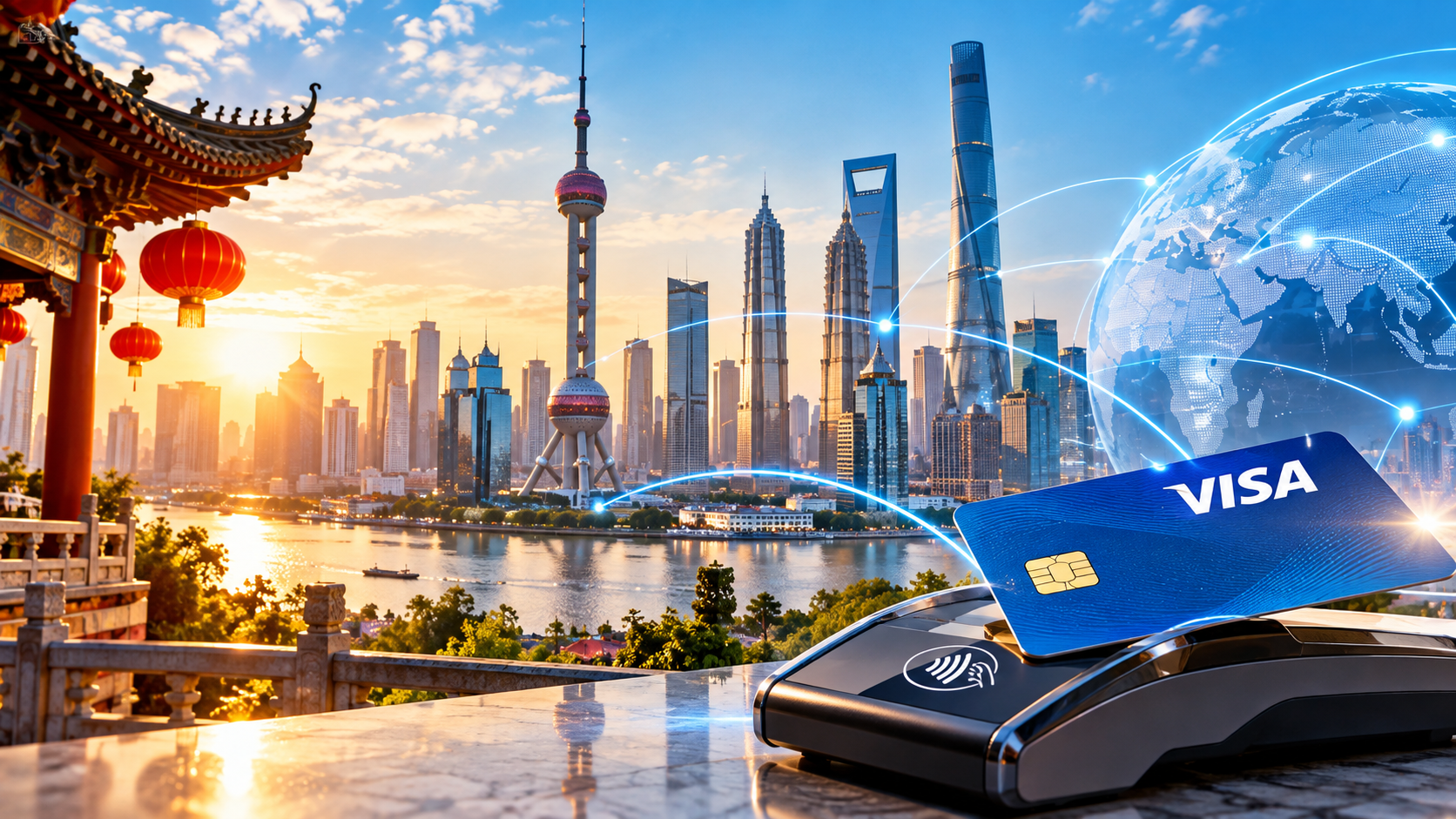
Beijing allows the American payments giant to prepare its entry into China’s domestic card-clearing market. As BRICS countries seek greater financial autonomy, a fundamental question emerges: will the future global financial order be shaped by competing systems, or by their ability to coexist?
from City of London
A financial decision with geopolitical implications
On 13 October 2026, the People’s Bank of China granted Visa, the American payments company, approval to begin formal preparations to establish a domestic bankcard clearing institution in China.
At first glance, this might appear to be a technical development of interest primarily to financial institutions and international investors.
Yet the decision raises a broader geopolitical question.
Why would China, one of the leading members of BRICS and a major advocate of developing alternatives to Western-dominated financial infrastructure, open its domestic payments market further to an American company?
Is this a contradiction?
Or does it reveal something more complex about the direction of the international economic order?
The question matters because the future of financial power will not be determined exclusively by currencies, central banks or international trade.
It will also depend on who develops, operates and regulates the infrastructure through which money moves.
What Beijing has actually authorised
Before interpreting the decision politically, an important distinction must be made.
Visa has not yet received its final licence to operate domestic bankcard clearing services in China.
The People’s Bank of China has authorised Visa Information Technology (Beijing) Co. Ltd. to undertake the necessary preparatory work.
The company has one year to complete that process. It must then submit a further application, which will be examined by the relevant Chinese regulatory authorities before any operational licence is granted.
This is therefore a significant regulatory milestone, not an unconditional or immediate opening of the market.
China retains control over the authorisation process.
For decades, China UnionPay has occupied a central position in the country’s bankcard payment infrastructure.
American Express and Mastercard have already secured access to domestic clearing activities through authorised local structures.
Visa is now moving closer to joining them.
But the importance of this decision extends beyond competition among payment companies.
It concerns the relationship between financial sovereignty and international economic integration.
A dispute that began long before 2026
To understand the significance of the announcement, we need to return to 2012.
That year, the World Trade Organization adopted a dispute settlement panel report concerning restrictions on electronic payment services in China.
The dispute, initiated by the United States, challenged several measures that favoured China UnionPay and affected the ability of foreign payment service providers to compete.
The WTO panel found that certain Chinese requirements were inconsistent with the country’s international commitments.
However, it did not establish that UnionPay enjoyed an unrestricted monopoly over every domestic renminbi payment transaction.
This distinction is important.
The case demonstrated both the existence of regulatory barriers and the complexity of determining their precise legal scope.
China subsequently undertook changes to its financial services framework, while disagreements over market access continued.
Visa’s latest approval is therefore part of a much longer regulatory, commercial and diplomatic process.
It should not be interpreted exclusively as a response to the geopolitical circumstances of October 2026.
The history matters.
International economic transformations rarely begin on the day they become headlines.
They often emerge from negotiations, regulatory decisions and institutional disputes that receive little public attention.
De-dollarisation is not the same as payment sovereignty
In recent years, de-dollarisation has become one of the most frequently used expressions in discussions about BRICS.
Yet the term is often applied to very different developments.
A country may seek to settle more international trade in its national currency.
It may develop alternative financial messaging systems.
It may strengthen its own payment and settlement infrastructure.
It may diversify foreign exchange reserves.
Or it may permit foreign companies to participate in domestic payment services.
These are not equivalent policies.
Nor are they necessarily mutually exclusive.
Allowing an American company to establish a regulated bankcard clearing operation in China does not mean that Beijing is abandoning the internationalisation of the renminbi.
It does not mean that the dollar will become more important in domestic Chinese transactions.
And it does not automatically transfer monetary sovereignty to the United States.
Currency issuance, monetary policy, payment networks, clearing arrangements and regulatory supervision are distinct components of the financial system.
China can seek greater international use of the renminbi while simultaneously allowing an American payments company to compete within its domestic market.
The two objectives can coexist.
Understanding this distinction is essential if we want to move beyond simplified narratives about a financial confrontation between BRICS and the West.
BRICS: replacing the Western system or reducing dependence on it?
This brings us to a larger question about the future of BRICS.
The group is not a monetary union.
It does not operate a common currency, and its members do not share a single integrated financial system capable of replacing the existing global payments architecture.
Their economic structures and strategic priorities differ considerably.
China is a major industrial and trading power, deeply connected to global production networks and international markets.
India, Brazil, South Africa and the other members have their own monetary interests, economic relationships and geopolitical priorities.
It would therefore be misleading to treat a Chinese regulatory decision as a collective BRICS policy.
Nevertheless, China’s approach offers an opportunity to examine the difference between two possible strategies.
The first is to replace existing Western-dominated financial infrastructure with alternative systems.
The second is to reduce dependence on any single infrastructure by developing additional options while retaining access to established international networks.
These approaches are not identical.
The first implies a degree of separation.
The second allows competition, cooperation and interdependence to exist simultaneously.
Could China’s long-term objective be less about replacing one financial order with another and more about increasing its freedom of choice within an increasingly fragmented international system?
That is a strategic hypothesis, not a confirmed statement of Chinese government policy.
But the Visa decision makes the question worth asking.
The diplomacy behind a banking authorisation
There is also a diplomatic dimension.
In Visa’s announcement, Chief Executive Officer Ryan McInerney acknowledged the role played by the leaders of the United States and China in pursuing a constructive and strategically stable relationship between the world’s two largest economies.
The statement is significant.
The approval comes amid continuing economic and diplomatic engagement between Washington and Beijing, despite persistent disagreements over technology, trade and strategic influence.
Some analysts have interpreted the decision as a possible goodwill gesture ahead of further high-level meetings.
That interpretation deserves consideration.
However, the available evidence does not establish that the approval was granted as part of a specific political bargain.
The distinction between an observable diplomatic context and a demonstrated causal relationship must be maintained.
What we can say is that relations between major powers are not conducted exclusively through summits, public declarations and trade disputes.
They also develop through licences, investment decisions, regulatory authorisations and market access.
Economic diplomacy is often less visible than political diplomacy.
That does not necessarily make it less important.
Visa is entering a different China
Another aspect deserves attention.
Visa has spent years seeking greater access to China’s domestic payment infrastructure.
But the Chinese payments market has changed dramatically during that period.
Alipay and WeChat Pay have helped make smartphone-based digital payments an integral part of everyday economic life.
China has developed an extensive digital payments ecosystem involving banks, technology platforms, merchants and consumers.
Consequently, Visa is not approaching the same market it sought to enter more than a decade ago.
Even if the company ultimately receives its operational licence, it will face a competitive environment shaped by established domestic payment networks and widespread mobile payment habits.
The issue is therefore not simply whether Visa can enter China.
It is whether the company can build a commercially significant position within a market that has already undergone profound technological change.
This raises another question.
Is Beijing primarily offering an opportunity to a foreign financial operator, or is it introducing additional international competition into a domestic digital ecosystem whose fundamental structure is already well established?
The answer will depend on the final regulatory conditions and the commercial results that follow.
Why Europe should pay attention
Although this decision directly concerns China and the United States, it also raises questions relevant to the European Union.
Europe has increasingly focused on strategic autonomy, technological sovereignty and the resilience of essential economic infrastructure.
Payments are an important part of that discussion.
A payment network is not simply a convenient way for consumers to complete transactions.
It is part of the infrastructure that supports commercial activity, financial stability and economic continuity.
At the same time, openness to international operators can encourage innovation, competition and investment.
The challenge is not necessarily to choose between foreign participation and domestic sovereignty.
It is to ensure that market openness does not eliminate the capacity to regulate, supervise and maintain essential services.
Europe’s own initiatives to strengthen its payments infrastructure should be examined in this context.
The objective should not be isolation.
It should be resilience, interoperability, competition and the ability to maintain alternatives when economic or geopolitical conditions deteriorate.
China’s decision does not provide Europe with a model to copy.
It does, however, illustrate why economic sovereignty cannot always be measured by the nationality of the companies operating within a market.
The distribution of regulatory authority, technological capabilities and operational control matters just as much.
The emerging geopolitics of coexistence
The decision announced on 13 October does not prove that China has abandoned its pursuit of greater financial autonomy.
Nor does it demonstrate that BRICS are retreating from their efforts to diversify international payment arrangements.
What it reveals is the inadequacy of interpreting the global financial system exclusively through a binary confrontation between competing blocs.
Geopolitical competition can coexist with economic interdependence.
The pursuit of sovereignty can coexist with international market access.
And the development of alternative systems does not necessarily require the elimination of existing ones.
Of course, coexistence is not guaranteed.
Trade disputes, sanctions, technological restrictions and international crises can undermine it.
But precisely because these risks exist, the ability to maintain multiple channels of economic cooperation may become increasingly valuable.
I remain convinced that Diplomacy, with a capital D, must retain a central place in international relations.
Even when countries compete, the ability to communicate, negotiate and preserve areas of cooperation is essential.
The Visa-China decision is not evidence of a comprehensive reconciliation between Washington and Beijing.
It is, however, a reminder that economic reality is often more complex than the political narratives used to describe it.
The question ItalyNews.it leaves open
Perhaps the future international financial order will not be determined solely by which country creates the next payment system or promotes the next currency.
It may also depend on the ability of different systems to operate alongside one another, under rules that preserve security, competition and national decision-making.
Because the question is not only who owns the money.
It is also who determines how money can move.
China is opening the door to Visa while continuing to pursue greater financial autonomy. Is this a contradiction, or a sign that the next phase of globalisation will be defined not by a single dominant financial system, but by the capacity of competing systems to coexist?
A question worth observing, understanding and sharing.
Riccardo Cacelli
International Geopolitical Analyst
Urban Air Mobility Manager
Senior Advisor — Advanced Air Mobility Institute, Boston
Sources and documentary references
- Visa Inc. — Visa Receives Approval to Begin Preparations for a Domestic Business in China, 13 October 2026.
- People’s Bank of China — Administrative approval concerning Visa Information Technology (Beijing) Co. Ltd., 13 October 2026.
- World Trade Organization — China — Certain Measures Affecting Electronic Payment Services, dispute DS413, panel report adopted 31 August 2012.
- Reuters — Visa gets approval to prepare for domestic business in China, 13 October 2026.
- Financial Times — Visa gets approval for China card business ahead of Trump-Xi summit, 13 October 2026.
#BRICS #BRICSPlus #China #Visa #Geopolitics #GlobalFinance #DeDollarization #FinancialSovereignty #DigitalPayments #USChinaRelations #EconomicDiplomacy #GlobalEconomy #FinancialInfrastructure #MultipolarWorld #ItalyNews