City of London – ❤️ 🖤 MilanVerse
🔴▬▬▬▬▬▬▬▬▬▬▬▬▬▬▬▬▬▬▬▬▬▬▬▬▬▬▬⚫
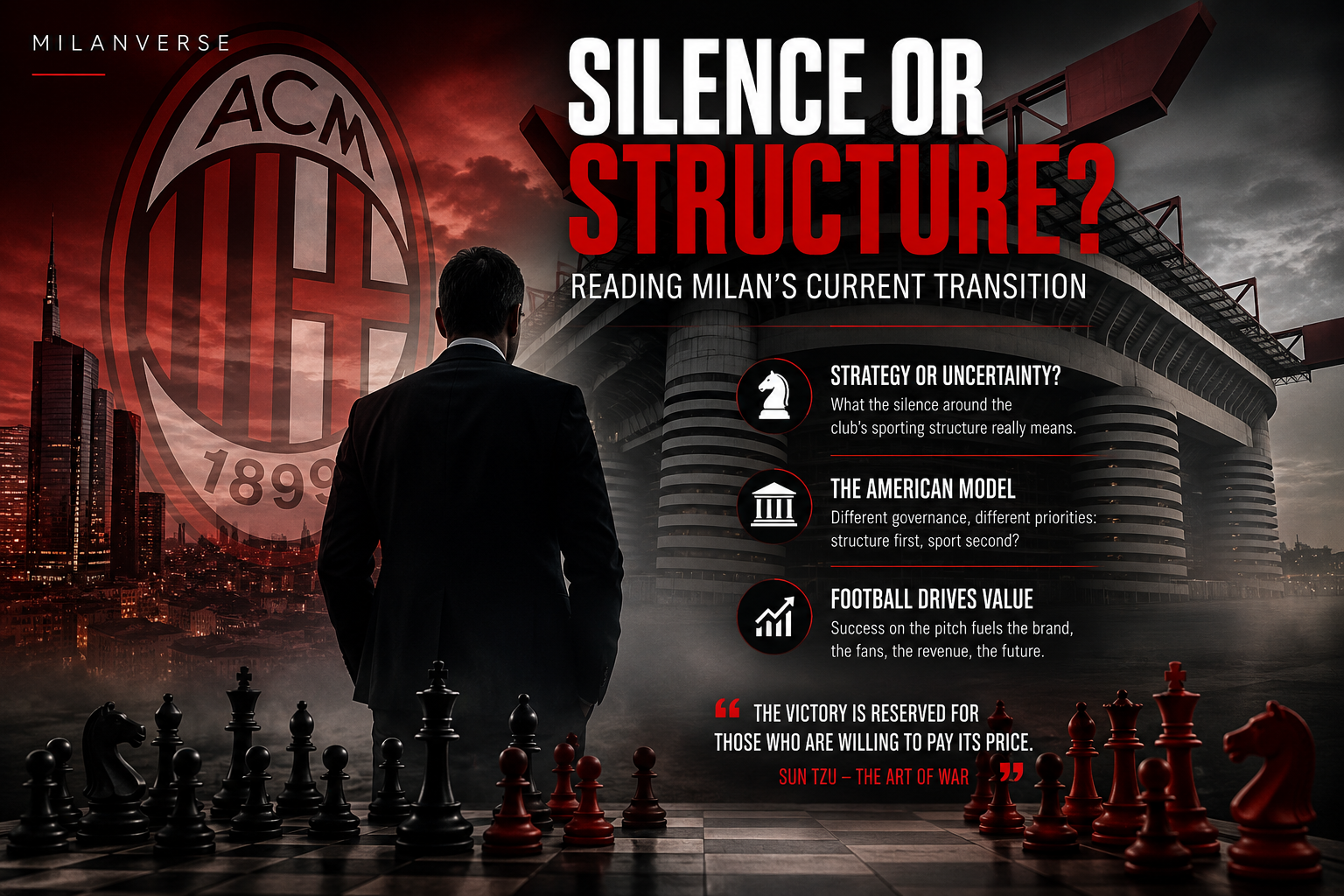
In football, silence is one of the hardest things to interpret.
Sometimes it signals preparation. Sometimes it signals uncertainty. From the outside, the two can look exactly the same.
That is the situation AC Milan finds itself in today.
While the appointment of Ruben Amorim has provided a clear indication of the club’s sporting direction, key elements of Milan’s leadership structure remain unresolved. At a time when many European clubs have already defined their sporting hierarchies for the upcoming season, Milan continues to operate with unanswered questions surrounding its football department.
The issue is not simply the absence of announcements. It is what that absence actually means.
Amorim arrives with a reputation as one of Europe’s most progressive coaches. His teams have been recognised for tactical identity, player development and a clear commitment to proactive football. In many ways, he represents the type of appointment supporters wanted to see: ambitious, modern and forward-looking.
Yet even the most talented coach cannot operate in isolation.
Sustainable success in modern football depends on far more than the individual standing on the touchline. Recruitment, scouting, performance analysis, sporting leadership and decision-making processes all contribute to the long-term competitiveness of a club.
This is where Milan’s current situation becomes particularly interesting.
🔴▬▬▬▬▬▬▬▬▬▬▬▬▬▬▬▬▬▬▬▬▬▬▬▬▬▬▬⚫
The Governance Question
The conversation is often framed around what has not happened yet. But perhaps the more important question is why.
Under American ownership, football clubs are increasingly managed as complex organisations rather than purely sporting institutions. Governance, operational efficiency, financial sustainability and long-term planning often play a larger role in strategic decision-making than they did in previous eras.
That does not mean sporting success becomes less important. In fact, quite the opposite.
Success on the pitch remains the single most powerful driver of value in football. It expands global fanbases, strengthens commercial partnerships, increases broadcasting revenues and elevates a club’s international profile. Trophies still matter. Results still matter. Winning still matters.
However, modern ownership groups increasingly view sporting success as the outcome of a well-built system rather than the starting point of one.
Traditional European football culture has often placed sporting leadership at the centre of a project, with directors, scouts and technical architects shaping the club’s identity from the football department outward.
The emerging American model tends to reverse the sequence. First establish the structure. Then empower the people who operate within it.
Neither approach is inherently right or wrong. Both have produced successful clubs. The challenge lies in execution.
🔴▬▬▬▬▬▬▬▬▬▬▬▬▬▬▬▬▬▬▬▬▬▬▬▬▬▬▬⚫
The Difference Between Silence and Uncertainty
This is where an idea associated with Sun Tzu’s The Art of War becomes relevant. Victory is rarely determined at the moment of battle. More often, it is the result of preparation, organisation and decisions made long before the contest begins.
The same principle applies to football clubs.
The difference between strategic patience and organisational uncertainty is often invisible in real time. It only becomes clear later, when results reveal whether the foundations were strong enough to support the ambitions built upon them.
Today, Milan sits precisely at that crossroads.
The club has already made one significant decision by appointing Amorim. Yet questions remain about the broader structure that will support his work and shape the next phase of the project.
For now, the silence surrounding those decisions can be interpreted in different ways. It may reflect careful planning taking place away from public scrutiny. Or it may indicate that important pieces of the puzzle are still missing.
Only time will tell which interpretation is correct.
What is certain is that modern football no longer allows clubs to choose between sporting ambition and organisational excellence. The most successful institutions combine both.
When structure and sporting vision move in the same direction, each reinforces the other. Structure supports performance. Performance validates structure.
Milan’s future will not be defined solely by the appointment of a coach, nor solely by the executives eventually chosen to lead the football department. It will be defined by the coherence of the system that connects them.
And that is why the current silence matters.
Not because silence itself is meaningful, but because one day it will be possible to look back and understand whether it was the silence of preparation or the silence of uncertainty.
🔴▬▬▬▬▬▬▬▬▬▬▬▬▬▬▬▬▬▬▬▬▬▬▬▬▬▬▬⚫
❤️ 🖤
Riccardo Cacelli
Founder of MilanVerse | Columnist for ItalyNews.it