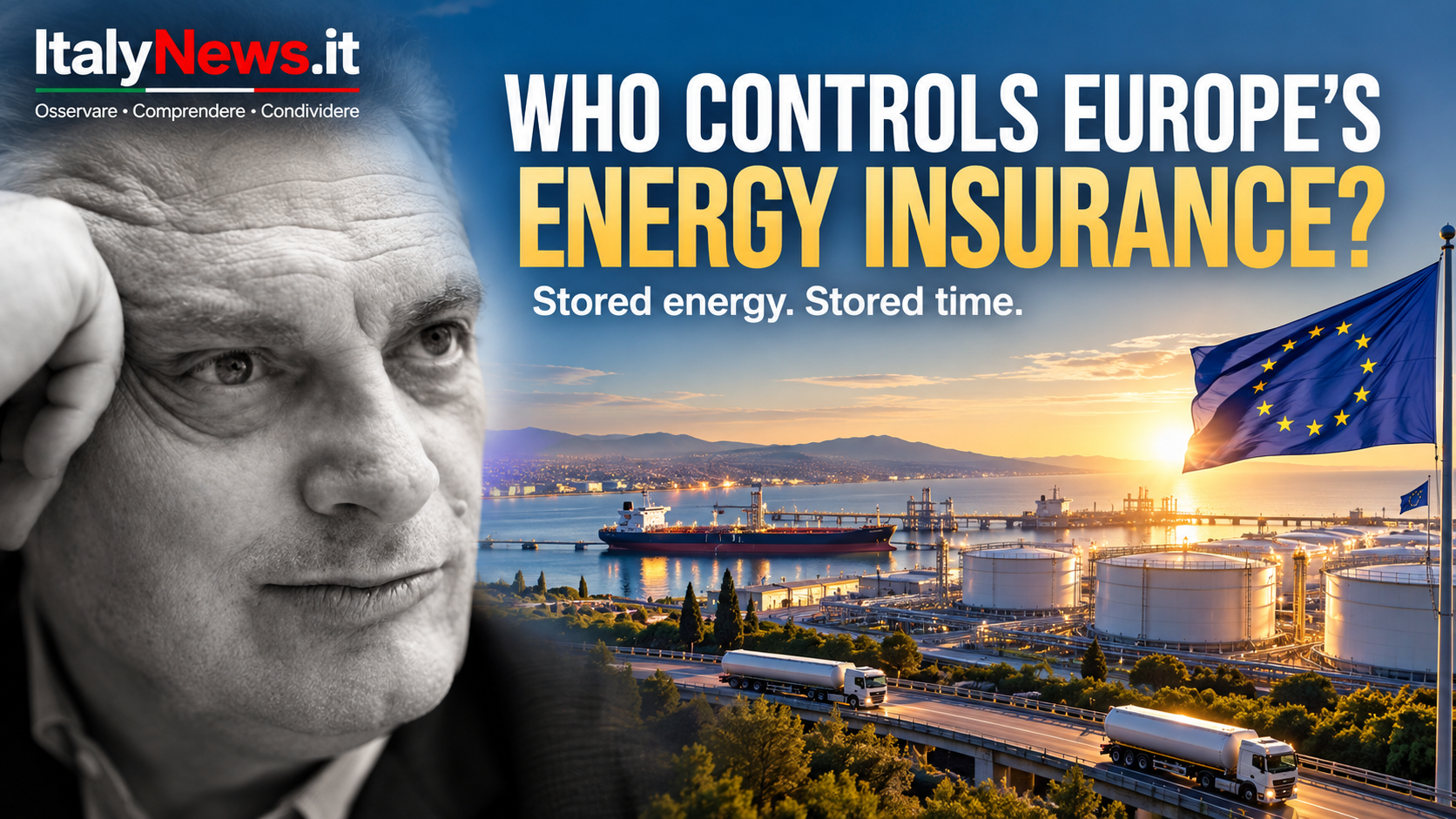
The G7 has agreed to release 100 million barrels from emergency reserves. The immediate question is whether this can stabilise the market. The strategic question is what happens to the insurance policy afterwards.
City of London – Europe keeps emergency oil reserves for a simple reason: to buy time when the normal energy system stops working normally.
Now some of that time is about to be spent.
On 2 October, G7 leaders agreed to begin immediately a coordinated release through the International Energy Agency of 100 million barrels from emergency reserves over four months, including a substantial release of diesel frontloaded within the first 20 days. The G7 also left open the possibility of additional diesel releases if necessary.
he decision changes the question.
Europe is no longer debating whether part of its energy insurance should be used.
It is beginning to use it.
Why diesel matters
The present crisis is increasingly a crisis of refined products rather than simply crude oil.
According to the IEA, crude exports from the Middle East have recovered significantly, but refined-product flows remain severely constrained. Gulf net exports of diesel and gasoil averaged only 390,000 barrels per day in August — just over one quarter of their pre-war level. Disruptions to Russian refining have tightened the market further.
Diesel is not just another fuel. It moves trucks, agricultural machinery and industrial supply chains. When diesel becomes scarce or expensive, the effects travel through much of the economy.
That explains why governments are intervening.
But intervention creates another problem.
Europe’s insurance policy
EU countries are required to maintain emergency oil stocks covering at least 90 days of net imports or 61 days of domestic consumption, whichever is greater.
The latest available Eurostat figures cited by Reuters put EU emergency diesel and gasoil stocks at approximately 39 million tonnes. Germany held around 5.6 million tonnes and France 8.2 million — together about 35% of the EU total.
| Strategic indicator | Situation |
|---|---|
| G7 coordinated release | 100 million barrels |
| Release period | 4 months |
| Diesel component | Frontloaded in first 20 days |
| Previous IEA action announced in March | 400 million barrels |
| Already released from that action | ~325 million barrels |
| EU emergency diesel/gasoil stocks* | ~39 million tonnes |
| France + Germany share of EU stocks* | ~35% |
*Latest available Eurostat stock data cited by Reuters: May 2025.
These numbers reveal something important.
Strategic reserves are not ordinary commercial inventories.
They are the margin between disruption and crisis.
The buffer is already being used
This is not the first emergency intervention of 2026.
In March, the 32 IEA member countries agreed to make 400 million barrels available following severe disruption to Middle Eastern oil flows — the largest coordinated stock release in the organisation’s history.
By 2 October, approximately 325 million barrels — more than 80% — had already been released.
Meanwhile, the European Commission says EU diesel supplies remain stable for the time being, although prices remain high because of tight global markets.
European refineries have recently been operating near maximum capacity, while commercial stocks at the Amsterdam-Rotterdam-Antwerp hub have been below their five-year average.
There is therefore no reason to describe Europe as facing an immediate diesel supply collapse.
But there is every reason to ask about resilience.
The question after the release
The G7 statement contains one particularly important detail.
It asks the IEA to report back within 20 days on implementation and market impact — and explicitly requests recommendations concerning the replenishment of stocks.
That may be the most important sentence in the entire decision.
Because releasing an emergency reserve solves only the first half of the problem.
The second is rebuilding it.
The G7 also committed to refrain from imposing energy export restrictions between its members. Shortly after the agreement, President Donald Trump said the United States would not impose a diesel export ban, removing for now the possibility that had generated concern in Europe earlier in the week.
The immediate tension may therefore have eased.
The structural question has not.
From stored oil to stored time
Energy security is normally measured by imports, suppliers, pipelines, shipping routes and storage capacity.
Perhaps another measurement is needed:
How quickly can a country rebuild its strategic buffer after using it?
A reserve that takes years to accumulate but months to consume creates a different kind of vulnerability.
And today’s crisis is occurring while the global system is already drawing heavily on inventories. The IEA estimates that observed global oil stocks had fallen by 507 million barrels since the beginning of the Middle East conflict by the end of August.
That makes replenishment more than an accounting exercise.
It becomes part of energy security itself.
My Observation
An emergency reserve is not simply stored energy. It is stored time.
The G7 has decided that some of that time must now be spent.
That may be necessary. Strategic reserves exist precisely to protect economies when normal markets cannot provide sufficient security.
But every emergency release creates a second responsibility: rebuilding the buffer before the next emergency arrives.
Europe should therefore measure energy resilience not only by how many barrels it can release today, but also by how quickly it can restore its strategic margin tomorrow.
Because the next disruption does not have to wait for the reserves to be replenished.
Europe is using its energy insurance. How quickly can it rebuild it?
#EnergySecurity #StrategicReserves #EnergyResilience #EuropeanUnion #G7 #IEA #EnergyGeopolitics #StrategicAutonomy #ItalyNews