
This editorial is also available in Italian, with additional analysis of public responsibilities, territorial planning and climate risk prevention.
🇮🇹 Edizione italiana: Leggi questo editoriale in italiano →
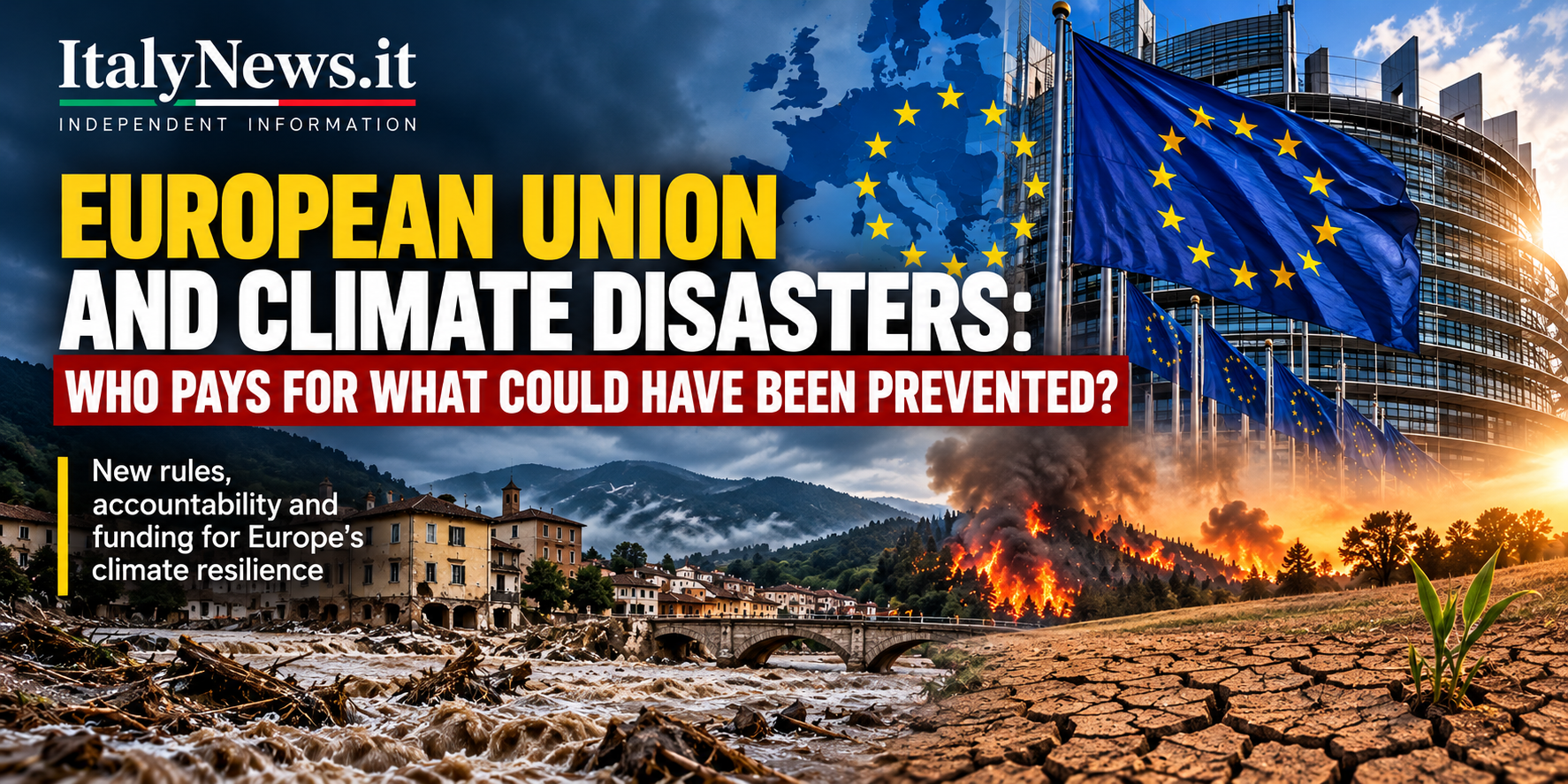
As the European Union outlines a new approach to climate resilience, a fundamental question emerges: who is responsible when known risks are not adequately addressed?
Every time floods devastate a community, wildfires destroy forests or drought threatens agriculture, Europe witnesses a familiar sequence.
Emergency operations begin. Political leaders visit affected areas. Governments announce financial assistance. Reconstruction plans follow.
Yet one essential question is often overlooked:
How much of the damage could have been prevented, and who was responsible for taking action?
On 27 October 2026, the European Commission presented a new framework for climate resilience, accompanied by a legislative proposal aimed at improving Europe’s ability to anticipate and manage climate-related risks.
Beyond environmental policy, the initiative raises important questions about public accountability, financial responsibility and the relationship between citizens and institutions.
The Economic Cost of Climate Disasters
According to figures presented by the European Commission, climate-related economic losses across the EU reached approximately €200 billion between 2022 and 2025.
The Commission also estimates that Europe needs around €70 billion annually in climate adaptation investments.
These figures represent more than financial losses.
They reflect damaged infrastructure, destroyed businesses, displaced families and communities struggling to recover.
Not every natural disaster can be prevented. Nor can every loss be avoided.
However, there is a fundamental difference between an unpredictable event and a known risk that has not been adequately addressed.
Prevention is not simply an environmental responsibility. It is also an economic and political choice.
Who Is Responsible for Prevention?
The European Commission’s proposal seeks to clarify responsibilities for climate risk management across Member States.
Under the proposed timetable, national climate risk assessments would be required by June 2029, followed by strategic resilience plans by December 2030.
These deadlines remain part of a legislative proposal, not obligations already in force.
Nevertheless, the underlying challenge is immediate.
Flood risks may be documented for years. Vulnerable infrastructure may already be identified. Local authorities may possess detailed maps showing which areas face the greatest danger.
But responsibility is often divided among municipalities, regional governments, national authorities and infrastructure operators.
When several institutions share responsibility, accountability can become fragmented.
A flood does not stop at an administrative boundary.
Effective prevention therefore requires more than scientific knowledge. It requires clear responsibilities, coordinated decisions and adequate resources.
Climate Change Is Not the Only Factor
Climate change can increase the frequency or intensity of certain extreme weather events.
However, the consequences of disasters also depend on land use, urban planning, infrastructure maintenance and the vulnerability of communities.
Building in flood-prone areas, increasing impermeable surfaces or failing to maintain critical infrastructure can worsen the impact of extreme events.
Each disaster requires its own scientific assessment.
Reducing every catastrophe to climate change alone risks overlooking decisions that may have increased local vulnerability.
The real challenge is to understand how climate hazards interact with human choices.
Who Ultimately Pays?
When disasters occur, governments frequently mobilise public funds for emergency response and reconstruction.
Citizens therefore contribute to recovery through taxation and public expenditure, while affected households may also suffer substantial personal losses.
But what happens when part of the damage might have been reduced through earlier investment?
This does not mean that every disaster involves negligence or institutional failure.
It does mean that governments should be able to explain how known risks were assessed, which preventive measures were considered and why particular decisions were made.
The European Commission has also announced plans for a Climate Insurance Alliance to address gaps in financial protection against climate-related disasters.
Insurance can help compensate economic losses.
It cannot replace prevention, restore lost lives or eliminate the social consequences of a catastrophe.
Financial protection and risk reduction must work together.
A European Question of Accountability
The European Environment Agency is developing its second European Climate Risk Assessment, EUCRA-2, expected in 2028.
The assessment aims to examine climate risks, policy responses and the responsibilities involved in managing them.
This is an important step towards connecting scientific evidence with public decision-making.
Yet a major challenge remains.
While the European Commission recognises the need for substantial annual investment in climate adaptation, its new framework does not establish an additional dedicated fund matching the estimated €70 billion required each year.
The question of financing therefore remains unresolved.
Europe is becoming increasingly capable of identifying climate risks.
But identifying a risk is not the same as reducing it.
Citizens need to know which institutions are responsible, what resources are available and whether preventive measures are actually being implemented.
Prevention Is Also a Matter of Public Trust
Public confidence in institutions depends not only on their ability to respond after a disaster, but also on their willingness to act before one occurs.
When communities suffer repeated flooding or other predictable hazards, citizens have legitimate questions.
Was the risk known?
Were preventive measures proposed?
Were resources allocated?
And if action was delayed, why?
These questions do not automatically establish legal responsibility. They are essential, however, to democratic accountability.
Europe’s climate resilience strategy should ultimately be judged not by the number of assessments produced, but by its ability to turn knowledge into effective protection.
The real question is not whether Europe can prevent every disaster. It cannot.
The question is whether European institutions can demonstrate that reasonable action was taken to prevent avoidable damage.
Because after every catastrophe, governments must calculate the cost of reconstruction.
But before the next one, citizens deserve to know who is responsible for prevention.
Riccardo Cacelli
Institutional references
- European Commission — EU Framework for Climate Resilience, 27 October 2026.
- European Commission — European Climate Resilience Law, legislative proposal.
- European Environment Agency — Second European Climate Risk Assessment (EUCRA-2), Interim Methodology Report, 27 October 2026.
- European Commission — EU Strategy on Adaptation to Climate Change.
#EuropeanUnion #ClimateChange #ClimateDisasters #ClimateResilience #FloodPrevention #ClimateAdaptation #EUClimatePolicy #PublicAccountability #ItalyNews