Every day, international headlines focus on a new crisis: a military conflict, a diplomatic dispute, an economic sanction, or a geopolitical summit.
Each event appears to stand alone.
Yet together they may represent something much larger.
The 21st century is witnessing not a collection of isolated crises, but a profound transformation of the international order. Understanding this transformation requires more than following daily events. It requires recognising the broader strategic position that is gradually emerging.
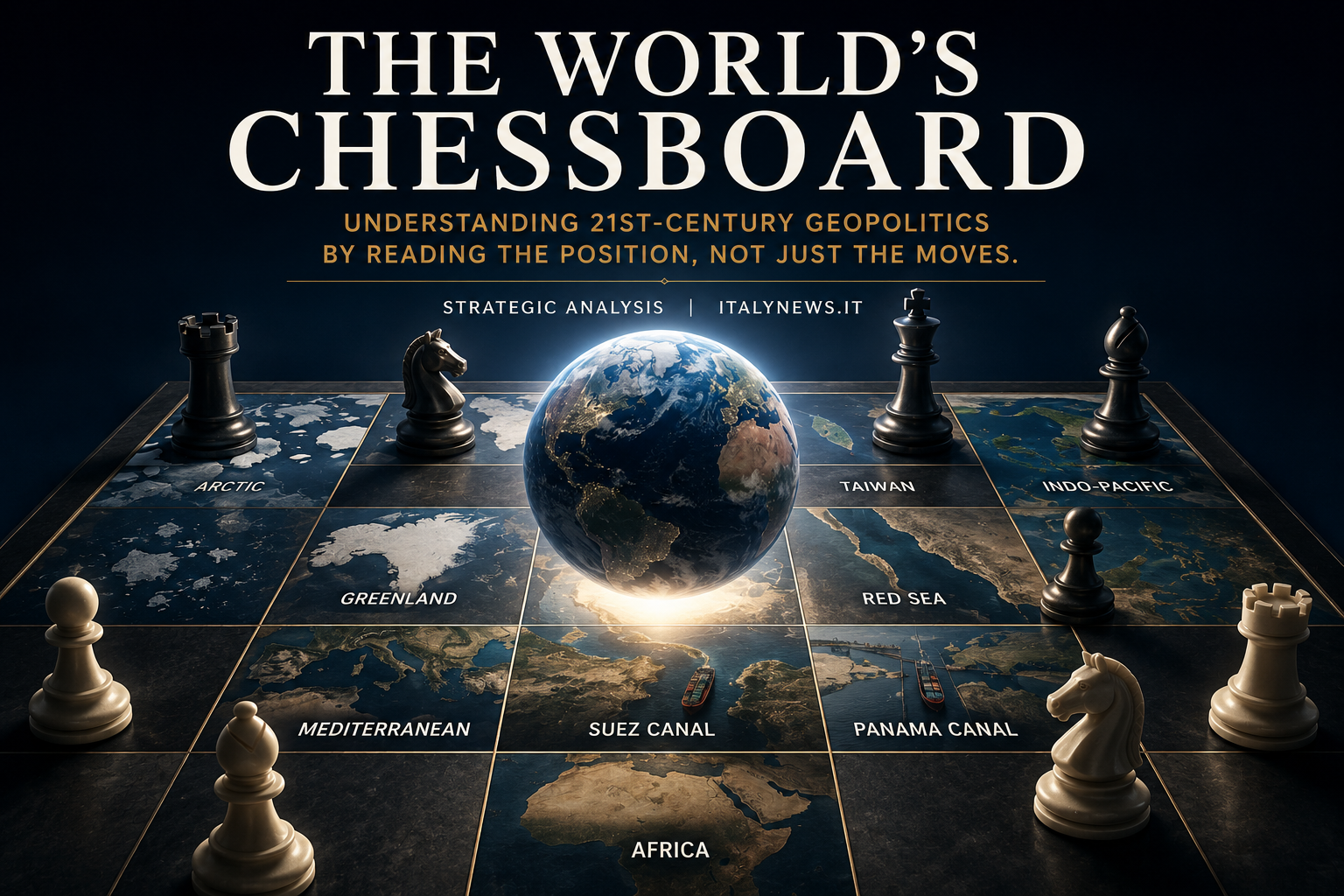
Chess offers a useful metaphor.
Not because the world is a game—wars are human tragedies with devastating consequences—but because chess teaches an essential lesson: individual moves matter, yet it is the overall position that determines the outcome.
Too often we analyse the latest move without asking how it changes the balance of the entire board.
Today’s international system is no longer defined by a single dominant centre of power.
The United States remains the leading strategic actor of the Western alliance. The European Union continues to exercise significant economic, regulatory and diplomatic influence. China is expanding its global presence through infrastructure, technology, industrial capacity and long-term investment. Russia remains a major military and security actor with global strategic relevance.
Rather than a simple confrontation between two rigid blocs, the emerging international landscape is characterised by shifting partnerships, overlapping interests and increasing strategic competition.
In chess, however, pieces alone do not determine victory.
Their position does.
The same principle increasingly applies to geopolitics.
Some territories have become disproportionately important because they connect global systems rather than simply occupying geographical space.
Greenland has become central to Arctic routes and critical minerals.
Taiwan plays a decisive role in advanced semiconductor production.
Africa is emerging as one of the world’s most strategic regions because of its demographic growth and its vast reserves of critical raw materials.
The Mediterranean, the Red Sea, the Suez Canal, the Panama Canal and the Indo-Pacific have become essential crossroads for global trade, energy security and military projection.
The competition of the 21st century extends far beyond territory.
It involves supply chains, artificial intelligence, rare earth elements, digital infrastructure, satellites, submarine cables, energy networks and access to strategic technologies.
Power increasingly belongs to those who control the world’s connections rather than simply its borders.
Perhaps this is the most important lesson that chess can offer geopolitics.
Experienced players do not focus only on the last move.
They study the position.
Likewise, understanding international affairs requires looking beyond today’s headlines to identify the long-term patterns that are reshaping the global order.
History rarely changes overnight.
It evolves through thousands of interconnected decisions that, taken together, redefine the balance of power.
Learning to read that evolving position may be one of the greatest challenges for policymakers, analysts and citizens alike.
Because understanding the world’s chessboard begins not with predicting the next move, but with recognising the strategy behind it.This article is part of ItalyNews.it’s Strategic Analysis series, offering independent perspectives on global affairs, geopolitics and emerging international trends.
Riccardo Cacelli
Strategic Analysis | ItalyNews.it
This article is part of ItalyNews.it’s Strategic Analysis series, offering independent perspectives on global affairs, geopolitics and emerging international trends.