London – The idea is politically powerful and journalistically irresistible.
A common BRICS currency would appear to offer Brazil, Russia, India, China, South Africa and the group’s newer members a direct alternative to the US dollar.
It would also provide a simple narrative for one of the most complex transformations taking place in the global economy: de-dollarisation.
But perhaps we have been watching the wrong thing. Because reducing dependence on the dollar does not necessarily require creating another dollar.
It may simply require creating different ways of moving money.
Listen to what the central bankers are actually discussing
On 11 August, Reserve Bank of India Governor Sanjay Malhotra confirmed that BRICS countries are discussing possible connections between their respective fast-payment systems and central bank digital currencies, or CBDCs.
The reason he gave was remarkably pragmatic.
Cross-border payments remain expensive, and there is considerable scope to reduce those costs.
Various options are being examined.
No common BRICS payment architecture has been agreed.
No new BRICS currency has been announced.
And the discussions remain at an early stage.
That caution matters.
But so does the direction of travel.
India is hosting the 2026 BRICS summit, and the Reserve Bank of India had already recommended that connecting CBDCs should be considered as part of the summit agenda.
At the same time, India continues to promote the internationalisation of the rupee and greater use of national currencies in cross-border trade and payments.
Put these elements together and a different picture begins to emerge.
Perhaps BRICS does not need a euro
When Europe created the euro, countries replaced their national currencies with a common currency.
That is one model of monetary integration.
But it is not the only possible model.
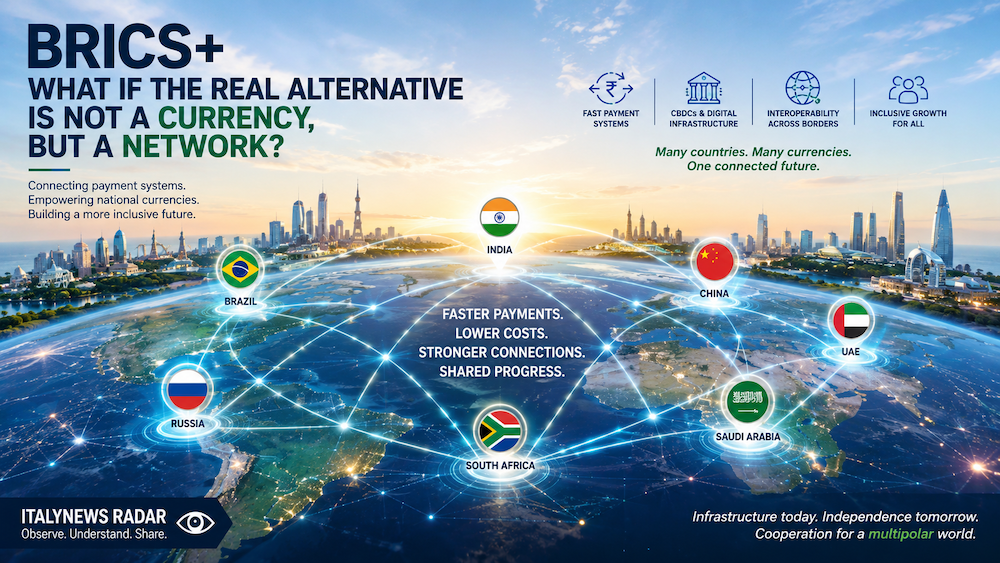
Imagine instead a world in which national currencies remain exactly where they are.
India keeps the rupee.
China keeps the yuan.
Brazil keeps the real.
The UAE keeps the dirham.
South Africa keeps the rand.
But the digital infrastructure connecting those currencies becomes faster, cheaper and increasingly interoperable.
In such a system, the important innovation would not necessarily be the creation of a new currency.
It would be the creation of new rails on which existing currencies can travel.
And that distinction matters enormously.
The dollar is more than a currency
The international power of the US dollar does not come solely from the notes themselves.
It is supported by an enormous financial ecosystem: banks, clearing systems, capital markets, correspondent banking relationships, payment infrastructure and deep pools of dollar-denominated assets.
That is why predictions of the dollar’s imminent collapse should always be treated with caution.
Replacing such an ecosystem is extraordinarily difficult.
But countries do not necessarily need to replace the entire dollar system in order to reduce their dependence on it.
They can begin by building alternatives for particular transactions.
A bilateral trade payment settled directly in national currencies is one example.
A connection between instant-payment systems could be another.
Interoperable CBDCs could eventually become another still.
None of these individually dethrones the dollar.
But together they could gradually change how often the dollar needs to be used in the first place.
From currencies to infrastructure
This is where the BRICS discussion becomes more interesting than the headlines about a hypothetical common currency.
A new currency would require extraordinary levels of political coordination.
BRICS countries have very different economies, monetary policies, financial systems and geopolitical interests.
Creating a genuine common currency would therefore be immensely complicated.
Infrastructure is different.
Countries do not need to surrender their monetary sovereignty simply to make their payment systems communicate more efficiently.
They can remain politically and monetarily independent while creating technical bridges between national systems.
That makes payment infrastructure potentially much easier to develop than monetary union.
And perhaps more consequential than it initially appears.
India provides an extraordinary laboratory
India is particularly important in this discussion because it already operates one of the world’s most remarkable digital-payment infrastructures.
The Unified Payments Interface — UPI — has transformed everyday payments across the country.
In August 2026 alone, it processed 24.51 billion transactions worth approximately 29.82 trillion rupees.
Now another experiment is emerging.
India is preparing a framework that could allow artificial-intelligence agents to make small payments through UPI without requiring the user to approve every individual transaction.
The proposed system is not a BRICS initiative.
That distinction must be clear.
But it demonstrates something important.
Payment infrastructure is evolving extremely quickly.
We are moving from cash to cards, from cards to smartphones, from smartphones to instant-payment networks — and potentially from human-initiated payments to transactions initiated by authorised AI agents.
Against this background, discussions about connecting national payment infrastructures across borders deserve much more attention than they normally receive.
De-dollarisation without declaring de-dollarisation
There is another reason why infrastructure matters.
Creating a “BRICS currency” would immediately become a geopolitical declaration.
Connecting payment systems can instead be presented as something much more mundane: reducing transaction costs.
That is precisely how the current discussion is being framed.
And it may be completely genuine.
Cheaper and faster cross-border payments benefit businesses and consumers regardless of geopolitics.
But infrastructure has geopolitical consequences even when it is built for practical reasons.
A railway changes trade. A port changes geography.
A telecommunications network changes information flows.
And a payment network can change the routes through which economic value moves.
The geopolitical significance may therefore emerge not from what BRICS calls the infrastructure, but from what that infrastructure eventually allows its members to do.
A paradox worth watching
There is a fascinating paradox here.
BRICS may be too diverse to create a common currency.
But that same diversity could make an interoperable payment architecture more attractive.
Members would not need to agree on a single monetary policy.
They would not need a BRICS central bank.
They would not necessarily need to abandon their national currencies.
They would simply need their systems to communicate.
That is still technically, legally and politically difficult.
But it is a very different challenge from creating a new global currency.
The question we should be asking
For years, the world has asked:
“When will BRICS create a currency to challenge the dollar?”
Perhaps ItalyNews.it should ask a different question:
“Does BRICS actually need a new currency to reduce its dependence on the dollar?”
The answer may ultimately be no.
The future of de-dollarisation, if it develops, may not arrive with the launch of a dramatic new banknote bearing the BRICS name.
It could arrive quietly.
One bilateral settlement agreement at a time.
One CBDC connection at a time.
One national payment system connected to another.
One transaction that previously needed the dollar — and one day no longer does.
Because sometimes the infrastructure beneath money can be more important than the name printed on the money itself.
And perhaps the biggest change in the global monetary system will not begin when BRICS creates a new currency.
It will begin when its members discover that, for some transactions, they no longer need one.
Observe. Understand. Share.
SOURCE: