Six sections to understand what is happening — and what could happen next.
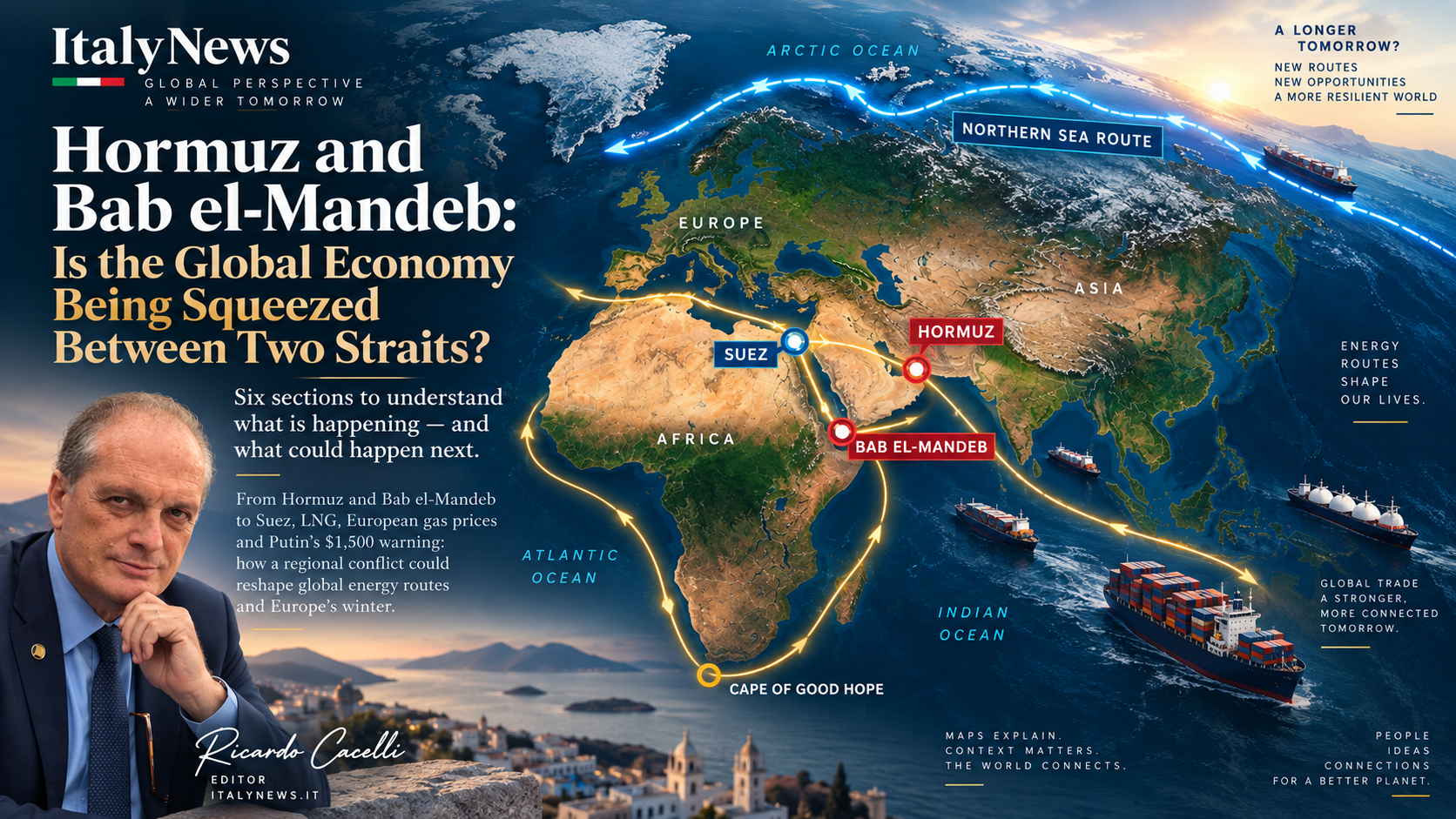
From Hormuz and Bab el-Mandeb to Suez, LNG, European gas prices and Putin’s $1,500 warning: six sections to understand how a regional conflict could reshape global energy routes and Europe’s winter.
City of London – There are moments when understanding geopolitics does not require looking at a capital city, a diplomatic summit or a frontline. It requires looking at a map.
The Strait of Hormuz and Bab el-Mandeb are thousands of kilometres apart, yet they belong to the same circulatory system of the global economy. Through the first passes a crucial share of the energy produced in the Persian Gulf; the second connects the Indian Ocean to the Red Sea and, through Suez, to the Mediterranean and Europe. Between them lie pipelines, ports, alternative routes and thousands of ships that for decades have provided something resembling redundancy within the system: when one route became difficult, at least some flows could seek another.
The events of recent weeks — and particularly those of the past 48 hours — suggest a different question from the one dominating most headlines: what happens when it is no longer just one route that becomes vulnerable, but its alternatives begin to become vulnerable too?
1. Hormuz: A Strait Does Not Have to Close to Stop Functioning Normally
On 13 September, UK Maritime Trade Operations (UKMTO) received a report that a commercial vessel had been struck by a projectile while transiting the area of the Strait of Hormuz. UKMTO is not a news agency: it is the British maritime-security service, linked to the Royal Navy, that acts as an important reporting and information hub for commercial shipping operating in high-risk waters, including the Gulf, the Strait of Hormuz and the Red Sea.
Iranian sources subsequently reported that the vessel was Iranian and that the incident had caused at least one death and several injuries. At the time of writing, however, responsibility for the attack has not been independently established. That distinction matters. To understand what is happening, we do not need to attribute every attack prematurely; we need to observe the system.
By 10 September, the International Maritime Organization had recorded 75 confirmed incidents connected with the regional crisis and estimated that around 20,000 seafarers were affected by the situation. But perhaps the most revealing figures come from the U.S. Energy Information Administration. In the fourth quarter of 2025, approximately 21.6 million barrels per day of petroleum and petroleum products moved through Hormuz. In the first quarter of 2026 the figure had fallen to 14.9 million; by the second quarter, it was just 4.9 million barrels per day.
Hormuz has not necessarily been “closed”, yet its economic function has already changed profoundly. A maritime chokepoint does not need to be physically blocked to produce global consequences. It is enough for passage to become sufficiently dangerous: insurance premiums rise, vessel availability falls, charter rates increase, crews face greater risks and shipping companies alter their routes. Geography has already begun to turn into economics.
A chokepoint does not have to be closed to stop functioning normally.
2. Bab el-Mandeb: When the Alternative Becomes More Important
While flows through Hormuz were falling dramatically, something apparently contradictory was happening farther west. According to the same EIA data, approximately 5.4 million barrels per day moved through Bab el-Mandeb in the fourth quarter of 2025, 5.6 million in the first quarter of 2026 and 8.1 million barrels per day in the second.
A simplistic conclusion should be avoided: those additional 2.7 million barrels do not automatically represent oil diverted from Hormuz to Bab el-Mandeb. Global energy flows are considerably more complex. But the trend tells us something important: as Hormuz lost a large part of its operational role, Bab el-Mandeb was gaining importance within the international energy system.
That is what gives the developments of recent days a different significance. Houthi forces have reached Perim — Mayun in Arabic — the island located inside Bab el-Mandeb itself, together with Dhubab on the Yemeni coast opposite the island. Perim physically divides the strait into two channels.
This does not mean that the Houthis “control Bab el-Mandeb”, nor does it mean that they can automatically close it. Such conclusions would go beyond the evidence currently available. It does mean, however, that an armed force which has already demonstrated the ability to use drones, missiles and other systems against maritime traffic has acquired a geographically much more sensitive position within one of the world’s most important commercial passages.
An apparently tiny island can therefore acquire an importance that its size does not suggest. Geography does not always measure power in square kilometres. Sometimes it measures it in position.
3. The Third Route: The Pipeline Built to Bypass Hormuz
Between Hormuz and Bab el-Mandeb lies a third element that risks being overlooked: Saudi Arabia’s East-West Pipeline. Running for roughly 1,200 kilometres across the country, it carries crude oil from the eastern producing regions to Yanbu on the Red Sea. Its strategic purpose is straightforward: it allows Saudi oil to reach the Red Sea without passing through Hormuz.
During the crisis, that function became even more important. The pipeline had been carrying approximately 4 million barrels per day towards Yanbu. Then it was hit by drones. Saudi Arabia said the drones had been launched from Iraq; Baghdad subsequently took measures and opened investigations. Once again, however, the key point for this analysis is not to establish political responsibility before all the evidence is available. It is to observe the network.
Hormuz is under pressure. A principal Saudi bypass of Hormuz is attacked. Bab el-Mandeb becomes more important precisely as the military situation around that strait changes. Three elements that might normally compensate for one another are therefore showing vulnerabilities at the same time.
This is where systemic risk begins: not when one route disappears, but when the number of available alternatives progressively declines.
4. Suez and Shipping: When Distance Becomes Money
From Yanbu, oil can move in two directions. Northwards through the Red Sea it can reach Suez, the Mediterranean and European markets; southwards it must cross Bab el-Mandeb to reach the Indian Ocean and the major Asian markets. This makes Suez increasingly interesting, and in recent months some large crude carriers loaded at Yanbu have chosen to sail north through Suez precisely to avoid Bab el-Mandeb.
But geography has a price. If a vessel has to avoid Hormuz, Bab el-Mandeb, or both, its journey can become dramatically longer. In some scenarios analysed during the crisis, voyages normally completed in around 19 days could take as many as 48. Fuel costs can more than double, on top of charter costs, insurance, crews, transit fees and the capital tied up in the cargo itself.
There is also a less visible consequence. A tanker that takes almost twice as long to complete a rotation does not disappear from the world’s fleet, but for many additional weeks it is unavailable for another voyage. Effective fleet capacity therefore falls even if the number of ships remains exactly the same. This is one of the ways a regional conflict can generate a global economic effect without a single vessel having to be sunk.
The market does not transport only oil. It transports time. And time has a price.
5. LNG and Europe: Winter Enters the Equation
For liquefied natural gas, the problem is different again. Qatar is one of the world’s leading LNG exporters, and its vessels must pass through Hormuz to reach international markets. For oil, pipelines can at least partially bypass the strait. For Qatari LNG, there is no equivalent East-West Pipeline. It is this asymmetry that makes Hormuz particularly important for the global gas market.
And this is where the Middle East crisis directly meets Europe. At the beginning of September, European gas storage stood at around 66%, unusually low for the time of year, while the European TTF benchmark had already moved above €75 per megawatt-hour. This does not mean that Europe is destined to run out of gas. It means something economically different: Europe could enter winter with less room to absorb another supply shock.
Against this background, on 12 September Vladimir Putin said that European gas prices could reach $1,500 per thousand cubic metres during the coming winter. The figure deserves attention, but its source deserves equal attention. It is not an independent energy-market forecast; it is a statement by the Russian President at a moment when energy, war and relations between Moscow and Europe are deeply intertwined.
The $1,500 figure should therefore be read simultaneously as an economic scenario and a geopolitical message. Putin has long argued that Europe’s move away from Russian energy would impose structural costs on European economies, and the crisis around Hormuz now gives that argument another dimension. The interesting question is not whether Putin has correctly predicted next winter’s gas price — nobody can know that today — but rather: how vulnerable does Europe become when its energy security increasingly depends on maritime routes crossing unstable regions?
For years, Europe has discussed energy diversification primarily in terms of suppliers. The current crisis reminds us that there is another form of diversification: diversification of routes. Changing supplier without sufficiently diversifying the routes through which energy arrives may simply shift risk from political dependence to geographical dependence.
6. The Question That Remains: What Could Happen Next?
This is where facts must be separated from scenarios. Hormuz is not completely closed. Bab el-Mandeb has not been closed. Holding Perim does not automatically amount to controlling the strait. The East-West Pipeline has been hit, but that does not mean it will remain permanently unavailable. And nobody can say today that European gas will necessarily reach $1,500 per thousand cubic metres.
Those are the limits of the available evidence. But there is another fact that is harder to ignore. The global energy system is built not only around major routes, but around the possibility of using alternatives when something goes wrong: Hormuz, the East-West Pipeline, Yanbu, Bab el-Mandeb, Suez and the Cape of Good Hope. Seen separately, they are places, infrastructure and shipping routes. Seen together, they form a network of resilience.
And it is that network we should now be watching.
The greatest risk would not necessarily be the complete closure of Hormuz or Bab el-Mandeb. It could be something less spectacular, and therefore more difficult to see: increasingly expensive insurance, longer voyages, fewer available tankers, LNG becoming harder to move, European inventories becoming more valuable and energy prices becoming more sensitive to every new incident.
A progressive erosion of alternatives.
How many alternatives can the global economy lose before a logistical problem becomes an economic one?
Because the story of Hormuz and Bab el-Mandeb may not ultimately be the story of two straits closing. It may be the story of a world discovering just how much it depends on keeping them open.
And What If the Next Route Goes North?
Economic geography is not immutable. For centuries, wars, crises, technologies and the search for safer or shorter passages have redrawn the map of world trade. If Hormuz, Bab el-Mandeb and Suez were to become structurally more expensive, slower or riskier, governments and companies could increasingly begin looking elsewhere.
Perhaps much farther north.
Changing conditions in the Arctic have already increased strategic interest in the Northern Sea Route, running along Russia’s Arctic coast and potentially offering, under certain conditions, a substantially shorter maritime connection between parts of Asia and Europe than traditional southern routes.
It is not a substitute for Suez today. It does not offer comparable capacity or operational freedom. Ice conditions, seasonality, limited infrastructure, insurance, search-and-rescue capacity, environmental risks and geopolitics impose enormous constraints. But perhaps the most interesting question is not what the Northern Sea Route is today. It is what it could become tomorrow.
If world trade genuinely began looking north to reduce its exposure to southern chokepoints, much more than shipping routes would change. The strategic value of the Arctic would change; Russia’s position would change; China’s interests would change; Europe’s security calculations would change.
And, once again, the geography of power would change.
So, after looking at Hormuz and Bab el-Mandeb, perhaps we should allow ourselves one final provocation:
What if the next great trade route between Asia and Europe no longer runs south — but along the edge of the North Pole?
Riccardo Cacelli
ItalyNews Observation
The greatest danger to the global economy may not be that one maritime chokepoint closes. It may be that, one after another, the alternatives stop being alternatives.
And when the alternatives disappear, geography may force us to draw a new map.