
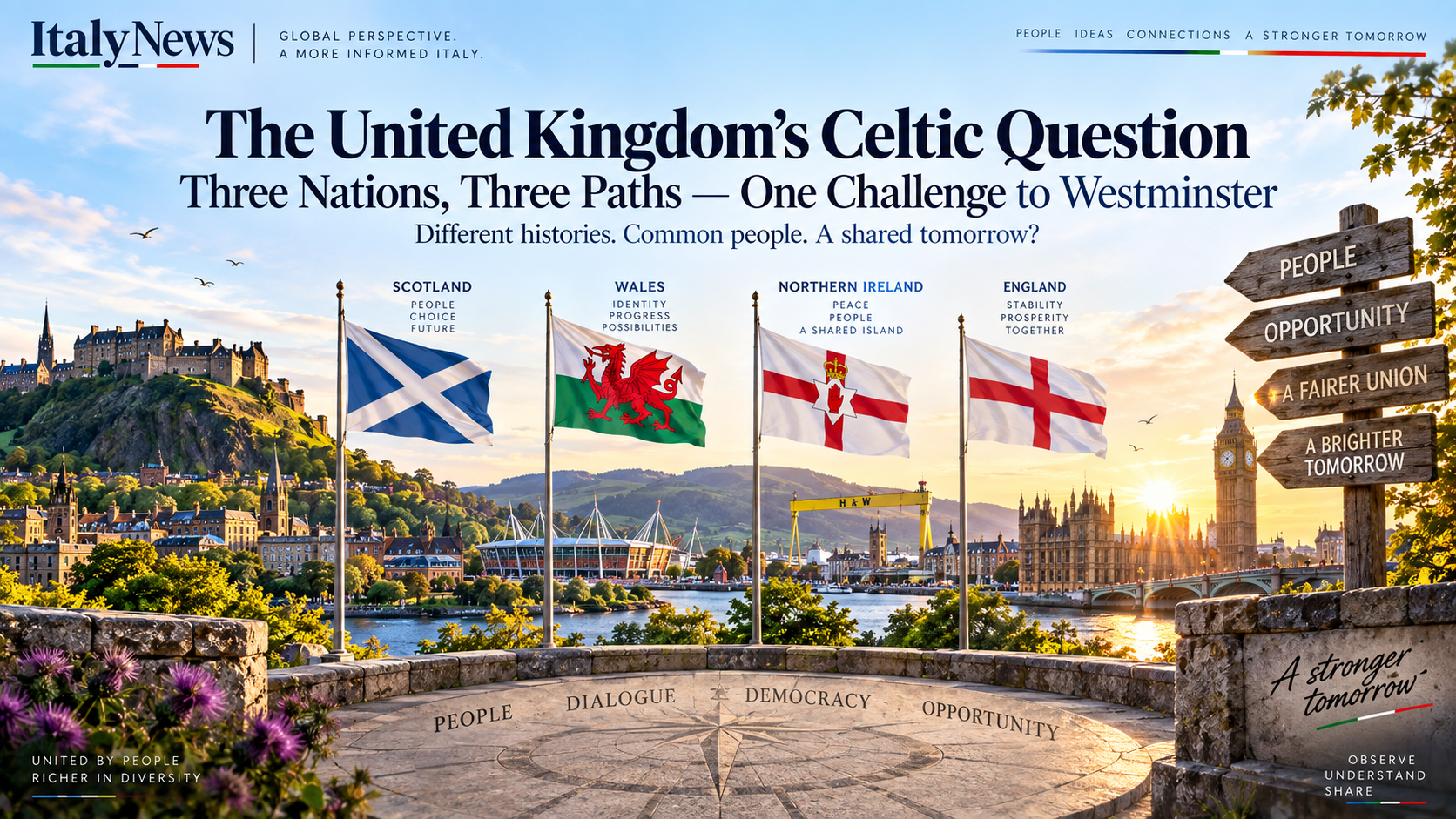
Cardiff did not produce a common road to independence. It produced something potentially more significant: a common claim that Scotland, Wales and Northern Ireland must be allowed to determine their own constitutional futures.
London – There are moments when political change becomes visible before constitutional change actually begins.
Cardiff may have been one of them.
On 14 September, the leaders of the Scottish National Party, Plaid Cymru and Sinn Féin met in the Welsh capital and signed a memorandum asserting the right of their respective peoples to determine their constitutional future. John Swinney, Rhun ap Iorwerth and Michelle O’Neill were joined by Sinn Féin president Mary Lou McDonald.
They did so as party leaders, an important distinction: this was not a constitutional agreement between the governments of Scotland, Wales and Northern Ireland. In Northern Ireland in particular, the devolved executive remains a power-sharing government in which Michelle O’Neill serves alongside DUP deputy First Minister Emma Little-Pengelly.
Yet the political significance of the meeting should not be underestimated.
For the first time, Scotland, Wales and Northern Ireland are simultaneously led by first ministers whose parties envisage a constitutional future outside the United Kingdom as it exists today. Their destinations are not the same. Their legal routes are not the same. Public opinion is not the same.
But in Cardiff they formulated a common principle:
the constitutional future of each nation should ultimately be decided by its people, not blocked by Westminster.
That is the real story.
First, understand what the United Kingdom actually is
For an international audience, there is a preliminary difficulty that British political debate frequently overlooks.
England is not Britain. And Britain is not the United Kingdom.
Great Britain is the island containing England, Scotland and Wales. The United Kingdom comprises those three nations plus Northern Ireland, which is situated on the island of Ireland.
That distinction matters enormously when discussing what happened in Cardiff. This is not simply a dispute between London and three peripheral regions. It involves three nations with different histories, institutions, identities and — crucially — different constitutional mechanisms through which their relationship with the United Kingdom might change.
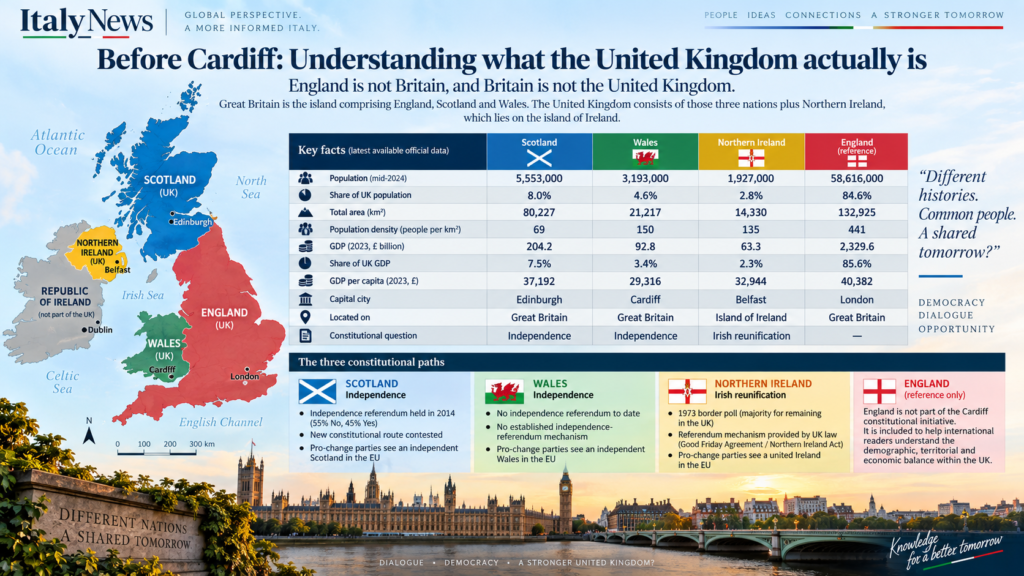
The numbers also reveal the extraordinary asymmetry of the Union. England accounts for roughly 85% of the UK’s population and a similarly dominant share of its economic output, while Scotland, Wales and Northern Ireland together occupy a far larger proportion of its territory than their demographic weight might suggest.
The United Kingdom is therefore a union of four nations, but it is not a union of four equally sized partners.
And that makes the question of consent particularly important.
Cardiff did not create one independence movement
Perhaps the greatest mistake would be to describe Cardiff as the birth of a single Celtic independence front.
It is not.
The memorandum itself recognises that the parties have different constitutional positions and that each nation will determine its future “in its own way and in its own time.”
That sentence deserves attention because it contains the central paradox of Cardiff.
The participants are united around the principle of self-determination precisely while acknowledging that the three constitutional journeys are profoundly different.
Scotland: independence revisited
Scotland has travelled furthest down the conventional independence route.
In September 2014, Scottish voters were asked directly whether Scotland should become an independent country. The answer was No, by 55.3% to 44.7%.
But the constitutional landscape subsequently changed.
Brexit is particularly important. Scotland voted decisively to remain in the European Union in 2016, while the United Kingdom as a whole voted to leave. For Scottish nationalists, that created a powerful argument: Scotland experienced a fundamental alteration in its international status despite voting against it.
The SNP therefore continues to seek another independence referendum.
The problem is constitutional authority. The UK Supreme Court ruled in 2022 that the Scottish Parliament could not legislate unilaterally for an independence referendum without Westminster’s consent.
Scotland consequently has a clearly articulated political destination, substantial electoral experience with the independence question — but no unilateral legal route to another binding referendum.
Cardiff does not solve that problem.
It places it back on the political table.
Wales: the youngest constitutional journey
Wales is different.
Welsh nationalism has deep historical roots, but contemporary political support for independence has developed from a substantially different starting point from Scotland.
Plaid Cymru’s rise to government has changed the political significance of the question. Rhun ap Iorwerth used Cardiff to argue for what he described as a “major reset” in relationships across the islands and spoke about independent nations cooperating on areas of common interest.
But Wales has never held an independence referendum.
Nor does it possess an established constitutional mechanism through which one would automatically take place.
This makes Wales perhaps the most interesting long-term case of the three.
The immediate question is not whether Wales will become independent. It is whether independence is moving from the margins of Welsh political debate towards becoming a permanent part of its constitutional mainstream.
That is a very different question.
And Cardiff may accelerate that process simply by placing Wales alongside Scotland and Northern Ireland in an international conversation about the future of the United Kingdom.
Northern Ireland: not independence, but reunification
Northern Ireland is fundamentally different from both.
Its constitutional alternative is not an independent Northern Irish state.
It is Irish reunification.
More importantly, unlike Scotland and Wales, the mechanism for potentially changing Northern Ireland’s constitutional status already exists.
The Good Friday Agreement and the Northern Ireland Act 1998 provide the framework under which a referendum — commonly called a border poll — can be held on whether Northern Ireland should remain within the United Kingdom or become part of a united Ireland.
Mary Lou McDonald emphasised precisely this distinction in Cardiff, describing the Good Friday Agreement as the roadmap for deciding Ireland’s constitutional future.
This creates an extraordinary constitutional asymmetry.
Three political movements may invoke the same principle — self-determination — while only one of the three nations already possesses a specifically established legal mechanism capable of transforming that principle into a referendum.
That may ultimately become one of Westminster’s most difficult questions.
If one part of the United Kingdom has an established right to determine whether it remains within the state, what principles should govern similar democratic demands elsewhere?
What the Cardiff memorandum actually changes
The strongest language from Cardiff was political rather than legal.
The memorandum argues that the political landscape across the islands is changing and declares that “constitutional change is coming.” More significantly, its signatories called upon the British government to “prepare for, plan and facilitate constitutional change in each jurisdiction.”
That is different from merely demanding another referendum.
It attempts to change Westminster’s role in the debate.
Instead of Westminster deciding whether constitutional change may be discussed, the Cardiff argument is that London should begin preparing for the possibility that democratic demands for change will emerge and should establish ways through which they can be expressed.
Downing Street rejected the underlying premise. Prime Minister Andy Burnham’s spokesperson said the government remains strongly committed to the Union and intends to concentrate on economic security and household pressures rather than further constitutional referendums.
And therein lies the political collision.
One side increasingly asks:
Who has the right to decide?
The other responds:
Why should this decision need to be taken now?
Those are not the same question.
Brexit is still in the room
There is another participant at the Cardiff table, even though it had no chair.
Brexit.
For nationalist movements in Scotland, Wales and Northern Ireland, the UK’s departure from the European Union changed more than trade arrangements.
It changed the constitutional imagination of the islands.
For Scotland, Brexit strengthened the argument that decisions taken by the UK majority can fundamentally alter Scotland’s international position despite a different Scottish electoral preference.
For Northern Ireland, Brexit produced an even stranger outcome. Northern Ireland remains politically inside the United Kingdom while maintaining a unique economic relationship with the European single market for goods because of the arrangements designed to prevent a hard border on the island of Ireland.
For Welsh nationalists, meanwhile, the European question increasingly becomes part of the discussion about what an independent Wales might look like internationally.
The Cardiff movements therefore do not simply imagine three futures outside the current United Kingdom.
They also envisage, in different forms, futures connected again with Europe.
That makes the question larger than British domestic politics.
And then there is England
England was not represented in the Cardiff initiative.
Yet England is impossible to remove from the equation.
With roughly 85% of the UK’s population and economic activity, England overwhelmingly dominates the demographic structure of the Union.
But England does not have its own devolved national parliament equivalent to Holyrood, the Senedd or the Northern Ireland Assembly.
The UK Parliament at Westminster therefore performs two overlapping functions: it is the sovereign parliament of the United Kingdom while also legislating on many matters affecting England alone.
If Scotland, Wales and Northern Ireland increasingly debate their constitutional futures, another question will eventually become unavoidable:
What is England’s constitutional future?
A redesigned United Kingdom could ultimately require England to define itself politically as clearly as the other nations already have.
That may prove to be one of the least discussed consequences of the debate now unfolding.
Three paths — one challenge
Cardiff did not make the break-up of the United Kingdom inevitable.
Scotland has not voted to leave.
Wales has not decided to become independent.
Northern Ireland has not voted for reunification.
No new state was created, no referendum was authorised and no constitutional power changed hands on 14 September.
Those facts matter.
But something did happen.
Three political movements governing very different nations, operating under three different constitutional circumstances, stood together and argued that Westminster should no longer regard the existing Union as constitutionally permanent simply because Westminster wishes it to remain so.
Their common ground is therefore not independence itself.
It is the right to choose.
And that distinction may prove much more important.
Because once a political argument moves from “Should we leave?” to “Who has the right to prevent us from deciding?”, the nature of the constitutional debate changes.
ItalyNews Observation
Perhaps the most important question after Cardiff is therefore not:
Is the United Kingdom breaking apart?
There is not enough evidence to say that it is.
The better question is: Can one United Kingdom continue to contain three nations claiming the same right to determine their future when each possesses a different constitutional route through which to exercise it?
Scotland has already voted once.
Wales may only be beginning its journey.
Northern Ireland already possesses a legal pathway towards a referendum on reunification.
Three nations. Three histories. Three constitutional paths.
For the moment, one United Kingdom.
Cardiff has not told us how that story will end.
It may, however, have told us that the next chapter has begun.