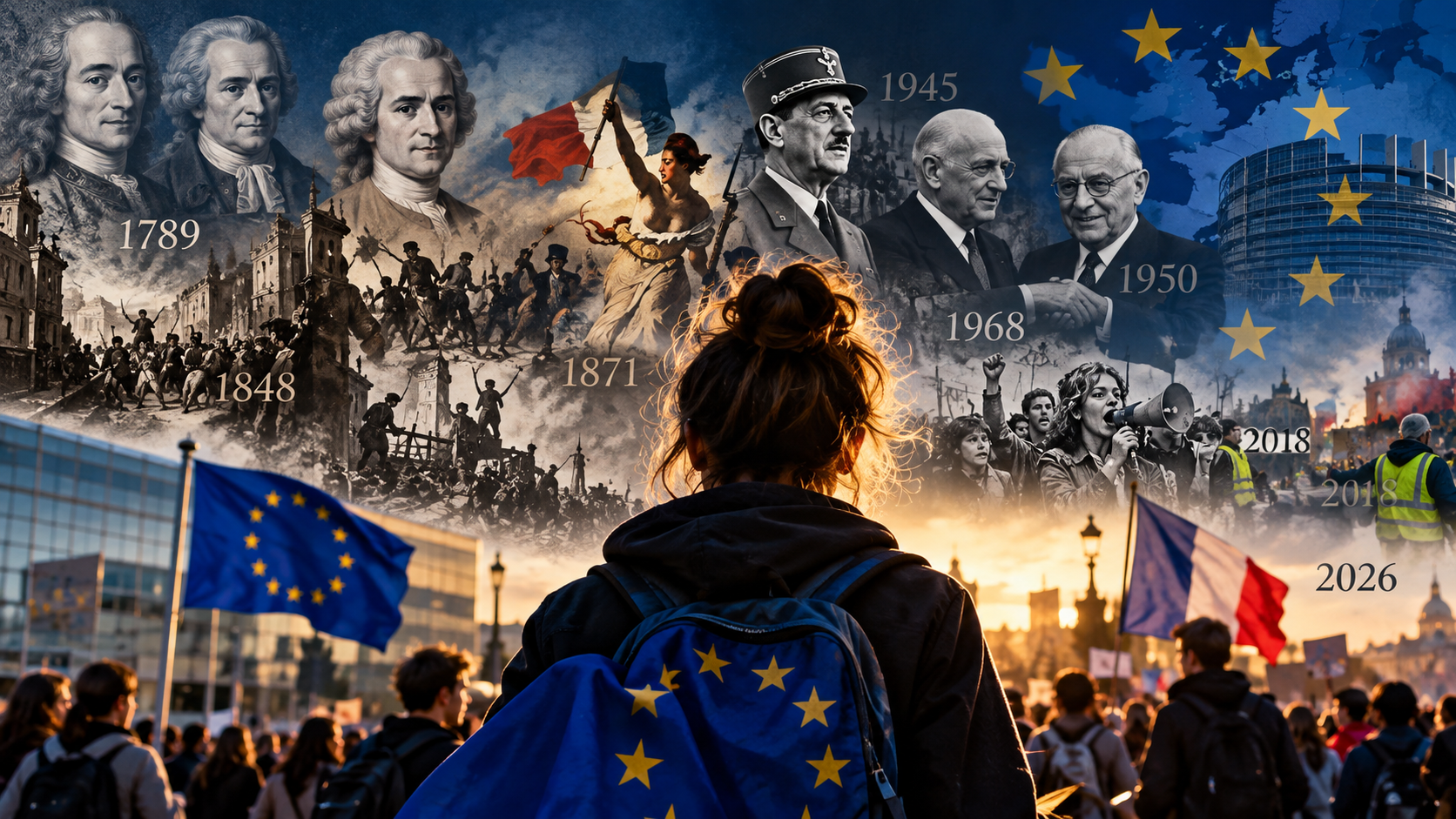
From the Enlightenment to Schuman and Monnet, from May 1968 to the protests of 2026. When France questions itself, it often ends up asking questions of Europe too.
City of London – A few weeks ago, on ItalyNews.it, we asked a question:
EUROPE IS TALKING ABOUT WAR AGAIN. ARE GENERATIONS Z AND ALPHA LISTENING?
We were talking about rearmament, European security, military service and the possibility that a generation raised in a Europe without wars between its member states might one day be asked to confront something that seemed to belong to history books: preparing for war again.
We did not know the answer.
Today, part of that answer may be coming from France.
Not through an opinion poll. Not through a political party.
Through students.
The French protests began with very concrete problems: teacher shortages, overcrowded classrooms, deteriorating buildings, territorial inequalities and what students regard as insufficient resources. Emerging particularly strongly from the Paris suburbs, the movement has spread to more than 1,200 high schools across the country.
There has also been violence: fires, assaults, clashes with police and thousands of arrests. That must be acknowledged. To describe only the students’ demands would risk romanticising a situation that has become considerably more complex. But reducing everything to violence would equally mean ignoring the grievances from which the protests began.
And within those protests, another question has started to emerge.\
It is no longer only about schools.
It is about the priorities of the State.
Education. Welfare. The future. Defence.
And this is where a French story begins to become a European one.
BEFORE THE BARRICADES CAME THE IDEAS
When we think about France changing Europe, we almost inevitably think of 1789.
But before the Revolution came the ideas.
Montesquieu questioned the organisation of power. Voltaire challenged authority and intolerance. Rousseau explored sovereignty and the social contract. Diderot and the Encyclopaedists sought to collect, organise and spread knowledge.
The Enlightenment was not exclusively French. It was a European phenomenon.
But France became one of its great laboratories.
Then came 1789.
Popular sovereignty, citizenship, rights and the relationship between the individual and the State moved from philosophical debate into politics — violently.
The French Revolution did not remain French.
Europe would never be quite the same again.
1848: WHEN PARIS SPOKE TO EUROPE
In February 1848, the monarchy of Louis-Philippe fell in Paris.
Within weeks, revolutions and uprisings spread through Vienna, Berlin, Milan, Venice, Budapest and many other European cities.
It would be historically wrong to suggest that Paris alone caused Europe’s revolutions of 1848. Every society had its own economic, national, constitutional and social tensions.
But France demonstrated something once again:
a national event could become a European accelerator.
Ideas travelled through newspapers, pamphlets, letters, universities and cafés.
They took days or weeks.
Today, they take seconds.
1871: A FEW WEEKS THAT OUTLIVED GENERATIONS
After the Franco-Prussian War and the fall of the Second Empire came the Paris Commune.
It lasted little more than two months.
It ended in bloodshed.
Yet its political influence survived far longer than its physical existence.
The Commune entered the political imagination of labour, socialist and revolutionary movements across numerous countries.
Once again, something happening in one French city had travelled beyond France.
Then the twentieth century completely changed the perspective.
1940: THIS TIME, FRANCE ITSELF HAD TO BE REBUILT
Military defeat. German occupation. Vichy. The Resistance.
France was no longer the country from which a European revolution was spreading.
It was a country that had to rebuild itself, its legitimacy and its place in Europe.
The Resistance brought together different experiences and political traditions. Charles de Gaulle became the symbol of Free France and of the continuity of the French State.
In 1945, Europe emerged from the Second World War devastated.
And from those ruins came perhaps one of the most remarkable French transformations of the European idea.
1950: NOT A BARRICADE. AN INSTITUTION.
On 9 May 1950, French Foreign Minister Robert Schuman presented a proposal developed together with Jean Monnet.
France and Germany had repeatedly fought one another.
Coal and steel were essential to industry, but also to the ability to wage war.
Schuman and Monnet proposed placing French and German coal and steel production under a common authority, open to other European countries.
That proposal led to the European Coal and Steel Community — France, West Germany, Italy, Belgium, the Netherlands and Luxembourg — the first step in the supranational process that would eventually lead to today’s European Union.
The objective was remarkably concrete: to make another war between France and Germany not merely unthinkable, but materially impossible.
Schuman also expressed a principle that would become fundamental to European integration: Europe would not be built all at once, but through concrete achievements creating a “de facto solidarity”.
After centuries in which France had influenced Europe through ideas, revolutions and conflict, this time it was proposing something different.
A method.
The generation that had experienced two world wars was trying to build institutions so that future generations would not have to experience a third.
And that is precisely what makes 2026 so interesting.
1968: WHEN THE STUDENTS WERE NO LONGER ALONE
Eighteen years after Schuman, France returned to the streets.
May 1968.
But if we want to understand the present, perhaps we should not look only at the barricades of the Latin Quarter.
We should look at the encounters. Students. Workers. Trade unions.
A protest that initially appeared generational encountered other social grievances and changed in scale.
That may be the most important question that 1968 hands to 2026:
not simply how many students are protesting, but who will stand beside them?
Support from teachers and trade unions suggests that this is at least a question worth watching.
That does not mean 1968 is returning.
History does not repeat itself on command.
2018: ANOTHER FRANCE, ANOTHER PROTEST
Fifty years later came the Gilets Jaunes.
They were not the students of the Sorbonne. Nor were they the traditional labour movement.
The immediate trigger was fuel taxation, but the movement rapidly expanded to include purchasing power, the cost of living, territorial inequality and a feeling — particularly in peripheral France — of not being heard.
Once again, the original trigger proved smaller than the questions the protest would eventually raise.
And that brings us to 2026.
A GENERATION THAT WAS LISTENING
The French student protests are, first and foremost, about education.
That should not be forgotten.
But when a student places the resources allocated to a high school and those allocated to defence in the same sentence, something else is happening.
The student is questioning the order of public priorities.
That does not necessarily mean opposing defence.
The Europe of 2026 is not the Europe of 1950.
Schuman and Monnet were primarily trying to prevent another war between European powers. Today’s rearmament debate is primarily about Europe’s ability to protect itself against external threats and guarantee its collective security.
These are different problems.
But that very difference creates a generational paradox.
The generation that inherited a Europe built so that Europeans would no longer have to fight one another is growing up while Europe once again talks about deterrence, rearmament, military preparedness and military service.
A few weeks ago, we wondered whether these young people were listening.
Perhaps they were listening very carefully.
“WE WILL NOT BE THE SOLDIERS OF YOUR WARS”
And the signal did not come only from France.
In Italy, even before the French protests erupted, one sentence had already provoked a heated political debate.
Virginia Libero, national secretary of the Young Democrats, declared: “We will not be the soldiers of your wars.”
She followed it with an even more controversial statement: “We will organise the deserters.”
Her words triggered reactions even within her own political area.
The point here is not to decide whether Libero was right or wrong.
It is to observe the language.
Us.
You.
Your wars.
Because within those words lies the possibility of a generational divide: between those who determine security policy and those who might one day be asked personally to bear its consequences.
There is also an absence worth observing.
So far, an equally explicit position from the principal youth organisations of Italy’s centre-right appears far less visible in the public debate on the relationship between rearmament, military service, welfare and the future of younger generations.
That absence cannot be interpreted as either agreement or disagreement.
It is simply another question still waiting for an answer.
And if we really want to understand a European generation, we will have to listen to that part of it too.
WERE THEY ALREADY TALKING TO EACH OTHER?
Here, 2026 introduces something that none of those previous generations possessed.
The network.
A photograph taken outside a French high school can reach Milan, Berlin, Brussels or Madrid before the demonstration itself has ended.
A slogan can be translated. A video shared. A protest recognised. A date circulated.
Instagram. TikTok. Telegram. WhatsApp. Snapchat.
The public square no longer disappears when demonstrators go home.
It continues inside the smartphone.
This does not mean that there is a single European command structure behind national protests. There is no evidence to support such a conclusion.
But it would be equally mistaken to continue observing Europe’s young people exclusively through national borders.
They may already inhabit the same digital space before they belong to the same political movement.
And this is no longer merely a theoretical possibility.
An international mobilisation of students and young people has already been called for 20 November 2026 under the slogan:
“FIGHT FOR OUR FUTURE, NOT THEIR WARS.”
Youth and student organisations in several European countries are linking rearmament and military service in their demands with education, healthcare, housing and welfare.
This does not demonstrate that the French protests are being directed by a European network.
It demonstrates something different.
The network through which young people in different countries can recognise common concerns already exists.
And perhaps this is the real novelty of 2026.
In 1848, ideas crossed Europe through newspapers, letters and pamphlets.
In 1968, through universities, leaflets, radio and television.
In 2026, every young person carries in their pocket the network through which one protest can recognise another.
FRANCE DOES NOT PREDICT EUROPE’S FUTURE
From the Enlightenment to the present day, France has not always pointed Europe in the same direction.
It has produced ideas.
It has produced revolutions.
It has experienced war and occupation.
It has produced protests.
And through Schuman and Monnet, it helped build institutions designed to transform national rivalries into European cooperation.
It would therefore be wrong to suggest that every French protest announces European change.
History does not work that way.
But history also suggests that when a question formulated in France begins to find similar words in other countries, it is worth listening.
2026 remains an empty space.
We do not yet know what history will eventually write beside that date.
And that is precisely why we should observe it.
MY OBSERVATION
A few weeks ago, ItalyNews.it asked: Are Generations Z and Alpha listening as Europe begins talking about war again?
Today, we can offer a first answer.
Some of them were listening.
But perhaps we were asking the wrong question.
While adults were discussing how much to spend on defence, how to strengthen Europe’s military capabilities and how to prepare a new generation to protect it, some of those young people were discussing education, housing, healthcare, welfare and their future.
And they were also talking to one another.
In 1950, a generation that had experienced war asked what kind of Europe it should build so that its children would not have to experience it again.
In 2026, a generation that knows that war only through books, stories and images may be beginning to ask the question in reverse:
IF ONE DAY YOU ASK US TO DEFEND EUROPE, WHAT KIND OF EUROPE ARE YOU ASKING US TO DEFEND?
#France #Europe #GenerationZ #GenZ #GenerationAlpha #EuropeanYouth #YouthProtests #StudentProtests #Education #Defence #Rearmament #MilitaryService #EuropeanSecurity #EuropeanUnion #RobertSchuman #JeanMonnet #CharlesDeGaulle #May1968 #Paris #FutureOfEurope #EuropeanHistory #EuropeanIntegration #ItalyNews